
Logo

American Heart Association

  62
  1


Final ID: Thu008

Novel Kinase Inhibitor Induces 2D and 3D organoid iPSC-Derived Cardiomyocyte Proliferation

Abstract Body: Introduction: Heart failure, which is one of the leading causes of death worldwide, is characterized by the irreversible loss of cardiomyocytes (CMs). Over the past few decades, there has been significant interest in exploring strategies to revive the inherent regenerative potential of the heart for repairing the damaged heart tissue. While various approaches to promote cardiac regeneration in vivo involving direct reprogramming to induced cardiomyocytes (iCMs) or induction of CM proliferation have been proposed, they are limited by strikingly low efficiency or negative impacts on heart function. Our lab has conducted an unbiased phenotypic screening and identified a group of structurally related small molecules that enhance proliferation in human induced pluripotent stem cell-derived cardiomyocytes (iPSC-CMs).
Methods and Results:
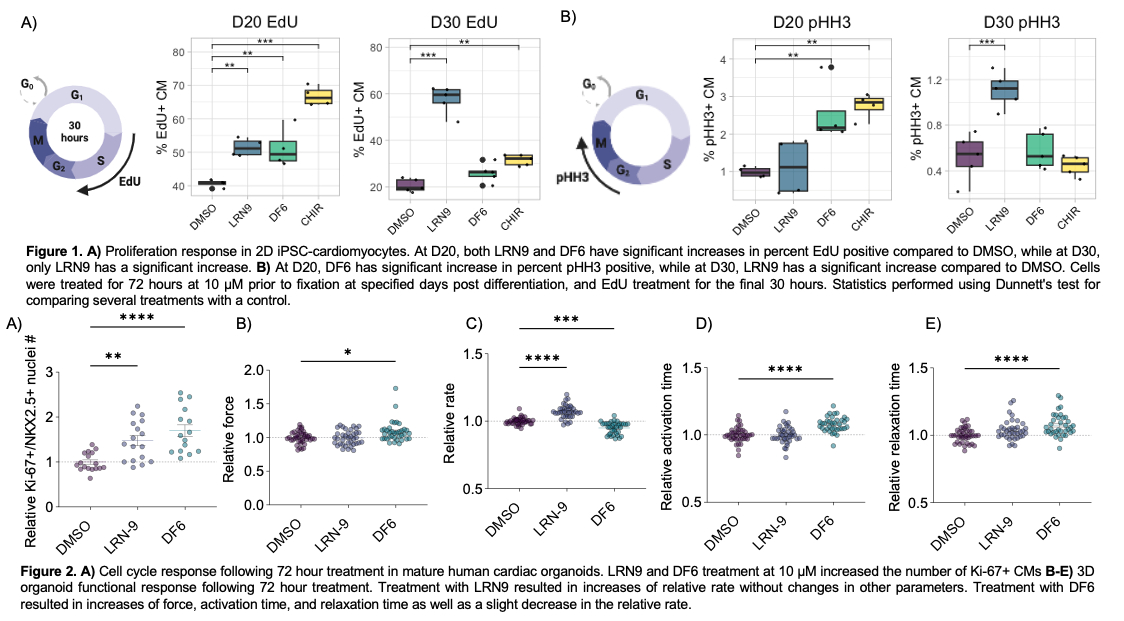
We performed a CM proliferation screen using compounds that had been previously identified as Wnt/β-catenin activators and analogues. The analogues DF6 and LRN9 were found to significantly upregulate the percent positive levels of Ki-67, EdU, and pHH3 CMs following treatment for 72 hours. Interestingly, more mature D30 cardiomyocytes responded better to LRN9 than DF6, as indicated by higher numbers of EdU+ and pHH3+ CMs following LRN9 treatment. In 3D cardiac organoids, both DF6 and LRN9 treatment significantly increased Ki-67+ cardiomyocytes, with DF6 showing the greatest effect. Notably, treatment with LRN9 resulted in no significant changes to force, activation time or relaxation time in the 3D organoids. GO-term enrichment analysis of RNA-seq data revealed upregulation of DNA replication, DNA repair, and cell division processes following LRN9 treatment. Using the Eurofins kinase screening platform, we found that DF6 and LRN9 target 14 and 39 kinases, respectively, at 10 µM, with high selectivity scores of 0.035 and 0.097.
Conclusions: This study identifies a novel therapeutic target for inducing iPSC-CM proliferation and reveals potential lead compounds for future regenerative therapies.
  • Fuller, Daniela  ( University of Maryland, Baltimore , Baltimore , Maryland , United States )
  • Devilee, Lynn  ( QIMR Berghofer , Brisbane , Queensland , Australia )
  • Vongdeuane, Sitthixai  ( University of Maryland, Baltimore , Baltimore , Maryland , United States )
  • Neitzel, Leif  ( Michigan State University , East Lansi , Michigan , United States )
  • Mills, Richard  ( MCRI , Melbourne , Victoria , Australia )
  • Williams, Charles  ( Michigan State University , East Lansi , Michigan , United States )
  • Hudson, James  ( QIMR Berghofer , Brisbane , Queensland , Australia )
  • Liu, Ruya  ( University of Maryland Baltimore , Baltimore , Maryland , United States )
  • Hong, Charles  ( Michigan State University , East Lansi , Michigan , United States )
  • Author Disclosures:
    Daniela Fuller: DO NOT have relevant financial relationships | Lynn Devilee: No Answer | Sitthixai Vongdeuane: DO NOT have relevant financial relationships | Leif Neitzel: No Answer | Richard Mills: No Answer | Charles Williams: No Answer | James Hudson: No Answer | Ruya Liu: DO NOT have relevant financial relationships | Charles Hong: No Answer
Meeting Info:

Basic Cardiovascular Sciences 2025

2025

Baltimore, Maryland

Session Info:

Poster Session and Reception 2

Thursday, 07/24/2025 , 04:30PM - 07:00PM

Poster Session and Reception

More abstracts from these authors:
In vivo conversion of ferric heme to NO-ferroheme has vasodilatory and anti-inflammatory effects

Rochon Elizabeth, Demartino Anthony, Liu Ruya, Xu Qinzi, Kim-shapiro Daniel, Gladwin Mark

C5ORF51/RIMOC1 is Required for Adult Cardiomyocyte Maturation and Quiescence

Vongdeuane Sitthixai, Fuller Daniela, Li Yijia, Chao Wei, Liu Ruya

You have to be authorized to contact abstract author. Please, Login
Not Available