Scientific Sessions 2024
/
Cardiac Repair and Regeneration
/
Application of PLGA-PEG-PLGA Thermosensitive Hydrogel Loaded with Human Induced Pluripotent Stem Cell-Derived Cardiomyocytes and Ginsenoside Rb3 in the Treatment of Acute Myocardial Infarction
American Heart Association
179
0
Final ID: MDP798
Application of PLGA-PEG-PLGA Thermosensitive Hydrogel Loaded with Human Induced Pluripotent Stem Cell-Derived Cardiomyocytes and Ginsenoside Rb3 in the Treatment of Acute Myocardial Infarction
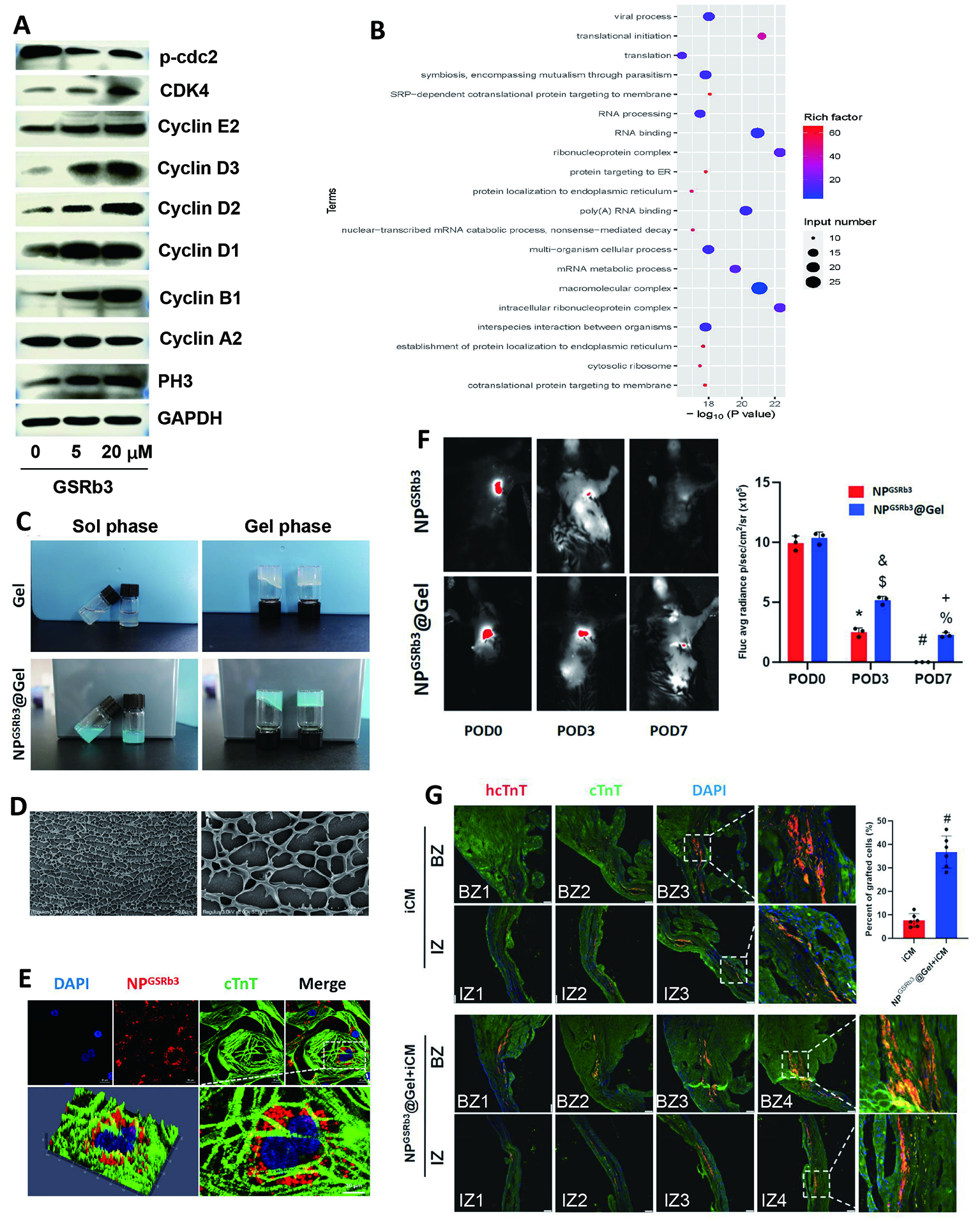
Abstract Body (Do not enter title and authors here): Background: Ginsenoside Rb3 (GSRb3) is a traditional Chinese medicine monomer. We aim to investigate the effects of GSRb3 on the proliferation of human induced pluripotent stem cell-derived cardiomyocytes (hiPSC-CMs) and the reparative effects of PLGA-PEG-PLGA thermosensitive hydrogel loaded with hiPSC-CMs and GSRb3 (NPGSRb3@Gel+iCM) on myocardial infarction (MI). Methods: 1. Western Blot, RT-qPCR, cell immunofluorescence staining, and CCK-8 assays were employed to assess the proliferative effects of different concentrations of GSRb3 on neonatal mouse primary cardiomyocytes (NCMs) and hiPSC-CMs. 2. Transcriptomic gene sequencing technology was utilized to investigate the mRNA expression changes of hiPSC-CMs induced by GSRb3; The NPGSRb3@Gel+iCM was injected into the left ventricular myocardium of the MI mice; the same volume injections of hiPSC-CMs (iCM group) and PLGA-PEG-PLGA thermosensitive hydrogel loaded with GSRb3 (NPGSRb3@Gel group) served as control; Additionally, MI model group without additional treatment and sham group were established. 3. At 4 weeks post-MI, echocardiography, Sirius Red/Fast Green staining and immunofluorescence staining were utilized to evaluate the heart function, infarction size and survival rate of transplanted hiPSC-CMs. Results: GSRb3 inhibit the apoptosis of NCMs while promote proliferation of NCMs and hiPSC-CMs significantly. After 4 weeks of treatment, the engraftment rate of hiPSC-CMs in NPGSRb3@Gel+iCM group (36.7%) was 4.8 times that of iCM group (7.7%); Compared to the MI group, NPGSRb3@Gel group and iCM group, NPGSRb3@Gel+iCM group showed significant improvement in cardiac function; The myocardial repair effect in NPGSRb3@Gel+iCM group was significantly superior to NPGSRb3@Gel group and iCM group, with a 47% reduction in infarct size compared to MI group, and further reduction in left ventricular anterior wall thickness compared to NPGSRb3@Gel group and iCM group. Conclusion: GSRb3 promotes the proliferation of hiPSC-CMs both in vitro and in vivo. NPGSRb3@Gel+iCM significantly increase the engraftment of hiPSC-CMs, promote angiogenesis, reduce infarction size, inhibit left ventricular remodeling and improve cardiac function.
Xiang, Kun
(
Central South University
, Changsha , China )
Zheng, Zilong
(
Central South University
, Changsha , China )
Li, Yichen
(
Central South University
, Changsha , China )
Tang, Weijie
(
Central South University
, Changsha , China )
Chen, Wangping
(
Central South University
, Changsha , China )
Yang, Jinfu
(
Central South University
, Changsha , China )
Fan, Chengming
(
Central South University
, Changsha , China )