
Logo

American Heart Association

  62
  0


Final ID: Thu109

The therapeutic effects of hyperbaric oxygen boosted adipose-derived stem cell-derived extracellular vesicles in limb ischemia injury via restoring PSMB6

Abstract Body: Background: Limb ischemia presents a significant public health challenge, involving abnormal proliferation and angiogenesis of vascular endothelial cells. Recent studies suggest that adipose-derived stem cells (ADSCs) offer a promising therapeutic option. Also, hyperbaric oxygen (HBO) therapy has been shown to enhance blood flow and angiogenesis in ischemic limbs but how HBO pre-conditions ADSCs and its EVs to enhance the capability of angiogenesis in ischemic limbs remains unknown.
Methods: Conditioned medium of ADSCs (ADSCs CM) and HBO-boosted conditioned medium of ADSCs (HBO-ADSCs CM) were obtained from ADSCs with or without HBO treatment, respectively. Following limb ischemia surgery, we evaluated the angiogenic capacity in C57BL/6J mice treated with HBO-ADSCs CM compared to those treated with ADSCs CM. Additionally, in vitro experiments assessed the effects of HBO-ADSCs CM on human umbilical vein endothelial cells (HUVECs) following oxygen-glucose deprivation (OGD) injury through proliferation, migration, and tube formation assays. Proteomic analysis identified the angiogenic regulator in HBO-ADSC EVs and we further validated its impact on endothelial functions.
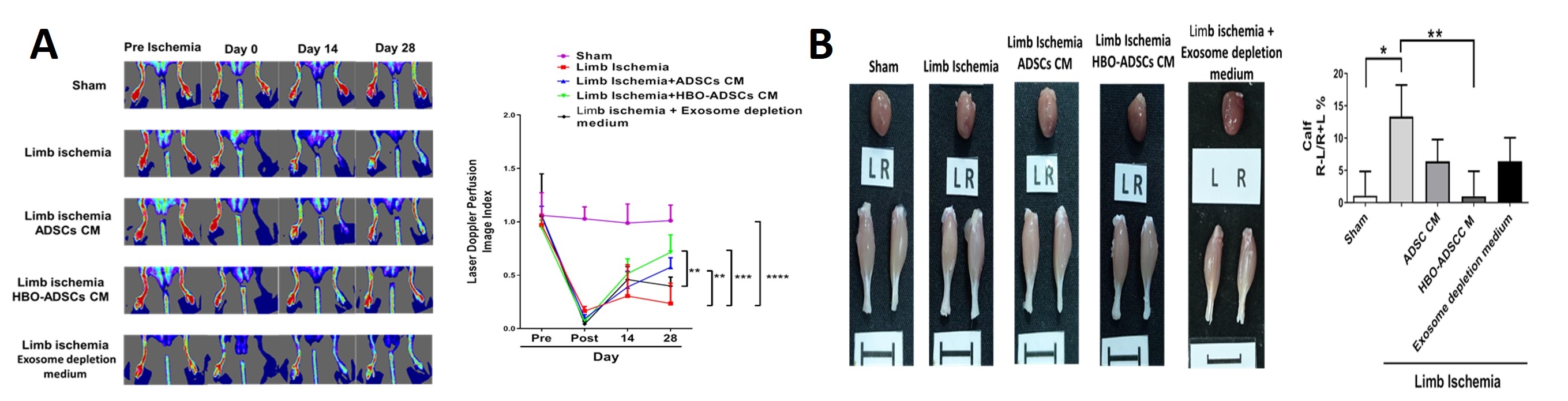
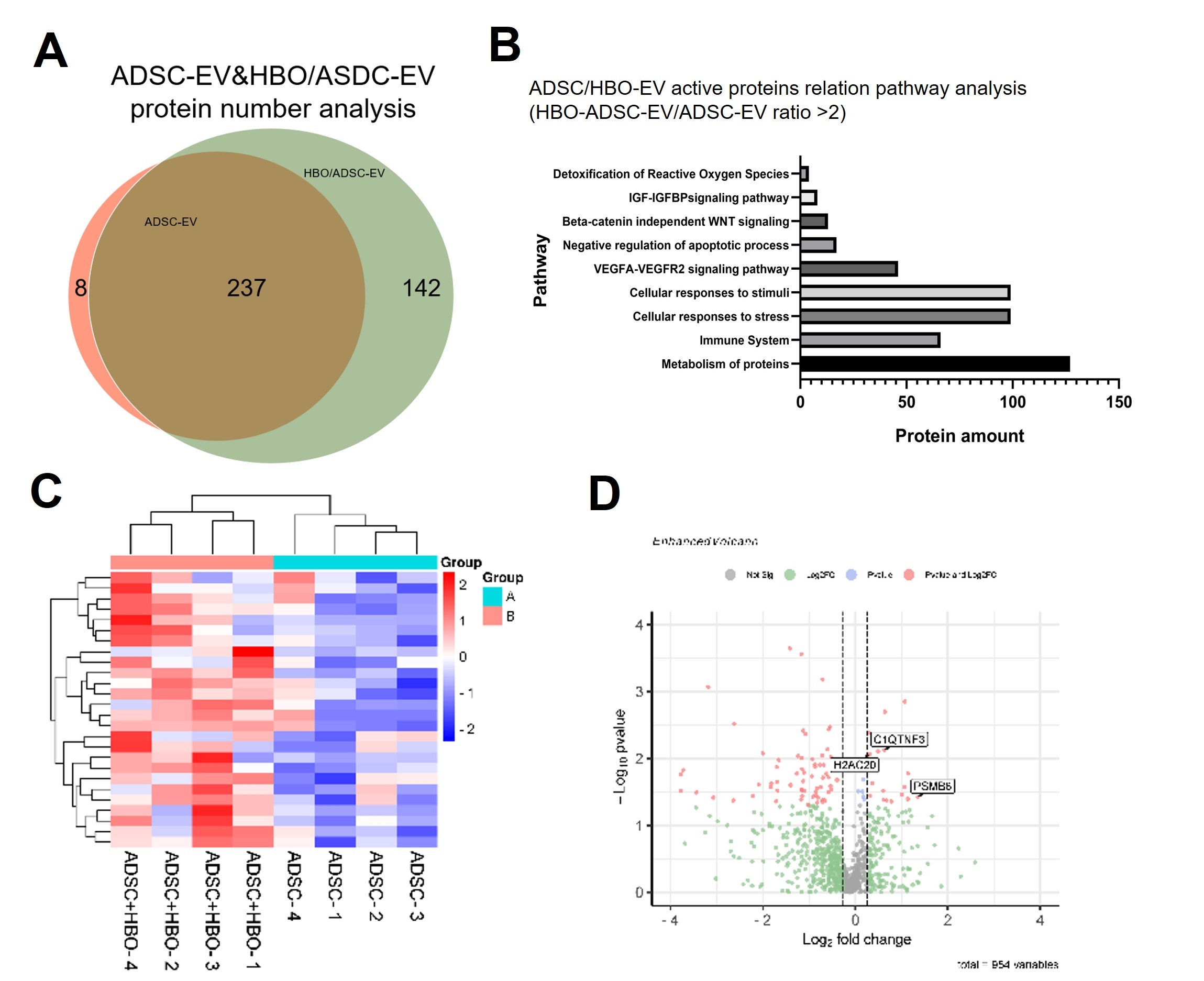
Results: Assessment through laser Doppler perfusion imaging and CD31 staining revealed that mice receiving HBO-ADSCs CM after limb ischemia surgery exhibited significantly enhanced angiogenic capability but the benefit diminished in EV depleted CM. In vitro analysis demonstrated that HBO-ADSCs CM treatment rescued impaired proliferation, migration, and tube formation of HUVECs under OGD injury. Proteomic analysis identified 93 upregulated proteins in ADSC-EVs following HBO treatment. Among them, Proteasome 20S Subunit Beta 6 (PSMB6), a key regulator of proteolytic degradation, was validated with the most highly expression in ADSC-EVs post-HBO treatment. Suppression of PSMB6 expression in HUVECs was also observed to impaired their proliferation, migration, and tube formation under OGD injury.
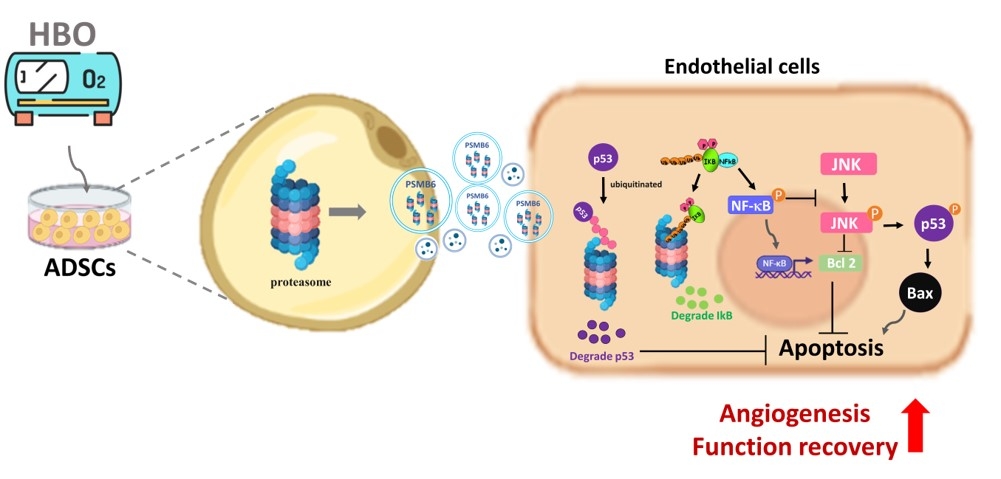
Conclusion: Our results indicate that HBO-ADSCs CM treatment enhances angiogenic capacity both in vivo and in vitro models of limb ischemia. Proteomic analysis highlights PSMB6 with in HBO-ADSCs EVs as a crucial factor promoting angiogenesis and perfusion recovery post-limb ischemia. Hence, HBO-ADSCs CM therapy emerges as a promising treatment option for limb ischemia, potentially benefiting patients unable to undergo high-risk surgical procedures.
  • Chang, Wei-ting  ( Chi Mei Medical Center , Tainan , Taiwan )
  • Lin, Yu-wen  ( Chi Mei Medical Center , Tainan , Taiwan )
  • Fisch, Sudeshna  ( Pfizer , Boston , Massachusetts , United States )
  • Niu, Ko-chi  ( Chi Mei Medical Center , Tainan , Taiwan )
  • Lin, Mao-tsun  ( Chi Mei Medical Center , Tainan , Taiwan )
  • Liao, Pao-chi  ( National Cheng Kung University , Tainan , Taiwan )
  • Chang, Ching-ping  ( Chi Mei Medical Center , Tainan , Taiwan )
  • Author Disclosures:
    Wei-Ting Chang: DO NOT have relevant financial relationships | Yu-Wen Lin: No Answer | Sudeshna Fisch: No Answer | Ko-Chi Niu: No Answer | Mao-Tsun Lin: No Answer | Pao-Chi Liao: No Answer | Ching-Ping Chang: No Answer
Meeting Info:

Basic Cardiovascular Sciences 2025

2025

Baltimore, Maryland

Session Info:

Poster Session and Reception 2

Thursday, 07/24/2025 , 04:30PM - 07:00PM

Poster Session and Reception

You have to be authorized to contact abstract author. Please, Login
Not Available