
Regulation of ERR mediated metabolic adaptation during Pressure-Overload Stress
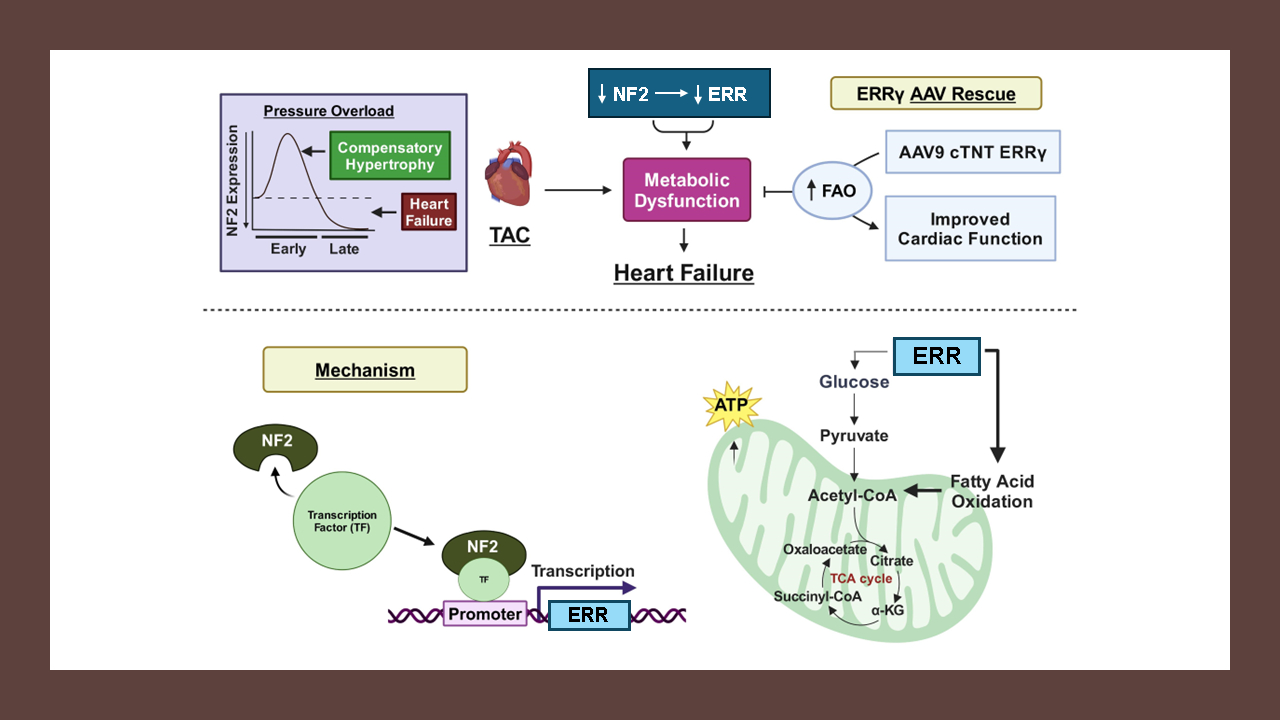
Abstract Body: Background: Neurofibromin 2 (NF2) is a tumor suppressor that can engage signaling pathways to modulate cell proliferation and survival. We previously demonstrated that NF2 mediates cardiomyocyte apoptosis and cardiac injury caused by acute myocardial infarction. Research Aim: The role of NF2 in heart failure remains uncharacterized. This study sought to determine whether NF2 modulates heart failure due to chronic stress. Approach: We generated cardiomyocyte-specific NF2 knockout (cKO) mice and used transverse aortic constriction (TAC) to generate chronic pressure overload (PO) stress, which elicits cardiac remodeling and failure. Complementary cell-based experiments were performed in neonatal rat ventricular myocytes (NRVMs). We analyzed cardiac function by echocardiographic and hemodynamic analysis. We used RNAseq and validated the novel findings using promoter pulldown, Seahorse metabolic profiling, and biochemical analyses to investigate underlying mechanisms. Results: We found that NF2 is transiently upregulated in wild-type mouse myocardium in response to early phase of PO, but is downregulated during heart failure. Following TAC, NF2 cKO hearts unexpectedly showed significantly worsened cardiac function, compared to controls. RNAseq analysis followed by qPCR indicated downregulation of several metabolic pathways and impaired Estrogen Related Receptor (ERR) signaling in NF2 cKO hearts. Luciferase experiments employing NRVMs confirmed that NF2 promoted expression of ERR isoforms (a, g), and DNA pulldown assays demonstrated NF2 association with ERR proximal promoters. Analysis of NRVM bioenergetics demonstrated that NF2 depletion impaired mitochondrial respiration, which was reversed by concomitant expression of ERRg. Moreover, AAV9-mediated restoration of ERRg in NF2 cKO mice normalized cardiac function in response to PO. As NF2 does not directly bind DNA, leveraging a proteomics-based approach we identified the transcription factor linking NF2 to ERR isoform expression and further validated its regulation using NRVMs based experiments. Conclusion: Based on these findings, we conclude that NF2 is essential and therefore transiently upregulated during PO stress to compensate and regulate metabolic demand.
Zhang, Yu
( NYU School Of Medicine
, New York
, New York
, United States
)
Sadoshima, Junichi
( RUTGERS NJMS
, Newark
, New Jersey
, United States
)
Del Re, Dominic
( RUTGERS NEW JERSEY MEDICAL SCHOOL
, Newark
, New Jersey
, United States
)
Mareedu, Satvik
( Rutgers University - NJMS
, Newark
, New Jersey
, United States
)
Mizushima, Wataru
( Rutgers New Jersey Medical School
, Newark
, New Jersey
, United States
)
Francisco, Jamie
( Rutgers Biomedical Health Sciences
, Newark
, New Jersey
, United States
)
Guan, Jin
( RUTGERS NJMS
, Newark
, New Jersey
, United States
)
Yang, Zhi
( RUTGERS NEW JERSEY MEDICAL SCHOOL
, Newark
, New Jersey
, United States
)
Oka, Shinichi
( RUTGERS NEW JERSEY MEDICAL SCHOOL
, Newark
, New Jersey
, United States
)
Zhai, Peiyong
( Rutgers
, Newark
, New Jersey
, United States
)
Abdellatif, Maha
( RUTGERS
, Newark
, New Jersey
, United States
)
Author Disclosures:
Yu Zhang:DO NOT have relevant financial relationships
| Junichi Sadoshima:DO NOT have relevant financial relationships
| Dominic Del Re:DO NOT have relevant financial relationships
| Satvik Mareedu:DO NOT have relevant financial relationships
| Wataru Mizushima:No Answer
| Jamie Francisco:DO NOT have relevant financial relationships
| Jin Guan:No Answer
| Zhi Yang:No Answer
| Shinichi Oka:DO NOT have relevant financial relationships
| Peiyong Zhai:DO NOT have relevant financial relationships
| Maha Abdellatif:No Answer
Zhang Yu, Sadoshima Junichi, Del Re Dominic, Mareedu Satvik, Mizushima Wataru, Francisco Jamie, Guan Jin, Yang Zhi, Oka Shinichi, Zhai Peiyong, Abdellatif Maha