Two Mechanistically Distinct Factor XI Antibodies, REGN9933 and REGN7508, for the Prevention of Venous Thromboembolism After Knee Arthroplasty: the ROXI-VTE-I and ROXI-VTE-II trials
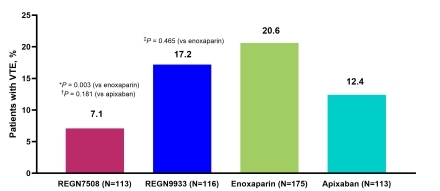
Abstract Body (Do not enter title and authors here): Background: Factor XI (FXI) inhibitors may attenuate thrombosis without increasing the bleeding risk. REGN9933 and REGN7508 are antibodies that bind to distinct FXI domains. We compared the efficacy and safety of REGN9933 with enoxaparin and with apixaban, as an exploratory comparator, and REGN7508 with enoxaparin for venous thromboembolism (VTE) prevention. Methods: ROXI-VTE-I (NCT05618808) and ROXI-VTE-II (NCT06454630) are randomized, open-label phase 2 studies conducted in patients undergoing knee arthroplasty. In ROXI-VTE-I, 373 patients were randomized to receive 300-mg REGN9933 (single IV dose), 40-mg enoxaparin (SC once daily), or 2.5-mg apixaban (orally twice daily). In ROXI-VTE-II, 179 patients were randomized to receive 250-mg REGN7508 (single IV dose) or 40-mg enoxaparin (SC once daily). All treatments started 12–24 hours post-surgery. The prespecified primary endpoint was objectively confirmed VTE. REGN9933/REGN7508 was considered superior to enoxaparin if the posterior probability (pp) of log odds ratio (OR) was >95%. Cross-study pooled analyses (prespecified for REGN7508; post-hoc for REGN9933) employed an 8.6% noninferiority margin. The principal safety outcome was bleeding. Results: In ROXI-VTE-I, the VTE rates were 17.2% (20/116), 22.2% (26/117), and 12.4% (14/113) with REGN9933, enoxaparin, and apixaban, respectively. For REGN9933 vs enoxaparin, the mean adjusted OR (90% credible interval) was 0.78 (0.47–1.32); the pp was 79%. In ROXI-VTE-II, the VTE rates were 7.1% (8/113) and 17.2% (10/58) with REGN7508 and enoxaparin, respectively. For REGN7508 vs combined enoxaparin arms, the mean adjusted OR (90% credible interval) was 0.37 (0.20–0.68); the pp was >99%. The cross-study pooled analyses (Figure 1) showed that the VTE risk difference (95% CI) for REGN7508 vs enoxaparin was −13.6% (−21.1% to −6.0%; P=0.003), REGN7508 vs apixaban was −5.3% (−13.2% to 2.4%; P=0.181), and REGN9933 vs enoxaparin was −3.5% (−12.7% to 5.7%; P=0.465). No major or clinically relevant nonmajor bleeds occurred. Conclusions: In the prespecified analysis, REGN7508 was superior to enoxaparin for VTE prevention. The cross-study analyses showed REGN7508 was noninferior to apixaban and REGN9933 was noninferior to enoxaparin.
Weitz, Jeffrey
(
MCMASTER UNIVERSITY
, Hamilton , Ontario , Canada )
Kithcart, Aaron
(
Regeneron Pharmaceuticals, Inc.
, Tarrytown , New York , United States )
O'brien, Meagan
(
Regeneron Pharmaceuticals, Inc.
, Tarrytown , New York , United States )
Levy, Oren
(
Regeneron Pharmaceuticals, Inc.
, Tarrytown , New York , United States )
Marin, Ethan
(
Regeneron Pharmaceuticals, Inc.
, Tarrytown , New York , United States )
Onisko, Malgorzata
(
Regeneron Pharmaceuticals, Inc.
, Tarrytown , New York , United States )
Mohammadi, Kusha
(
Regeneron Pharmaceuticals, Inc.
, Tarrytown , New York , United States )
Li, Dateng
(
Regeneron Pharmaceuticals, Inc.
, Tarrytown , New York , United States )
Meagher, Karoline
(
Regeneron Pharmaceuticals, Inc.
, Tarrytown , New York , United States )
Olenchock, Benjamin
(
Regeneron Pharmaceuticals, Inc.
, Tarrytown , New York , United States )
Gutstein, David
(
Regeneron Pharmaceuticals, Inc.
, Tarrytown , New York , United States )
Young Bryan, Hirshberg Boaz, George Richard, Olenchock Benjamin, Devalaraja-narashimha Kishor, Morton Lori, Janssens Stefan, Redaelli Giulia, Mei Jingning, Kithcart Aaron, Herman Gary
4391438_File000000.jpg
You have to be authorized to contact abstract author. Please, Login