Differences in Social Determinants of Health And Health Literacy Between Individuals With Sickle Cell Disease With and Without a History of Stroke
Abstract Body (Do not enter title and authors here): Introduction: Sickle cell disease (SCD) affects approximately 100,000 individuals in the United States. One of the common complications of SCD is stroke, affecting up to 24% of these individuals. Prior studies have shown that SCD severity is impacted by social determinants of health, such as education level and employment status, both of which can be worsened by a stroke. The impacts of socioeconomic deprivation (SD) and health literacy in individuals with SCD has also been studied. The objective of this study was to investigate differences in SDOH, including SD, and health between individuals with SCD with and without a history of stroke.
Methods: Using data from the All of Us Research Program, we used the Observational Medical Outcomes Partnership Common Data Model to create a sample of individuals diagnosed with some form of sickle cell disease who experienced a stroke or similar neurological event (i.e. residual cognitive deficit due to stroke, dysphagia due to stroke, hemiparesis due to stroke). To create a control group, we selected individuals not diagnosed with stroke or a similar neurological event and used survey data to identify individuals with no self-reported a history of stroke or TIA. From this group, we selected a random sample the same size as the stroke group. We ran Welch’s t-tests and logistic regression modeling to identify significant differences in SDOH, SD, and HL between the stroke and control group. Analyses were completed in Python 3.
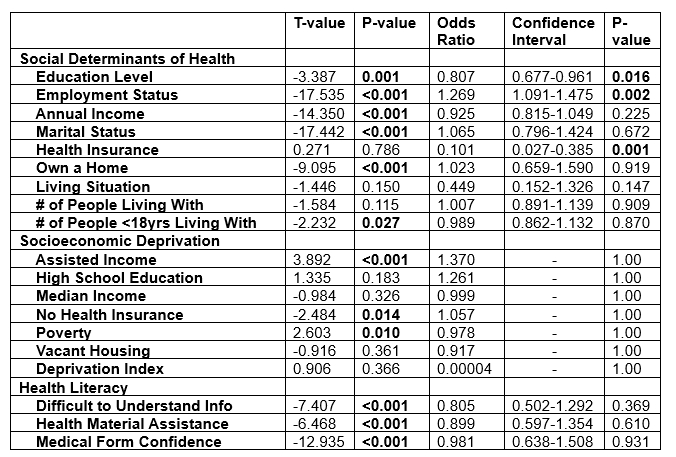
Results: The total sample size was 256 (128 stroke, 128 control). For the t-tests, the two groups differed significantly in education level, employment status, annual income, marital status, whether they owned a home, how many people under the age of 18 they lived with, the proportion of households receiving public assistance, whether they lacked health insurance, whether they found medical information difficult to understand, whether they needed assistance understanding medical information, and confidence in their ability to complete medical forms. For the logistic regression model, the two groups differed significantly in education level, employment status, and whether they had no health insurance. The logistic regression model was unable to analyze the socioeconomic measures due to collinearity between several of the measures.
Conclusion: There are significant differences in SDOH, SD, and HL among individuals with SCD with and without a history of stroke.
Taylor, Brittany
(
Columbia University School of Nursing
, Pittsburgh , Pennsylvania , United States )
Conley, Yvette
(
University of Pittsburgh
, Pittsburgh , Pennsylvania , United States )
Author Disclosures:
Brittany Taylor:DO NOT have relevant financial relationships
| Yvette Conley:DO NOT have relevant financial relationships