Sudden Cardiac Death in Women: A 21-Year Trend Analysis by Race and Age Group Reveals Persistent Disparities
Abstract Body (Do not enter title and authors here): Introduction Sudden cardiac death (SCD) is a leading contributor to cardiovascular mortality in women, yet long-term trends have been understudied particularly across menopausal transitions and racial groups. Understanding these patterns is essential to influence targeted prevention efforts and address disparities.
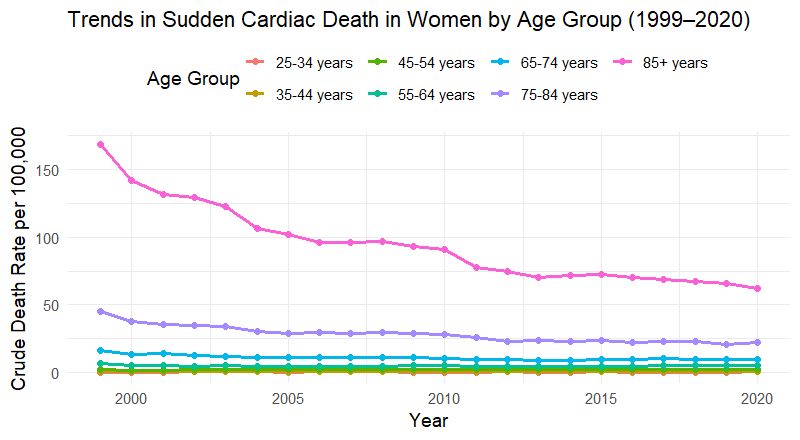
Methods We extracted national mortality data from the CDC WONDER database for U.S. females from 1999 to 2020 using ICD-10 codes I46 (I46.0, I46.1, I46.9) and R96 ( R96.0, R96.1) to identify SCD cases. Data were stratified by age, menopausal status (pre-menopausal: 25-54; post-menopausal: 55+) and race. Crude death rates were calculated per 100,000 population. Joinpoint regression analysis was used to estimate annual percent changes (APCs) and identify significant changes in trend over time.
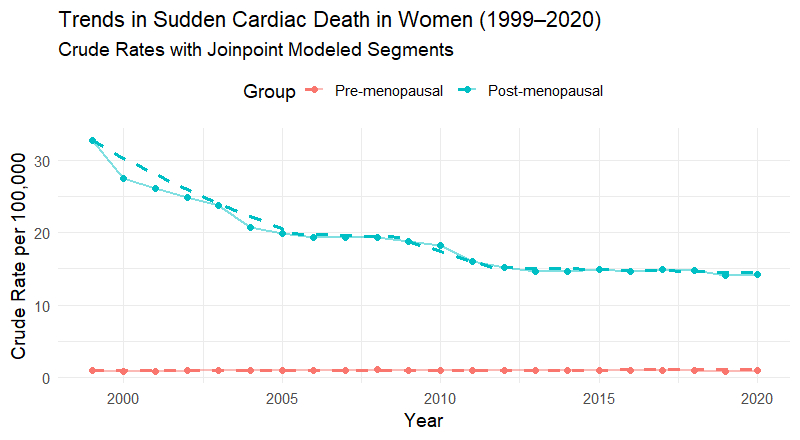
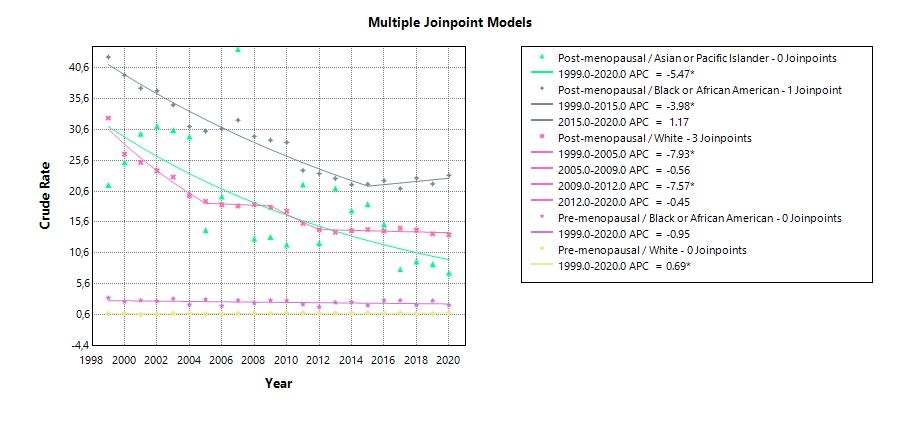
Results From 1999 to 2020 a total of 183,360 deaths from SCD in females aged 15-85+ were reported, SCD rates among pre-menopausal women (ages 25-54) increased slightly but significantly (APC +0.51%, 95% CI: 0.07 to 0.99), trend was consistent with no joinpoints identified. In contrast, post-menopausal women (ages 55+) experienced two periods of significant decline: 1999-2005 (APC -7.46%, 95% CI: -9.31 to -6.39) and 2009-2012 (APC -7.62%, 95% CI: -9.21 to -4.77). These were interrupted by non-significant plateaus from 2005-2009 and 2012-2020. To further explore disparities, we conducted a race-stratified Joinpoint analysis which revealed significant declines in SCD rates among post-menopausal Asian/Pacific Islander women across the entire study period (APC -5.47%, 95% CI: -8.51 to -2.16). Among Black women, rates declined significantly from 1999-2015 (APC -3.98%, 95% CI: -4.98 to -3.48) followed by a non-significant increase. White post-menopausal women exhibited multiple significant declines (notably -7.93% from 1999-2005, 95% CI: -10.27 to -6.66, and -7.57% from 2009-2012, 95% CI: -9.41 to -3.96) separated by plateaus. Among pre-menopausal women, SCD rates rose slightly in White women (APC +0.69%, 95% CI: 0.17 to 1.24) but remained stable in Black women.
Conclusion Post-menopausal women carried the highest burden of SCD, however, they experienced the most substantial declines over time. The statistically significant rise in SCD rates among younger pre-menopausal women and the racial disparities in trend patterns highlight the need for renewed prevention strategies tailored to women across age and race groups.
Abousaid, Dayana Gandi
(
Medical University of Plovdiv
, Plovdiv , Bulgaria )
Bahariev, Dimitar
(
Western Michigan University Homer Stryker M.D. School of Medicine
, Kalamazoo , Michigan , United States )
Author Disclosures:
Dayana Gandi Abousaid:DO NOT have relevant financial relationships
| Dimitar Bahariev:DO NOT have relevant financial relationships