Suboptimal Sleep Associates with Heightened Stress-Related Neurobiological and Leukopoietic Activity: Mediating Pathways to Cardiovascular Disease in Humans
Abstract Body (Do not enter title and authors here): Background: Suboptimal sleep (SleepSO)—due to insufficient duration or sleep disorders—is prevalent and linked to cardiovascular disease (CVD) risk. Experimental data suggest a stress-driven neural-immune axis linking poor sleep to atherogenesis, but the mechanisms in humans remain uncertain.
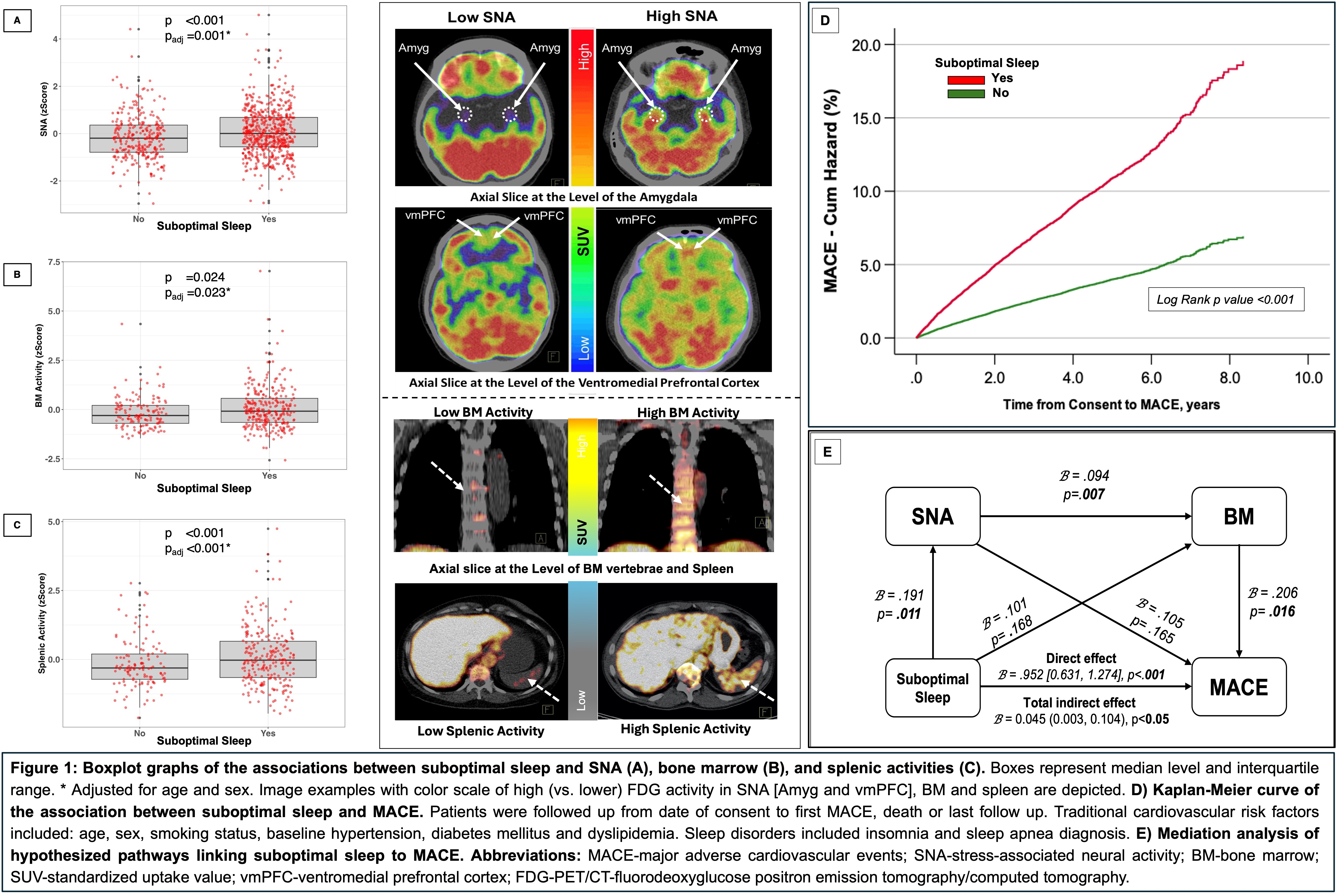
Hypotheses: 1) SleepSO is associated with greater stress-related neural activity (SNA), increased leukopoietic activity, and higher incidence of major adverse cardiovascular events (MACE); 2) heightened SNA and leukopoiesis partly mediate the SleepSO-MACE associations.
Methods: We studied 46,827 Mass General Brigham Biobank (MGBB) participants (median age 58 years; 40% men). SleepSO—defined as <7 h/night or an ICD–10–coded sleep disorder—was ascertained from baseline surveys and electronic records. SNA (AmygAc, the ratio of amygdalar to ventromedial prefrontal cortical activity) and leukopoietic activity (in bone marrow [BM] and spleen) were quantified by FDG PET/CT imaging. Incident MACE after consent was identified via ICD codes. Covariables—traditional cardiovascular risk factors (CVDRFs), Charlson Comorbidity Index (CCI), socioeconomic status (SES: income, employment, education, noise), lifestyle (obesity, exercise, alcohol), psychiatric history and a polygenic risk score (PRS) for coronary disease—were obtained from MGBB records. Multivariable regression and mediation analyses tested associations and pathways.
Results: In age and sex adjusted models, SleepSO associated with higher AmygAc (standardized β [95% CI]: 0.26 [0.10, 0.41], p=0.001; 1A), BM (β [95% CI]: 0.22 [0.03, 0.40], p=0.023;1B), and splenic activities (β [95% CI]: 0.18 [0.08, 0.30], p<0.001; 1C). Further, AmygAc associated with high BM (β: 0.15, p=0.002) and splenic activities (β: 0.15, p<0.001). Over a median 3.3 years follow-up, 2,033 subjects (1.4%) had MACE. SleepSO associated with greater MACE risk (HR: 1.43; 95% CI: 1.29-1.59; p<0.001; 1D) after adjusting for CVDRFs. Prior associations persisted after further adjustment for lifestyle, psychiatric history, SES, CCI, and PRS. Mediation analyses showed that the SleepSO-MACE link is serially mediated by SNA-BM pathways (log odds: 0.05, p<0.05; 1E).
Conclusions: SleepSO is independently associated with elevated MACE risk through stress-mediated neural-immune pathways. These results highlight the need for routine sleep screening and suggest that sleep hygiene interventions may attenuate neural-immune activation and lower CVD risk.
Abohashem, Shady
(
Harvard Medical School-Mass General
, Boston , Massachusetts , United States )
Aldosoky, Wesam
(
Harvard Medical School-Mass General
, Boston , Massachusetts , United States )
Grewal, Simran
(
Hershey Medical Center
, Hershey , Pennsylvania , United States )
Abbasi, Taimur
(
Harvard Medical School-Mass General
, Boston , Massachusetts , United States )
Civieri, Giovanni
(
University of Padova
, Padova , Italy )
Alani, Omar
(
Icahn School of Medicine
, NewYork , New York , United States )
Seligowski, Antonia
(
Massachusetts General Hospital
, Boston , Massachusetts , United States )
Choi, Karmel
(
Massachusetts General Hospital
, Boston , Massachusetts , United States )
Smoller, Jordan
(
Massachusetts General Hospital
, Boston , Massachusetts , United States )
Wasfy, Jason
(
MASSACHUSETTS GENERAL HOSPITAL
, Cambridge , Massachusetts , United States )
Osborne, Michael
(
Massachusetts General Hospital
, Boston , Massachusetts , United States )
Armoundas, Antonis
(
MASSACHUSETTS GENERAL HOSPITAL
, Charlestown , Massachusetts , United States )
Tawakol, Ahmed
(
Massachusetts General Hospital
, Boston , Massachusetts , United States )
Author Disclosures:
Shady Abohashem:DO NOT have relevant financial relationships
| Jason Wasfy:DO NOT have relevant financial relationships
| Michael Osborne:DO have relevant financial relationships
;
Consultant:WCG Imaging:Active (exists now)
; Speaker:American Society of Nuclear Cardiology:Active (exists now)
; Other (please indicate in the box next to the company name):Quiet Communities, Expert Witness:Active (exists now)
| Antonis Armoundas:DO NOT have relevant financial relationships
| Ahmed Tawakol:DO have relevant financial relationships
;
Consultant:Genentech:Active (exists now)
; Research Funding (PI or named investigator):Lung Biotech:Active (exists now)
; Consultant:Tourmaline:Active (exists now)
| Wesam Aldosoky:DO NOT have relevant financial relationships
| Simran Grewal:DO NOT have relevant financial relationships
| Taimur Abbasi:DO NOT have relevant financial relationships
| Giovanni Civieri:DO NOT have relevant financial relationships
| Omar Alani:No Answer
| Antonia Seligowski:DO NOT have relevant financial relationships
| Karmel Choi:No Answer
| Jordan Smoller:No Answer