
Logo

American Heart Association

  16
  0


Final ID: Mo3092

Double Trouble: Bilateral Coronary to Pulmonary Artery Fistulae

Abstract Body (Do not enter title and authors here): Background: Coronary artery fistulae (CAF) are rare anomalies, found in approximately 0.05- 0.2% of the population. Fistulous connections draining into the pulmonary artery represent an uncommon subset, usually clinically silent but occasionally symptomatic due to coronary steal.

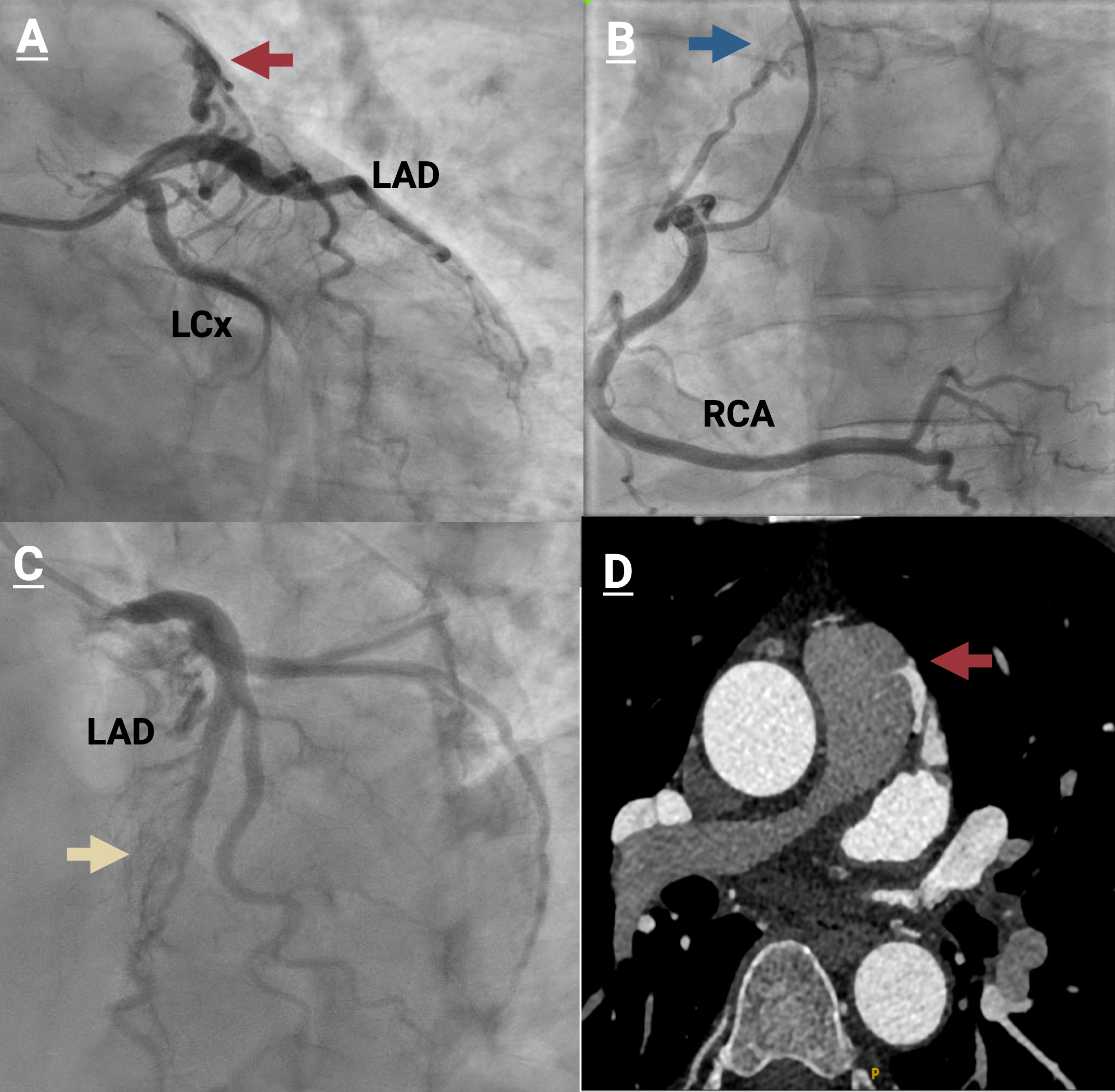
Case: A 51-year-old man with hyperlipidemia presented with a 1-month history of exertional chest pain. Baseline transthoracic echocardiography revealed normal biventricular size and function. Exercise ECG stress testing elicited chest tightness at peak exertion (14.8 METs) and showed 1.5 mm horizontal ST-segment depression in leads V4- V6. Coronary angiography via right radial artery showed revealed no obstructive coronary artery disease but identified a myocardial bridge in the mid left anterior descending (LAD) artery and bilateral coronary artery fistulae. Both fistulae were Sakakibara Type-A, originating from the proximal LAD and right coronary artery (RCA), and draining into the main pulmonary artery. Coronary CT angiography confirmed two simple, small-caliber fistulae: one from the first septal branch of the LAD and another from the conus branch of the RCA.

Decision Making: The patient’s symptoms were attributed to a combination of dynamic compression from the LAD myocardial bridge and coronary steal from bilateral CAFs. Due to the small size and simple morphology of the fistulae, initial management was conservative, using beta-blockers to reduce myocardial oxygen demand. Invasive options such as transcatheter coil embolization or surgical correction are reserved for cases with progressive symptoms, significant shunting, or pulmonary artery dilation.

Conclusion: Coronary to pulmonary artery fistulae, though rare, should be considered in patients with ischemic symptoms and 'normal' coronary arteries. Detailed anatomical assessment with invasive coronary angiography and cardiac CT angiography is essential for diagnosis and risk stratification. Management should be individualized based on symptom burden and fistula anatomy.
  • Aggarwal, Devika  ( Mount Sinai Morningside , New york , New York , United States )
  • Badar, Mustanser  ( Mount Sinai Morningside , New york , New York , United States )
  • Gowda, Ramesh  ( Mount Sinai Morningside , New york , New York , United States )
  • Author Disclosures:
    Devika Aggarwal: DO NOT have relevant financial relationships | Mustanser Badar: No Answer | Ramesh Gowda: No Answer
Meeting Info:

Scientific Sessions 2025

2025

New Orleans, Louisiana

Session Info:

Cool Clinical Cases in Cardiomyopathies

Monday, 11/10/2025 , 01:00PM - 02:00PM

Abstract Poster Board Session

More abstracts on this topic:
Anomalous Origins: Hereditary Transthyretin Cardiac Amyloidosis Mimicking Ischemia in a Patient with Congenital Coronary Anomalies

Labin Jonathan, Carmona Rubio Andres, Liu Joseph, Hanna Mazen, Menon Venu, Higgins Andrew

CARDIAC TUMORS EVOLUTION IN PATIENTS WITH TUBEROUS SCLEROSIS

Hotta Viviane, Ribeiro Anna Christina, Quadro Matos Maria Rosa, Tanaka Ana Cristina, Soliani Marilia, Oishi Gardenia, Rocha Ruiza, Miura Nana, Fernandes Fabio

More abstracts from these authors:
You have to be authorized to contact abstract author. Please, Login
Not Available