The Hidden Heart Failure Epidemic: Cocaine Use Disorders and Their Rising Toll Across 204 Nations (1990–2021)
Abstract Body (Do not enter title and authors here): Background:Cocaine use is a growing global public health concern, with its use rising steadily over the past decades. As a potent sympathomimetic agent, cocaine is linked to a broad spectrum of cardiovascular(CV) complications. Among these complications, heart failure (HF) stands out as one of the most severe and disabling consequences of chronic cocaine exposure.
Method:Estimates from the Global Burden of Disease Study 2021 was utilized to quantify the non-fatal burden of HF attributable to cocaine use disorders(CUDs) across 204 countries and territories from 1990-2021. Prevalence and YLDs were estimated using standardized case definitions and epidemiological modeling techniques, and age-standardized rates were calculated to allow for temporal and regional comparisons. Annualized percentage change(APC) was used to assess trends. Estimates were stratified by sex, age group, region.
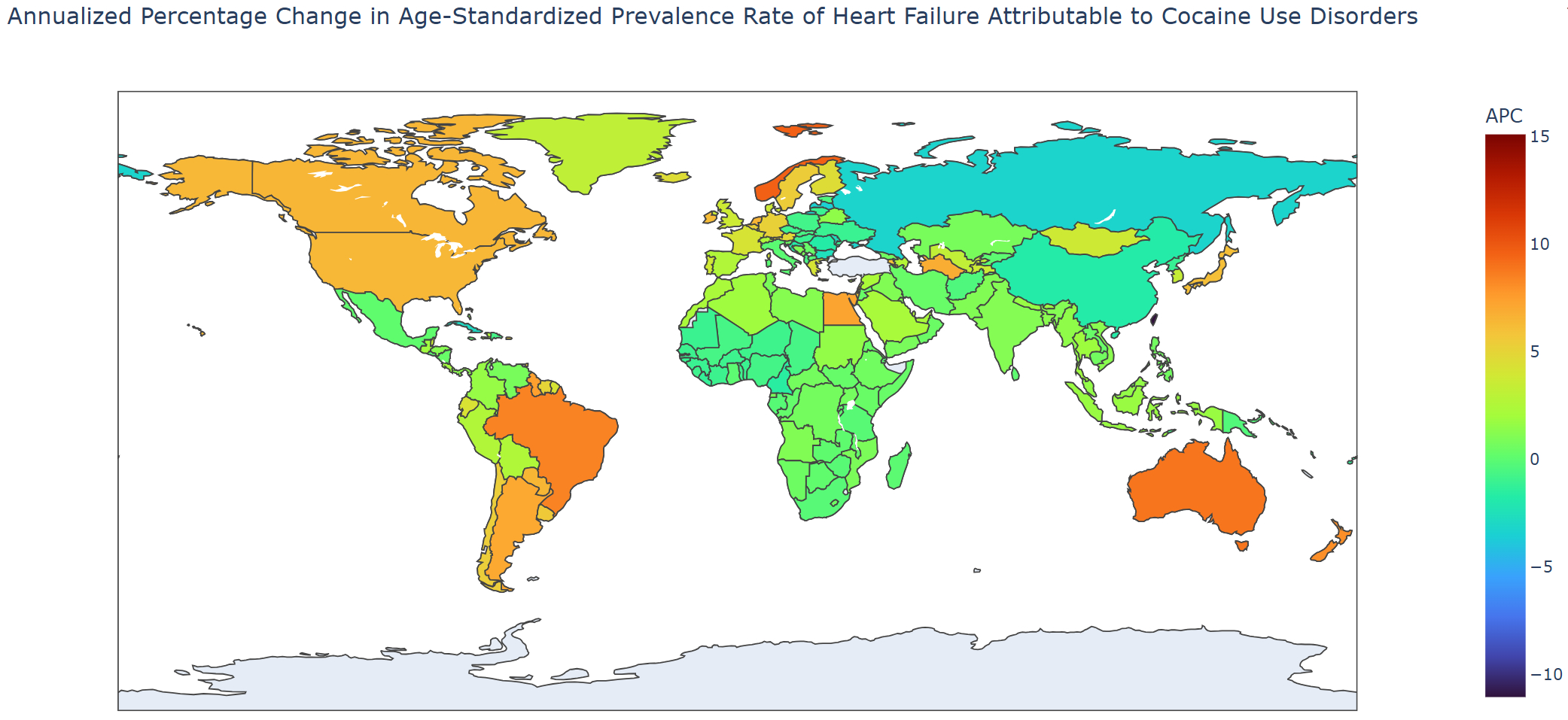
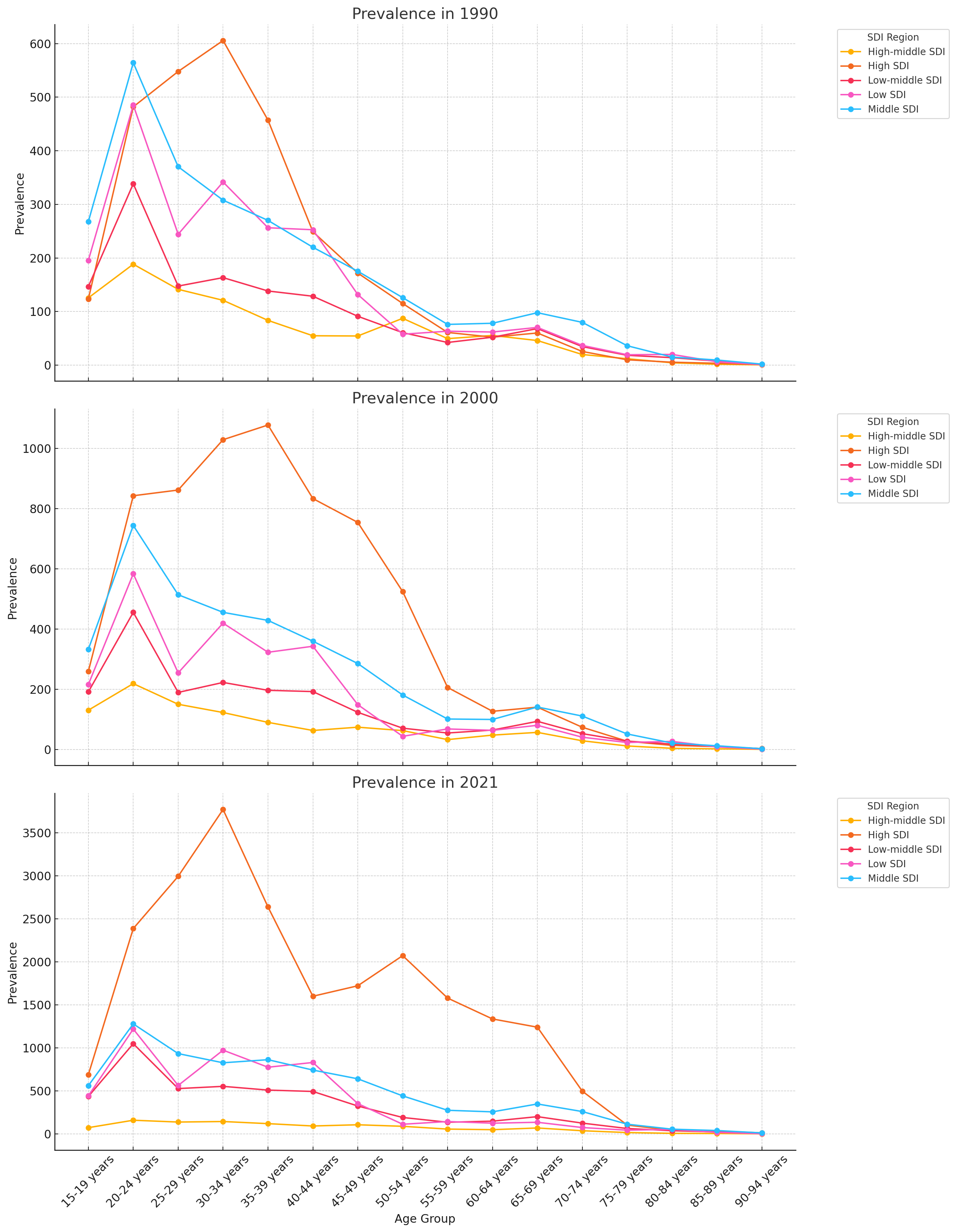
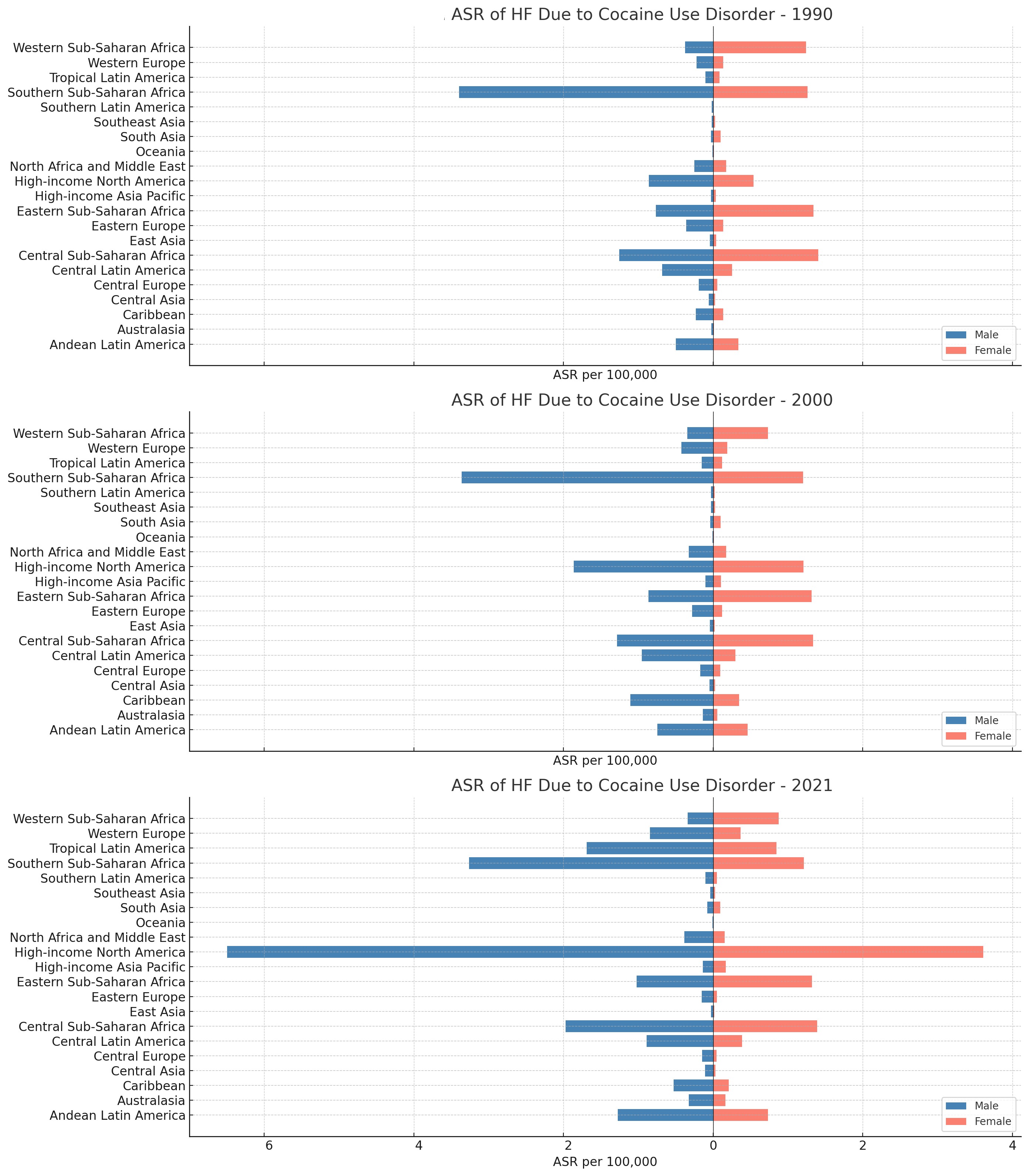
Results:Between 1990-2021, the global prevalence of HF attributable to CUDs rose markedly from 10,413(95%UI:8,240–13,061) to 42,284(34,080–52,224), while YLDs increased from 965(608–1,445) to 3,921(2,549–5,671). This reflects a 306% increase in total prevalence, significantly outpacing the 118% rise observed for all-cause HF. Regionally, the most pronounced APC increases in age-standardized prevalence rates were observed in Australasia 9.21%, Tropical Latin America 8.75%, High-income North America 6.57%, Southern Latin America 6.10%, High-income Asia Pacific 5.18%, and Western Europe 4.02%. In 2021, over half 54.15% of all global HF cases due to CUDs were concentrated in high-income regions (HIC), with the United States(US) alone accounting for 75%(17,246/22,901) of the burden. By age, the highest prevalence rate was recorded in the 15–39 age group (0.85 per 100,000), followed by 40–44 (0.75), 45–49 (0.67), 50–54 (0.65), and 55+ (0.53) age brackets in 2021. Sex-specific trends showed a disproportionately higher burden among males, with a 366% increase, compared to 237% in females.
Conclusion:HF attributable to CUDs is an escalating global concern, with a disproportionate burden falling on young males in HIC—particularly the U.S, which accounts for three-quarters of the total cases in these settings. This trend highlights how substance use is silently dismantling CV health among youth in economically advanced nations. While the burden remains lower in low-income countries, increasing drug accessibility and limited health infrastructure raise the risk of a similar surge.
Rayudu, Uma Shailendri
(
Gitam institute of medical sciences and research
, Visakhapatnam , India )
Tummala, Thanmayee
(
Bhaskar Medical College, yenkapally, Hyderabad, Telangana, India - 500075
, Hyderabad , India )
Kothawala, Azra
(
MedStar Health
, Baltimore , Maryland , United States )
Varagantiwar, Vaidheesh
(
Internal medicine,Rajiv Gandhi institute of medical sciences, Adilabad,504001, India
, Adilabad , India )
Varma, Revati
(
Internal Medicine, Cook County Health, Chicago, Illinois, United States of America, 60612
, Chicago , Illinois , United States )
Parisapogu, Anusha
(
University of Connecticut
, Hartford , India )
Patel, Ridham
(
Internal Medicine, Corpus Christi Medical Center, Corpus Christi, Texas, USA, 78411
, Austin , Texas , United States )
Sami, Shahzad Ahmed
(
Internal medicine, DCH regional medical center/university of Alabama, Tuscaloosa, AL, 35401
, Tuscaloosa , Alabama , United States )
Patoliya, Jaimini
(
Gujarat University
, Ahmedabad , India )
Sharma, Kamal H.
(
U N Mehta Institute of Cardiology and Research Center
, Ahmedabad , Gujarat , India )
Patel, Rutvij
(
Department of Cardiology, Creighton University, Omaha, Nebraska, US, 68178
, Omaha , Nebraska , United States )
Author Disclosures:
Uma Shailendri Rayudu:DO NOT have relevant financial relationships
| Jaimini Patoliya:DO NOT have relevant financial relationships
| Kamal H. Sharma:DO NOT have relevant financial relationships
| Rutvij Patel:No Answer
| Hardik Dineshbhai Desai:DO NOT have relevant financial relationships
| Thanmayee Tummala:No Answer
| Azra Kothawala:DO NOT have relevant financial relationships
| Vaidheesh Varagantiwar:No Answer
| Revati Varma:No Answer
| Anusha Parisapogu:DO NOT have relevant financial relationships
| Ridham Patel:DO NOT have relevant financial relationships
| SHAHZAD AHMED SAMI:No Answer
Eltawansy Sherif, Khan Muhammad, Iqbal Asad, Sharif Aleena, Hossain Mohammad, Ali Muhammad Faizan, Ahmad Husnain, Faizan Muhammad, Ahmed Ashraf, Abdul Malik Mohammad Hamza Bin, Pahwani Ritesh, Patel Rahul, Mehdi Hassan