
Logo

American Heart Association

  24
  0


Final ID: Su3140

Breaking the Clot: Restoring the flow with the ClotTriever System in Aortic Thrombosis

Abstract Body (Do not enter title and authors here): Aortic thrombosis (AT) is a rare but life-threatening condition that can result in ischemia, organ failure, or embolization. It presents significant management challenges, particularly in high-risk patients. Mechanical thrombectomy (MT) has emerged as a minimally invasive alternative for managing complex thrombotic occlusions. Devices like the ClotTriever System (CTS) enable effective clot removal, minimizing bleeding risks and allowing treatment in patients with contraindications to traditional therapies. This case discusses the successful use of the CTS to restore perfusion in a patient with severe AT following open-heart surgery.

Can MT serve as a safe and effective alternative in patients with aortoiliac thrombosis?

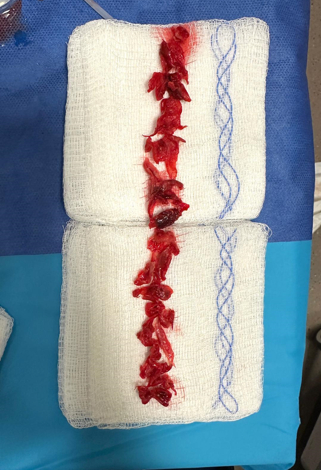
We present the case of an 82-year-old male patient who presented with chest pain, and echocardiographic findings of reduced ejection fraction (35-40%). Coronary angiography revealed multivessel disease, and he underwent coronary artery bypass surgery, mitral and aortic valve replacement. Postoperatively, he developed cold lower extremities and absent pulses, indicative of severe aortoiliac thrombosis. Given the high surgical risk, balloon angioplasty and MT with the CTS were performed. The ClotTriever sheath was inserted via the left femoral artery for multiple aspiration of the thrombus. Persistent occlusions in both iliac systems required additional MT, ultimately restoring near-normal flow and resolving the ischemia.

AT is a rare but severe condition associated with ischemic complications. Traditional treatments, such as surgical thrombectomy or thrombolytic therapy, are often unsuitable for high-risk patients. MT has emerged as a minimally invasive alternative, with the CTS offering an effective option for thrombus removal. This device enabled the removal of significant thrombus from the distal aorta and iliac systems in this patient. This approach successfully restored near-normal flow, resolving ischemia. Similar cases support the efficacy of the CTS. Wazni et al. (2021) reported effective management of postoperative venous and arterial thrombosis, and Farber et al. (2022) documented its role in resolving critical limb ischemia caused by aortic thrombus.

This case underscores the CTS as a safe and effective tool for managing complex thrombotic conditions, especially in high-risk or postoperative patients.
  • Razzeto Rubio, Mariano  ( Palmetto General Hospital , Doral , Florida , United States )
  • Razzeto Rubio, Luis  ( Palmetto General Hospital , Doral , Florida , United States )
  • Basart, Lazaro  ( Palmetto General Hospital , Doral , Florida , United States )
  • Gorrepati, Maanvita  ( Palmetto General Hospital , Doral , Florida , United States )
  • Cintron, Daniel  ( Palmetto General Hospital , Doral , Florida , United States )
  • Yuvaraj, Yaswanraj  ( Palmetto General Hospital , Hialeah , Florida , United States )
  • Patton, Marquand  ( Palmetto General Hospital , Doral , Florida , United States )
  • Author Disclosures:
    Mariano Razzeto Rubio: DO NOT have relevant financial relationships | Luis Razzeto Rubio: No Answer | Lazaro Basart: No Answer | Maanvita Gorrepati: No Answer | Daniel Cintron: No Answer | Yaswanraj Yuvaraj: No Answer | Marquand Patton: DO NOT have relevant financial relationships
Meeting Info:

Scientific Sessions 2025

2025

New Orleans, Louisiana

Session Info:

Aortic Disease

Sunday, 11/09/2025 , 03:15PM - 04:15PM

Abstract Poster Board Session

You have to be authorized to contact abstract author. Please, Login
Not Available