In a vascular disease cohort, pTau217 correlates with processing speed and executive function, but not memory.
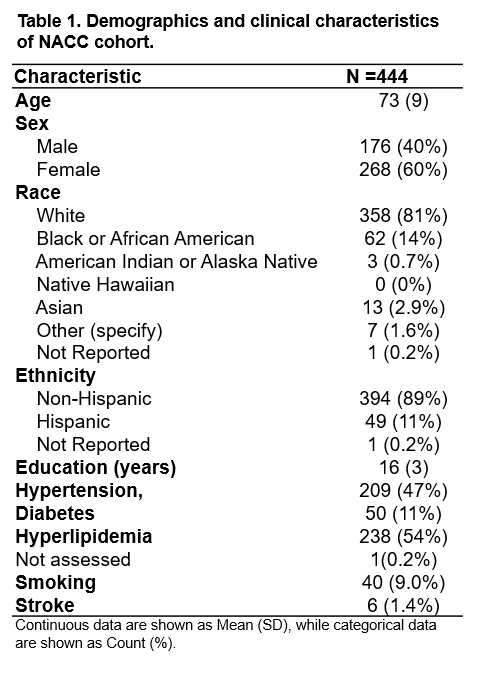
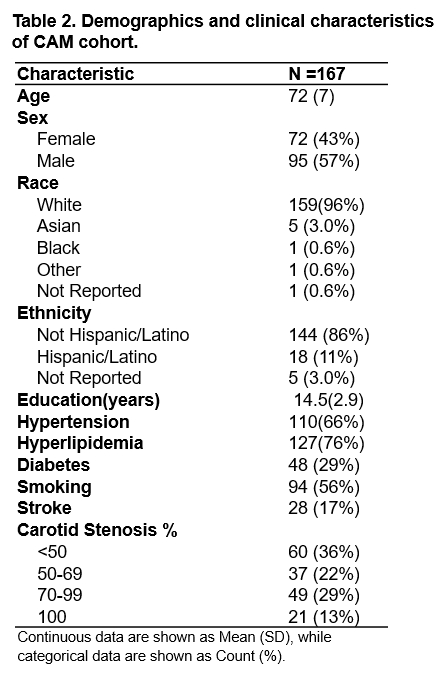
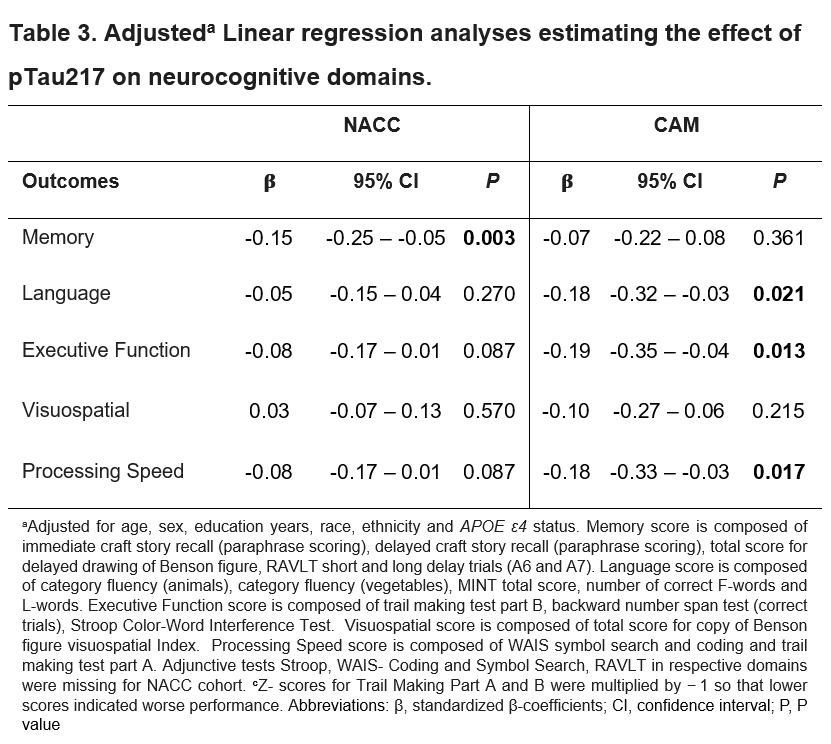
Abstract Body (Do not enter title and authors here): Introduction Cerebrovascular disease and vascular risk factors have important contributions to Alzheimer’s disease (AD) risk, and greater understanding of cognitive changes in vascular versus non-vascular populations may help reveal complementary and overlapping clinical changes. The aim of this work was to evaluate how cognitive changes in middle to later aged vascular and non-vascular cohorts are related to AD pathology. Methods A subset of the National Alzheimer’s Coordinating Center (NACC) cohort with pTau217 testing available (ages 50-90, n=444) was included as a general population cohort. The first 167 participants enrolled in our prospective Carotid and Minds (CAM) study (participants aged 50-85 with ≥2 vascular comorbidities with/without asymptomatic carotid stenosis were included as a vascular disease cohort. Both cohorts were assessed using a full UDS neurocognitive battery and compared to plasma pTau217 adjusting for demographics and APOE ε4 status. Dementia and other neurological disorders were exclusionary. Results Demographics of NACC cohort shown (Table1). When adjusted for age, sex, education, race, ethnicity and APOE ε4 status, pTau217 was associated with significantly worse memory (β=-0.15, p=0.003) while no significant association with domains of language, executive function, visuospatial and processing speed was seen. Demographics of CAM are shown (Table 2). Within CAM, pTau217 was associated with significantly worse non-amnestic domains including language (β=-0.18, p=0.02), executive function (β=-0.19, p=0.013) and processing speed (β=-0.18, p=0.02), but not memory (β=-0.07, p=0.36) independent of age, sex, education, race, ethnicity and APOE ε4 status. Poorer cognition was associated with age, sex and education in both cohorts; in contrast, worse processing speed and executive function in CAM cohort is associated with carotid stenosis (β=-0.24, p<0.001) and a history of stroke (β=-0.47, p=0.02), but not APOE ε4 status or cerebral white matter lesion volumes. Conclusion Within a vascular disease cohort, association of AD pathology with non-amnestic domains of processing speed, executive function and language complements and contrasts with memory domain impacts often associated with the classic notion of AD. Further assessment of these pathways associated with AD pathology could help understand unique and potentially complimentary cognitive changes relevant in understanding vascular contributions to cognitive impairment and dementia.
Zahra, Summan
(
University of Arizona
, Tucson , Arizona , United States )
French, Scott
(
University of Arizona
, Tucson , Arizona , United States )
Arias, Juan
(
University of Arizona
, Tucson , Arizona , United States )
Escareno, Cris
(
University of Arizona
, Tucson , Arizona , United States )
Heitkamp, Emma
(
University of Arizona
, Tucson , Arizona , United States )
Wiskoski, Haley
(
University of Arizona
, Tucson , Arizona , United States )
Culwell, Gavin
(
University of Arizona
, Tucson , Arizona , United States )
Ally, Madeline
(
University of Arizona
, Tucson , Arizona , United States )
Johnson, Kevin
(
University of Arizona
, Tucson , Arizona , United States )
Bedrick, Edward
(
University of Arizona
, Tucson , Arizona , United States )
Vitali, Francesca
(
University of Arizona
, Tucson , Arizona , United States )
Mushtaq, Raza
(
Barrow Neurological Institute
, Phoenix , Arizona , United States )
Altbach, Maria
(
University of Arizona
, Tucson , Arizona , United States )
Trouard, Theodore
(
University of Arizona
, Tucson , Arizona , United States )
Alexander, Gene E.
(
University of Arizona
, Tucson , Arizona , United States )
Weinkauf, Craig
(
University of Arizona
, Tucson , Arizona , United States )
Author Disclosures:
Summan Zahra:DO NOT have relevant financial relationships
| Edward Bedrick:No Answer
| Francesca Vitali:No Answer
| Raza Mushtaq:DO have relevant financial relationships
;
Consultant:Ischemiaview :Active (exists now)
| Maria Altbach:No Answer
| Theodore Trouard:No Answer
| Gene E. Alexander:DO NOT have relevant financial relationships
| Craig Weinkauf:No Answer
| Scott French:DO NOT have relevant financial relationships
| Juan Arias:No Answer
| Cris Escareno:No Answer
| Emma Heitkamp:No Answer
| Haley Wiskoski:No Answer
| Gavin Culwell:No Answer
| Madeline Ally:DO NOT have relevant financial relationships
| Kevin Johnson:No Answer