
Logo

American Heart Association

  22
  0


Final ID: MP2374

Impact of Maternal Gestational Diabetes on Offspring Cardiac Function: A Systematic Review and Meta-Analysis

Abstract Body (Do not enter title and authors here): Background: Gestational diabetes mellitus (GDM) affects 6–12% of pregnancies globally and is linked to adverse fetal cardiac remodeling. Offspring exposed to GDM in utero show altered myocardial performance index (MPI) and increased left ventricular mass index (LVMI). We performed a systematic review and meta-analysis to assess the impact of maternal GDM on neonatal and early childhood cardiac structure and function.

Methods: A PRISMA-compliant search was conducted across PubMed, Scopus, and Web of Science (last updated April 2024) for studies comparing echocardiographic parameters in GDM-exposed vs non-GDM-exposed offspring. Inclusion criteria: (1) human subjects, (2) reported MPI or LVMI, (3) GDM diagnosed per WHO/ADA criteria, and (4) echocardiography performed <12 years of age. Pooled effect sizes were computed using a random-effects model (Hedges’ g). Heterogeneity assessed via I2, and subgroup analyses explored term vs preterm outcomes and GDM treatment status.

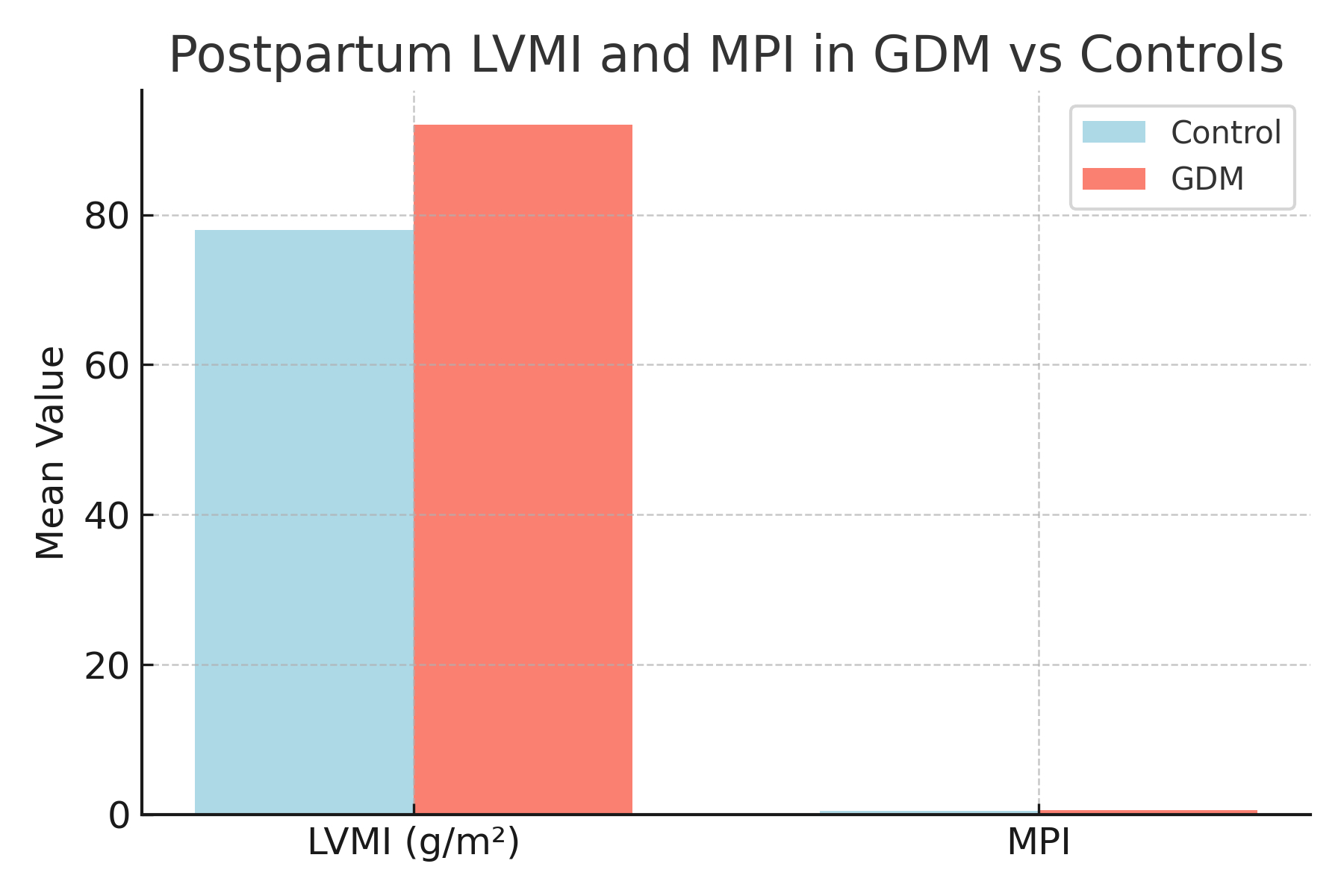
Results: 13 studies (n = 1,621 offspring) met inclusion. GDM-exposed offspring had significantly higher LVMI (Hedges’ g = 0.51; 95% CI: 0.34–0.67) and abnormal MPI (Hedges’ g = 0.59; 95% CI: 0.43–0.75) compared to controls. The effect was most pronounced in third trimester GDM and insulin-treated cohorts. Heterogeneity was moderate (I = 48%). Subgroup analysis showed greater dysfunction in boys vs girls (p = 0.04). Meta-regression revealed stronger MPI alteration with increasing maternal HbA1c (β = 0.22, p = 0.003). No evidence of publication bias was observed.

Conclusion: In utero exposure to maternal GDM is associated with early subclinical LV dysfunction and remodeling, reflected by elevated MPI and LVMI. These changes may predispose offspring to long-term cardiometabolic risk. Our findings support the utility of early echocardiographic screening in this population and the importance of optimized GDM management to prevent fetal cardiac programming.
  • Chintharala, Karthik  ( NRI Academy of Medical Sciences , Vijayawada , India )
  • Sekharamahanti, Hadassa Evangeline  ( Mercy Catholic Medical Center , Darby , Pennsylvania , United States )
  • Madam, Sai Tapasvi  ( G.S.L Medical College , Rajahmundry , Andhra Pradesh , India )
  • Miriyala, Varsha  ( University of Miami Miller School of Medicine , Miami , Florida , United States )
  • Author Disclosures:
    Karthik Chintharala: DO NOT have relevant financial relationships | Hadassa Evangeline Sekharamahanti: DO NOT have relevant financial relationships | SAI TAPASVI MADAM: DO NOT have relevant financial relationships | Varsha Miriyala: DO NOT have relevant financial relationships
Meeting Info:

Scientific Sessions 2025

2025

New Orleans, Louisiana

Session Info:

Dangerous Rhythms and Silent Threats: Cardiac Curveballs in Pregnancy and Postpartum

Monday, 11/10/2025 , 12:15PM - 01:30PM

Moderated Digital Poster Session

More abstracts on this topic:
Age-standardized trends in Incidence Rates of Noncommunicable diseases among Adults Aged 30 to 79 in Senegal from 2000 to 2019

Gaye Ngone, Ka Mame, Kyem Damaris, Jobe Modou, Sattler Elisabeth, Gary-webb Tiffany, Gaye Bamba

Aficamten is safe and effective in oHCM with comorbidities obesity, hypertension, and diabetes: a SEQUOIA-HCM sub-study

Lee Matthew, Malik Fady, Kupfer Stuart, Wohltman Amy, Coats Caroline, Abraham Theodore, Claggett Brian, Maron Martin, Miao Zi, Meder Benjamin, Olivotto Iacopo, Heitner Stephen, Jacoby Daniel

More abstracts from these authors:
AI-Powered Handheld Ultrasound for Rapid Left Ventricular Assessment: A Systematic Review and Meta-Analysis

Chintharala Karthik, Sekharamahanti Hadassa Evangeline, Madam Sai Tapasvi, Munnangi Pragathi

Cognitive Impairment in Heart Failure: A Systematic Review and Meta-Analysis of Prevalence and Predictors

Chintharala Karthik, Sekharamahanti Hadassa Evangeline, Miriyala Varsha, Madam Sai Tapasvi

You have to be authorized to contact abstract author. Please, Login
Not Available