
Logo

American Heart Association

  15
  0


Final ID: MP641

Widening Income-Based Disparities in Cardiovascular Mortality Among Working-Age US Adults 1999-2023

Abstract Body (Do not enter title and authors here): Background: After decades of progress, cardiovascular (CV) mortality among younger US adults is rising, but little is known about how these patterns vary by income.
Objective: To evaluate trends in cardiovascular mortality among working-age US adults by county-level income from 1999-2023.
Methods: We used American Community Survey data to assign US counties to quintiles by median household income (Q1: lowest; Q5: highest). Age-adjusted CV mortality rates (AAMRs) per 100,000 population in each quintile were obtained from CDC WONDER for adults age 25-64 using ICD codes I.00-99 as the primary cause of death. Annual percent changes (APCs) were determined for 1999-2009 and 2009-2019 using inverse variance-weighted log-linear regression models. Differential trends were assessed using interaction terms with Q1 and Q5 as reference groups. Given the short time period around the COVID-19 pandemic, absolute changes in AAMRs between 2019 and 2023 were calculated and compared using two-sample z-tests.
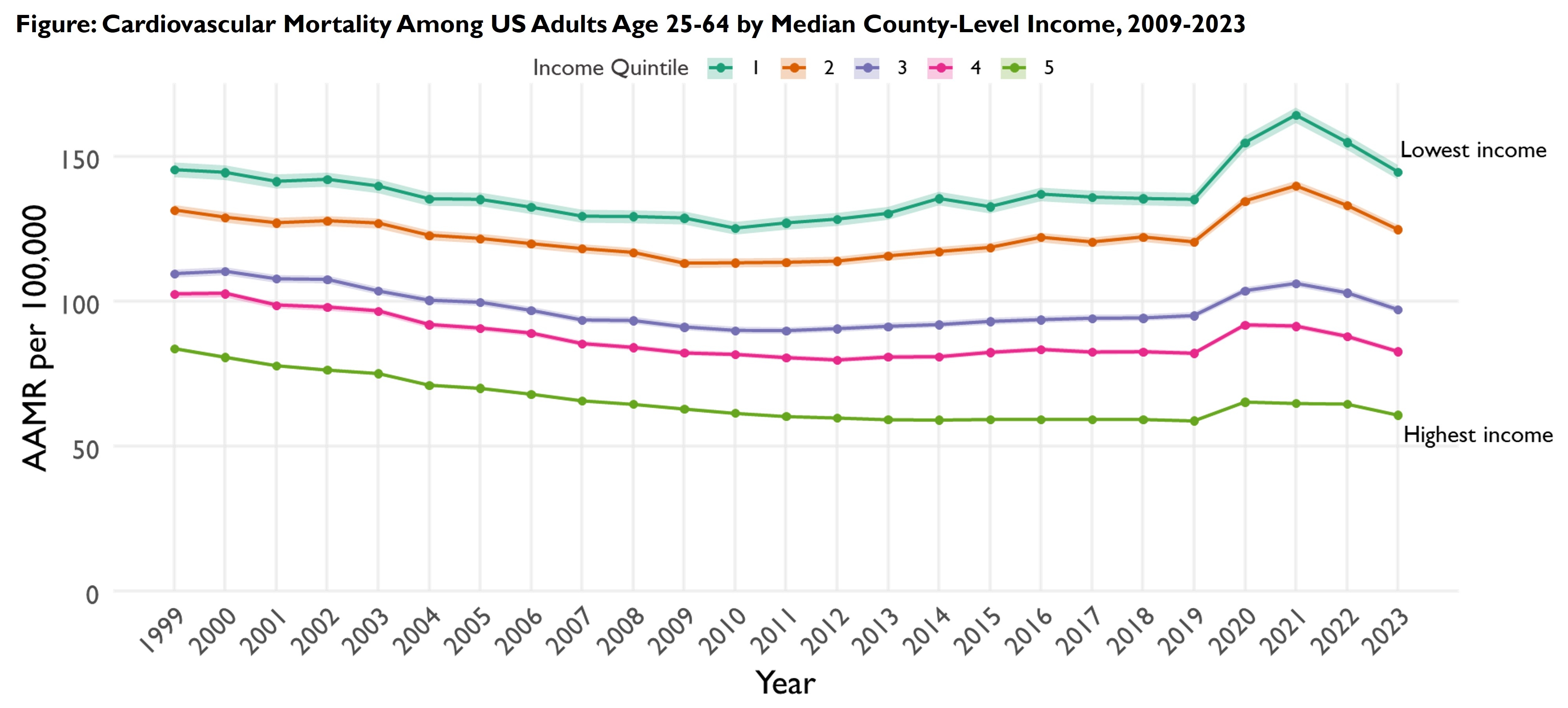
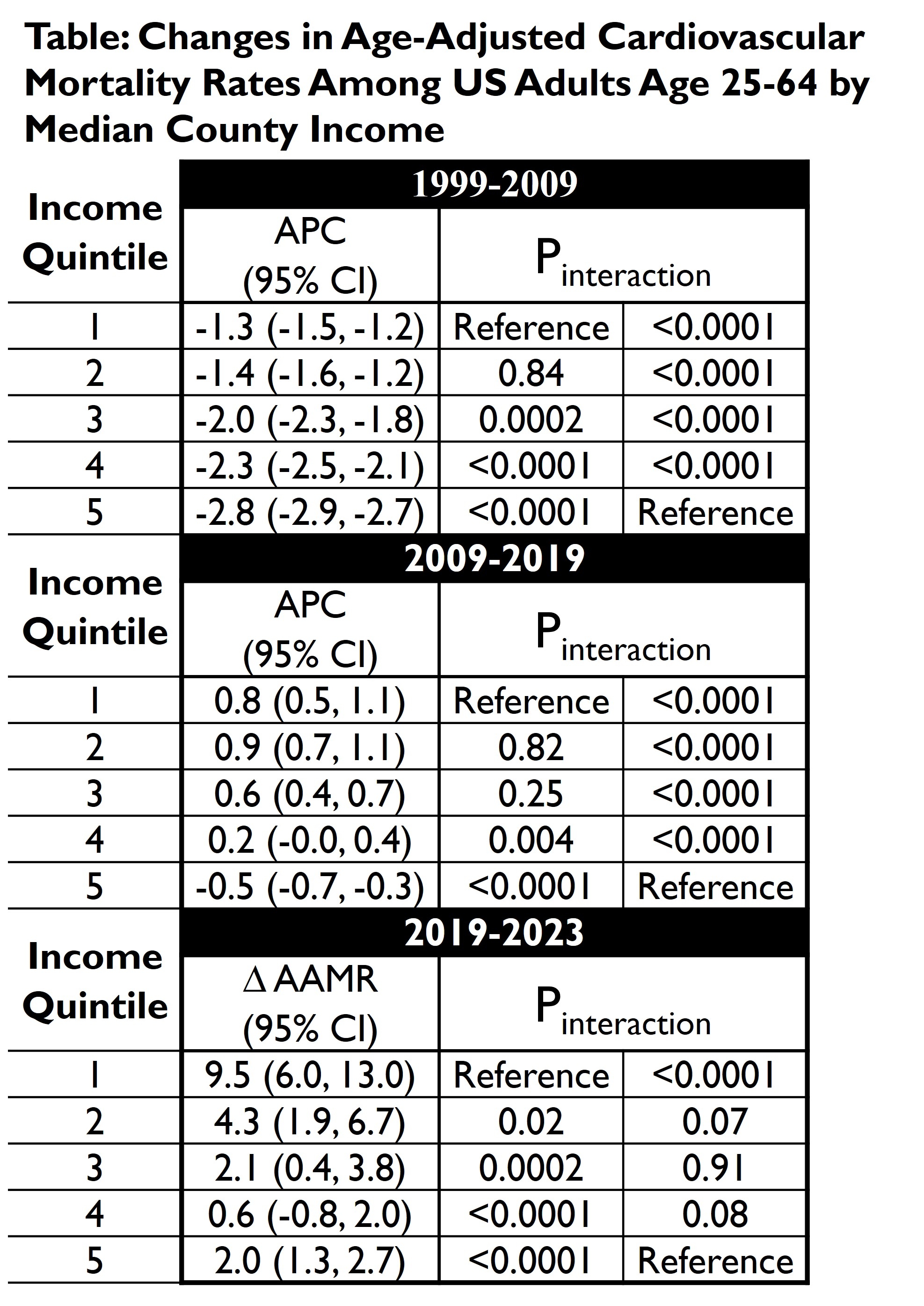
Results: From 1999-2023, cardiovascular mortality rates were consistently higher in lower-income counties (Figure). Between 1999-2009, CV mortality declined in all quintiles, but higher-income counties experienced a greater decline than lower-income counties (Q5 APC -2.8% [-2.9, -2.7] vs. Q1 APC -1.3% ([-1.5,-1.2]; p<0.0001). From 2009-2019, trends reversed and mortality increased for those in the lower income counties (Q1 APC +0.8% [0.5-1.1]; Q2 APC +0.9% [0.7-1.1];), whereas mortality continued to decline in the highest income counties (Q5: APC -0.5% [-0.7, -0.3]). From 2019-2023, CV mortality increased across all income quintiles, but increases were greatest in the lowest-income county (ΔAAMR +9.5 [6.0-13.0]) compared to all other income groups (p<0.05) (Table).
Conclusions: From 1999-2023, income-based disparities in cardiovascular (CV) mortality widened substantially among working-age U.S. adults. Although CV mortality declined across all income quintiles between 1999 and 2009, gains were more pronounced in higher-income counties. This progress stalled and reversed in 2009, with mortality rates rising among adults in the lowest-income counties while continuing to improve in the highest-income counties. From 2019 to 2023, CV mortality increased across all income groups, but the steepest rises occurred in the lowest-income quintiles. These findings highlight the urgent need to address rising CV mortality that is disproportionately impacting low-income, working-age adults.
  • Marinacci, Lucas  ( Smith Center for Outcomes Research , Boston , Massachusetts , United States )
  • Wadhera, Rishi  ( Beth Israel Deaconess Medical Centr , Cambridge , Massachusetts , United States )
  • Author Disclosures:
    Lucas Marinacci: DO NOT have relevant financial relationships | Rishi Wadhera: DO have relevant financial relationships ; Consultant:Abbott Vascular:Past (completed)
Meeting Info:

Scientific Sessions 2025

2025

New Orleans, Louisiana

Session Info:

Health Justice in Cardiology: Confronting Disparities in Care and Research Leadership

Saturday, 11/08/2025 , 03:15PM - 04:30PM

Moderated Digital Poster Session

More abstracts on this topic:
25-Year Decline in Aortic Aneurysm and Dissection Mortality in the U.S.: Impact of Endovascular Repair and Forecast to 2030

Ali Manzer, Umar Haddaya, Nazir Tahira, Nizam Muhammad, Steafo Lark, Sharif Ayesha, Jehangir Hanzala, Arham Muhammad, Hamza Anfal, Hassan Arbaz, Amjad Ans, Ali Iman, Zuha Zuha

A Contemporary Machine Learning-Based Risk Stratification for Mortality and Hospitalization in Heart Failure with Preserved Ejection Fraction Using Multimodal Real-World Data

Fudim Marat, Weerts Jerremy, Patel Manesh, Balu Suresh, Hintze Bradley, Torres Francisco, Micsinai Balan Mariann, Rigolli Marzia, Kessler Paul, Touzot Maxime, Lund Lars, Van Empel Vanessa, Pradhan Aruna, Butler Javed, Zehnder Tobias, Sauty Benoit, Esposito Christian, Balazard Félix, Mayer Imke, Hallal Mohammad, Loiseau Nicolas

More abstracts from these authors:
You have to be authorized to contact abstract author. Please, Login
Not Available