
Logo

American Heart Association

  24
  0


Final ID: Su1006

Targeting Cerebrovascular Risk in Diabetes: GLP-1 Receptor Agonists as Neuroprotective Agents

Abstract Body (Do not enter title and authors here): Background:
Glucagon-like peptide-1 receptor agonists (GLP-1 RAs) are established therapies for type 2 diabetes (T2D) that lower major adverse cardiovascular events. Their specific impact on stroke incidence and stroke-related death remains unclear.
Hypothesis:
We hypothesized that treatment with GLP-1 RAs reduces the risk of nonfatal stroke in T2D patients and may also influence stroke-related mortality.
Methods:
A systematic search of PubMed (2010–June 2025) identified randomized controlled trials (RCTs) of GLP-1 RAs in adults with T2D reporting stroke outcomes. Trials without separate stroke data were excluded. The primary outcome was first occurrence of nonfatal stroke; the secondary outcome was fatal stroke. A total of thirteen RCTs (n = 58 432) met inclusion criteria. Hazard ratios (HRs) for each outcome were pooled using a random-effects model. Study quality was assessed using Cochrane Risk of Bias tools. Agent-specific effects and subgroup analyses in patients with established cardiovascular disease (CVD) were also evaluated.
Results:
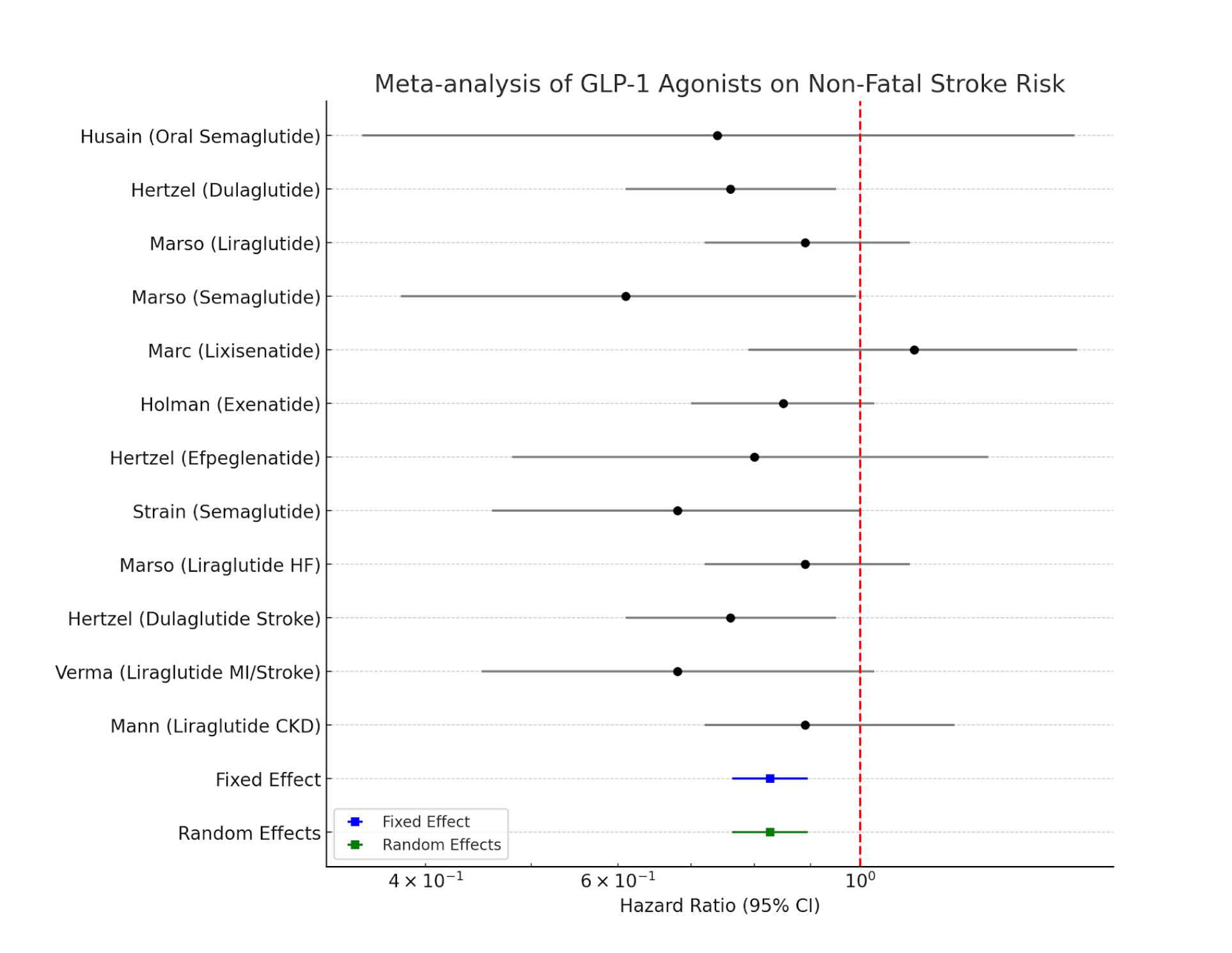
A total of thirteen trials involving liraglutide, semaglutide, dulaglutide, exenatide, lixisenatide, and efpeglenatide were analyzed. The median follow-up was 3.4 years (range 0.5–5.4 years). Overall, GLP-1 RA therapy was associated with an 18 percent reduction in nonfatal stroke risk (pooled HR 0.82; 95 percent CI 0.75–0.90; I^2 = 25 percent; p < 0.001). Dulaglutide achieved a significant reduction (HR 0.76; 0.61–0.95), as did semaglutide (HR 0.61; 0.38–0.99), while lixisenatide showed no benefit (HR 1.12; 0.79–1.58). Patients with prior CVD experienced an amplified benefit (HR 0.68; 0.45–1.03). No statistically significant effect on fatal stroke was observed (HR 0.71; 0.47–1.07; based on three trials). Stroke subtypes were reported in seven of thirteen trials; 100 percent reported nonfatal stroke separately, and 32 percent reported fatal stroke separately. The event rate in control arms averaged 2.1 percent per year.
Conclusions:
In adults with T2D, GLP-1 RA therapy significantly lowers the risk of nonfatal stroke, especially with dulaglutide and semaglutide, while no definitive reduction in stroke-related death was detected. These findings support preferential GLP-1 RA selection for cerebrovascular risk reduction in high-risk diabetic populations
  • Prajapati, Hem  ( medical college baroda , Vadodara , India )
  • Sharma, Bhavya  ( Baroda Medical College , Vadodara , India )
  • Jadawala, Sharv  ( medical college, Baroda , Ahmedabad , India )
  • Mody, Mansi  ( M. P. Shah Government Medical Colle , Bharuch , India )
  • Chauhan, Yesha  ( Medical College Baroda , Vadodara , India )
  • Author Disclosures:
    Hem prajapati: DO NOT have relevant financial relationships | Bhavya Sharma: No Answer | Sharv Jadawala: DO NOT have relevant financial relationships | Mansi Mody: DO NOT have relevant financial relationships | Yesha Chauhan: DO NOT have relevant financial relationships
Meeting Info:

Scientific Sessions 2025

2025

New Orleans, Louisiana

Session Info:

Stroke Risk Redefined: New Frontiers in Mechanisms, Disparities, and Prevention

Sunday, 11/09/2025 , 11:30AM - 12:30PM

Abstract Poster Board Session

More abstracts on this topic:
10-Year Trend Analysis of Medicare Payment in Stroke Inpatient Hospital Admission

Wong Ka-ho, Krothapalli Neeharika, Littig Lauren, Champagne Alison, Majersik Jennifer, Reddy Vivek, De Havenon Adam

3-HKA Promotes the Vascular Remodeling after Stroke by Modulating the Activation of A1/A2 Reactive Astrocytes

Chen Jun-min, Shi Guang, Yu Lulu, Shan Wei, Zhang Xiangjian, Wang Qun

More abstracts from these authors:
Optimizing Cardiovascular Outcomes in Hypertensive Patients with Obstructive Sleep Apnea: A Systematic Review of CPAP and Adjunctive Therapies

Jadawala Sharv, Prajapati Hem, Mody Mansi, Tandel Hemeesh, Bhuva Ronit, Chauhan Yesha, Sharma Bhavya

Redlining, Segregation, and Disparities in Heart Health: Structural Racism as a Driver of Adverse Cardiovascular Outcomes

Prajapati Hem, Chauhan Yesha, Mody Mansi, Tandel Hemeesh, Jadawala Sharv

You have to be authorized to contact abstract author. Please, Login
Not Available