
Logo

American Heart Association

  16
  0


Final ID: MP116

Can the presence of vascular endothelial dysfunction be a prognostic factor for vasospastic angina?

Abstract Body (Do not enter title and authors here): Backgrounds
Vascular endothelial dysfunction (VED) is considered one mechanism underlying the development of vasospastic angina (VSA). However, the prognostic impact of VED on VSA has yet to be extensively studied. This retrospective study investigated whether the clinical background and prognosis differ based on the presence or absence of VED in patients with VSA.
Methods
The present study included 244 patients (mean age 67 years, 107 males) who were admitted to our hospital for chest pain screening and were diagnosed with VSA by spasm provocation test (SPT). Vascular endothelial function was evaluated using brachial artery echocardiography, and flow-mediated dilation (FMD) was determined as previously reported. Based on the median FMD value (3.7%), the subjects were classified into two groups: a high group (FMD-H, n = 123) and a low group (FMD-L, n = 121). VSA was defined as coronary artery vasoconstriction of ≥90% on coronary angiography with chest symptoms and/or electrocardiographic changes during SPT. Focal spasm was defined as a coronary spasm occurring within one American Heart Association classification segment. The major adverse cardiovascular events (MACE) were defined as cardiac death and cardiovascular rehospitalization.
Results
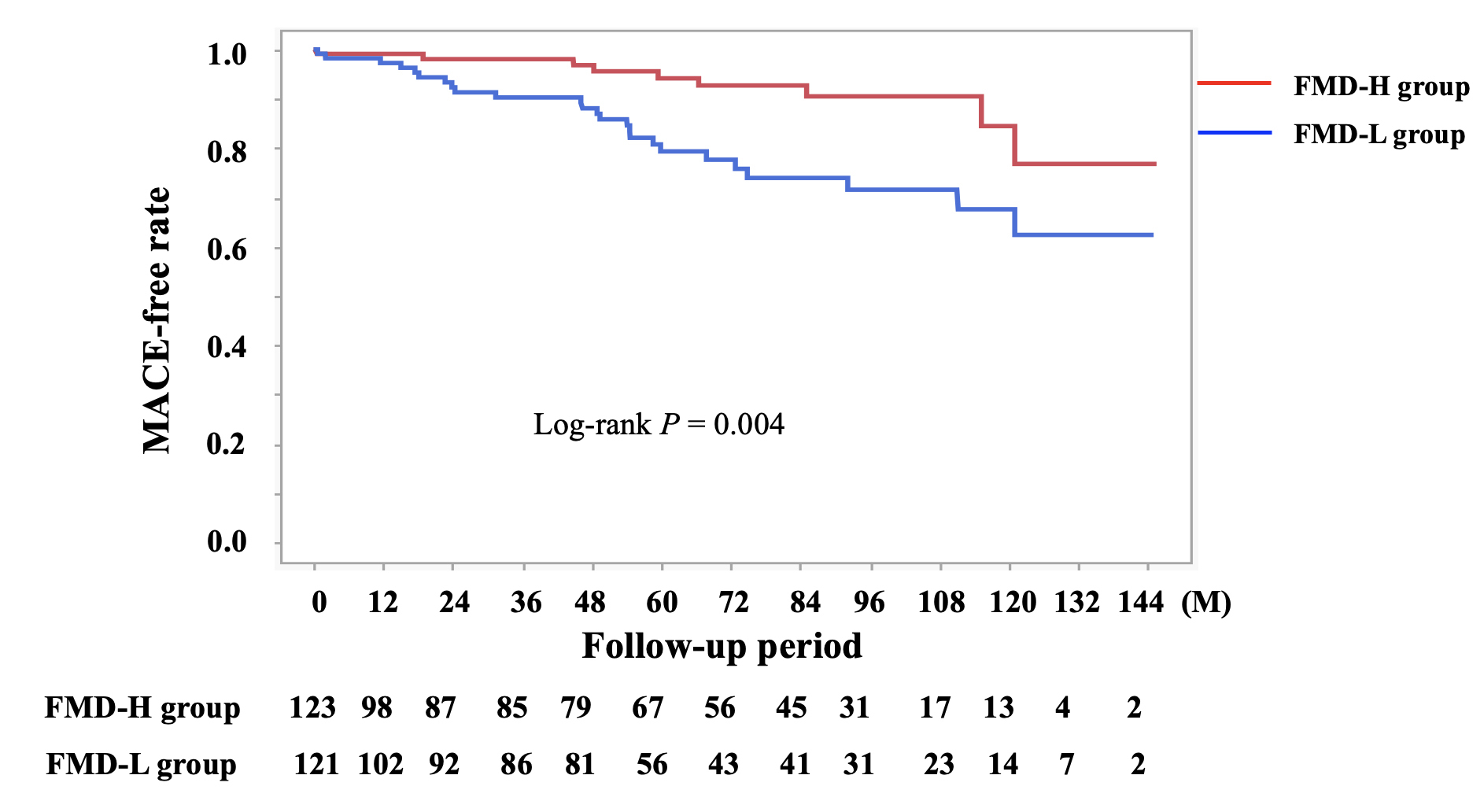
There were no significant changes in the patients’ characteristics in the two groups. On SPT, focal spasm tended to be more frequently observed in the FMD-L group (L: 43% vs. H: 32%, p = 0.068). MACE by Kaplan-Meier was significantly lower in the FMD-L group (Log-rank p = 0.004, figure). Cox hazards proportional model analysis showed that FMD-L (p = 0.023) as well as age (p = 0.026) were significant prognostic factors, while the presence of focal spasm was not (p = 0.164).
Conclusions
These findings suggest that VED is a significant factor influencing the prognosis of VSA, and that evaluating VED may be useful for estimating the prognosis of VSA.
  • Teragawa, Hiroki  ( Futabanosato Prefectural Hospital , Hiroshima , Japan )
  • Hashimoto, Yu  ( Futabanosato Prefectural Hospital , Hiroshima , Japan )
  • Nomura, Shuichi  ( Futabanosato Prefectural Hospital , Hiroshima , Japan )
  • Author Disclosures:
    Hiroki Teragawa: DO NOT have relevant financial relationships | Yu Hashimoto: No Answer | Shuichi Nomura: No Answer
Meeting Info:

Scientific Sessions 2025

2025

New Orleans, Louisiana

Session Info:

Chronic Coronary Disease 2

Saturday, 11/08/2025 , 03:15PM - 03:50PM

Moderated Digital Poster Session

More abstracts on this topic:
Association Between the Severity of Coronary Artery Stenosis with the Minimum Responsive Dose of Intracoronary Acetylcholine Provocation Test

Rha Seung-woon, Park Chang Gyu, Oh Dong, Ahn Woo Jin, Hyun Sujin, Cha Jinah, Choi Se Yeon, Choi Byoung Geol, Sinurat Markz, Park Soohyung, Choi Cheol Ung

Aberrant Regulation of endMT in Turner Syndrome: Implications for the Pathogenesis of Congenital Cardiovascular Disease

Garcia Huitron Eric Ivan, Zhang Xiaoying, Babcock Lance, Grande-allen Kathryn, Prakash Siddharth

You have to be authorized to contact abstract author. Please, Login
Not Available