
Logo

American Heart Association

  11
  0


Final ID: Su3071

Virtual Surgical Planning for Thoracic Access Port Placement in Patients with Congenital Heart Disease: A Pre-Surgical Study in Pediatric and Adult Cases

Abstract Body (Do not enter title and authors here): Background
Epicardial pacemaker lead placement is often required in patients with congenital heart disease (CHD) who are not candidates for transvenous systems. However, traditional surgical access may involve sternotomy or thoracotomy, which can have complications, especially in small children or patients with comorbidities. We have previously developed and validated a thoracic access port, PeriPath (PP), a novel subxiphoid entry system, which enables intrapericardial access using direct visualization through a minimally invasive 12 mm incision. Here, we performed preclinical virtual surgical planning to evaluate the feasibility of PP for epicardial pacing lead delivery in CHD patients with contraindications to open-chest and transvenous approaches.
Methods
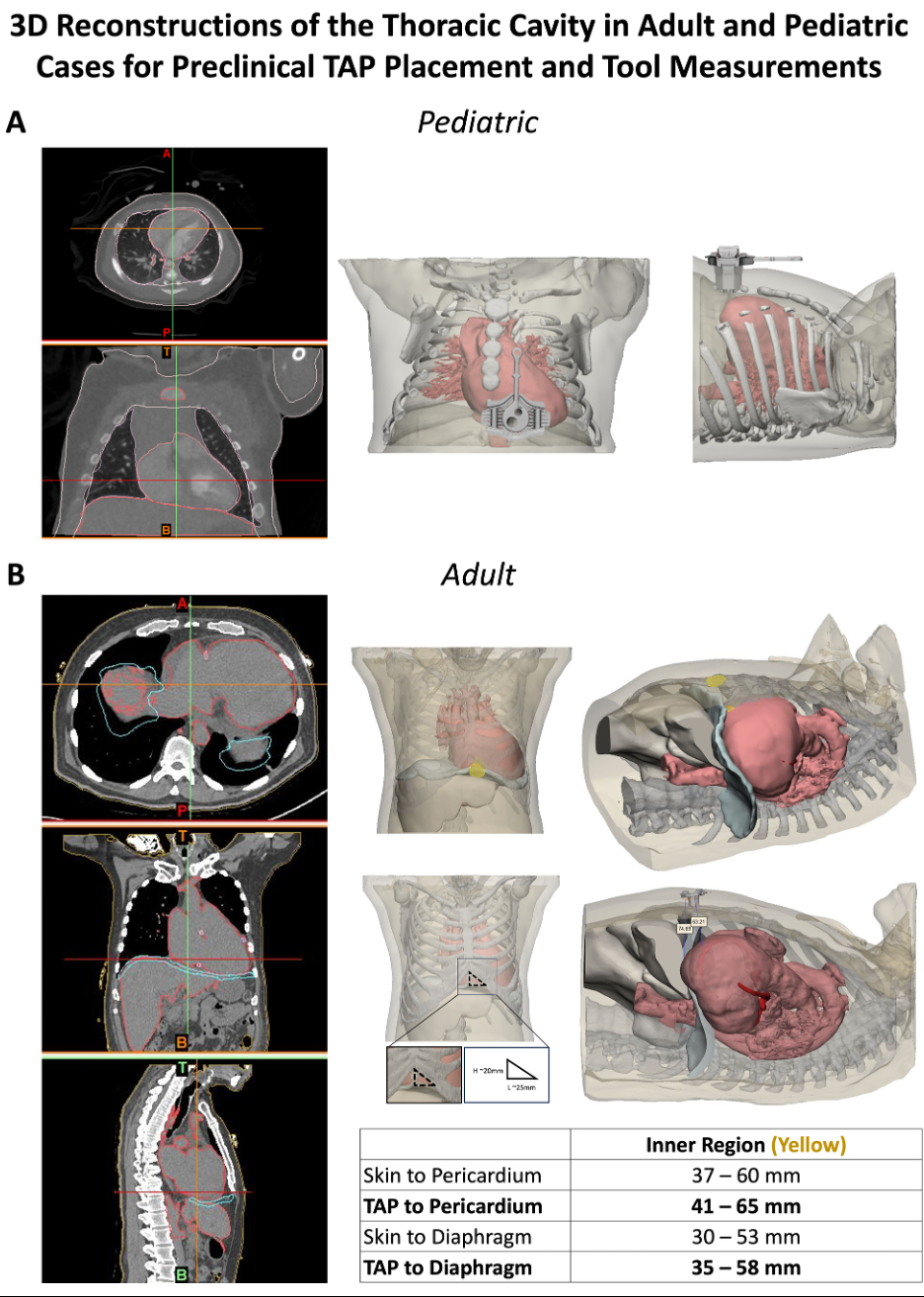
Patient-specific CT-based 3D reconstructions of the thoracic cavity (Fig.) were created for two patients unamenable for transvenous approach (one pediatric, one adult). Virtual PP placement just left of the subxiphoid process was performed. Anatomical measurements were taken to assess distances from PP to cardiac targets and surrounding structures, with the goal of identifying safe, direct trajectories to the epicardial surface. The pediatric patient was a 10-week-old full-term male with DILV, hypoplastic RV and aortic arch, and complete heart block. Temporary pacing was performed following a Norwood procedure until permanent pacemaker possible. The adult patient was a 5X-year-old man with unrepaired partial anomalous and sinus venosus ASD who had a complication from previously placed transvenous ICD. He was not a candidate for either commercial S-ICD or EV-ICD.
Results
In both models, PP placement offered a feasible, anatomically favorable trajectory to the anterior right ventricular epicardium. In the pediatric patient, the narrow thoracic cavity allowed unobstructed access without interference from bone or lung structures. In the adult patient with significant RV dilation and anomalous venous return, PP offered a viable route to epicardial targets and guide procedural planning.
Conclusion
Virtual surgical planning confirmed that PP placement is feasible in pediatric and adult CHD patients who are not candidates for transvenous systems. This approach may avoid sternotomy or thoracotomy while enabling less-invasive, targeted interventions. These findings support 3D modeling as a valuable tool for preoperative PP assessment and lay the groundwork for future clinical application in this high-risk population.
  • O'hara, Ryan  ( Children's National Hospital , Washington , District of Columbia , United States )
  • Clark, Bradley  ( University of Minnesota , Minneapolis , Minnesota , United States )
  • Opfermann, Justin  ( Johns Hopkins University , Balitmore , Maryland , United States )
  • Kumthekar, Rohan  ( Nationwide Children's Hospital , Columbus , Ohio , United States )
  • Berul, Charles  ( Children's National , Washington , District of Columbia , United States )
  • Author Disclosures:
    Ryan O'Hara: DO NOT have relevant financial relationships | Bradley Clark: DO have relevant financial relationships ; Ownership Interest:PeriCor, LLC:Active (exists now) ; Consultant:Medtronic, Inc:Active (exists now) | Justin Opfermann: No Answer | Rohan Kumthekar: No Answer | Charles Berul: No Answer
Meeting Info:

Scientific Sessions 2025

2025

New Orleans, Louisiana

Session Info:

Potpourri 2: Pediatric and Congenital Cardiology

Sunday, 11/09/2025 , 03:15PM - 04:15PM

Abstract Poster Board Session

More abstracts on this topic:
18F-FDG PET/CT Evaluation of Incidental Extracardiac CT Findings on 82Rb-Chloride PET Myocardial Perfusion Imaging

Dhaliwal Jasmeet, David Sthuthi, Puente Cesar, Nandakumar Menon, Sayre James, Zhong Jin, Berenji Gholam, Packard Rene

Late Gadolinium Enhancement-Derived Heart Digital Twins Non-Invasively Predict Ventricular Tachycardia Risk in Duchenne Muscular Dystrophy

Tso Justin, Dellefave-castillo Lisa, Villa Chet, Kertesz Naomi, Mcnally Elizabeth, Wagner Kathryn, Calkins Hugh, Leung Doris, Cripe Linda, Barth Andreas, Trayanova Natalia, Prakosa Adityo, Zhang Kelly, Kholmovski Eugene, Vasquez Nestor, Yanek Lisa, Beckman Brian, Bibat Genila, Yep Mary

You have to be authorized to contact abstract author. Please, Login
Not Available