Viscous Soluble Fiber Supplement Improves Glycemic Control but not Novel Cardiometabolic Markers in Type 2 Diabetes; A Randomized Control Trial
Abstract Body (Do not enter title and authors here): Introduction: Diabetes affected 529 million people globally by 2021, largely due to rising obesity contributing to Type 2 diabetes (DM2). In the U.S., it is the seventh leading cause of death and closely linked to cardiovascular disease, the leading cause of mortality in this population. Effective, low-cost strategies to improve glycemic and cardiometabolic health are essential. Psyllium, a viscous soluble fiber, has been shown to lower LDL cholesterol and improve glycemic indices, whereas non-viscous fibers like wheat dextrin lack similar benefits. Emerging lipid markers such as ceramides are associated with cardiometabolic risk but have not been studied in response to fiber. The interaction between fiber and GLP-1 agonists is also unclear.
Hypothesis: Psyllium supplementation will improve cardiometabolic markers more than wheat dextrin in people with DM2.
Methods: In this randomized trial at Mayo Clinic, adults with DM2 (HbA1c 6.5–10%) were randomized to psyllium or wheat dextrin for 12 weeks. Participants were recruited via electronic health records. Key exclusions: GI disease, bariatric surgery, steroid use, and pregnancy. Follow-up visits occurred at weeks 4, 8, and 12. Primary endpoints were changes in HbA1c and fasting glucose; secondary endpoints included lipids, ceramides, hsCRP, and BMI. An ex post facto analysis evaluated GLP-1 use. Primary analysis was intention-to-treat. Adherence = ≥85% dose completion.
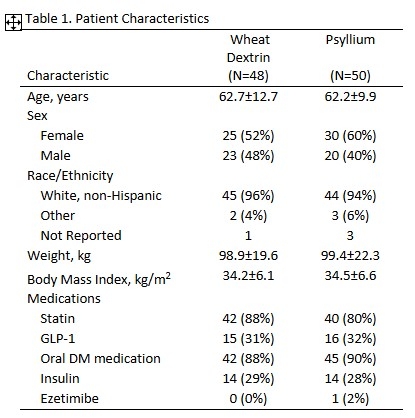
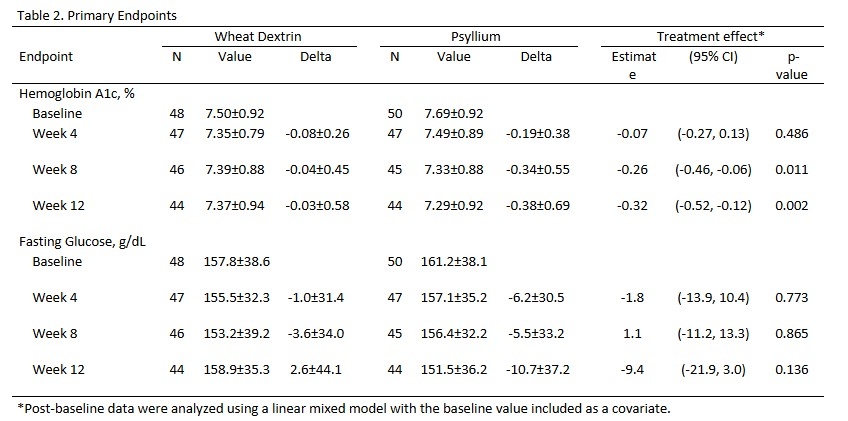
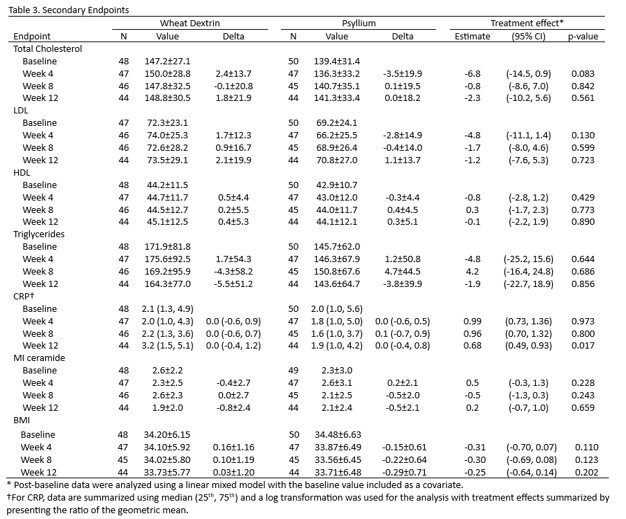
Results: Ninety-eight participants enrolled (Psyllium n=50, Dextrin n=48) with similar baseline characteristics. At 12 weeks, psyllium significantly reduced HbA1c (-0.38 ± 0.69, p=0.002). Among adherent users, HbA1c dropped further (-0.41 ± 0.70, p=0.001) with reduced fasting glucose (-14.5 ± 38.2, p=0.013). Wheat dextrin showed no benefit. In subgroup analysis, GLP-1 users on psyllium saw greater HbA1c reductions than non-users (-0.45 vs. -0.23), while GLP-1 users on dextrin had no change (+0.06). No significant changes were found in ceramides, lipids, or BMI in any analysis. CRP trended lower in adherent psyllium users (p=0.055).
Conclusion: Psyllium significantly reduced HbA1c over 12 weeks in DM2, especially in adherent and GLP-1–treated groups. Effects may be attributed to psyllium's ability to form a gel in the gastrointestinal tract, modulating nutrient absorption. No effects were seen on ceramides or lipids, likely due to low baseline levels in the latter. Psyllium appears to be a safe, accessible adjunct for glycemic control in DM2.
Neff, Rachel
(
Mayo Clinic
, Rochester , Minnesota , United States )
Theofiles, Meghan
(
Mayo Clinic
, Rochester , Minnesota , United States )
Lambeau, Kellen
(
Mayo Clinic
, Rochester , Minnesota , United States )
Wetherly, Renee
(
Mayo Clinic
, Rochester , Minnesota , United States )
Schmidt, Tyler
(
Mayo Clinic
, Rochester , Minnesota , United States )
Kopecky, Stephen
(
Mayo Clinic
, Rochester , Minnesota , United States )
Author Disclosures:
Rachel Neff:DO NOT have relevant financial relationships
| Meghan Theofiles:DO NOT have relevant financial relationships
| Kellen Lambeau:No Answer
| Renee Wetherly:No Answer
| Tyler Schmidt:No Answer
| Stephen Kopecky:No Answer
Anyetei-anum Grace Patrice, Kaihoi Brian, Kopecky Stephen, Leth Shawn, Malik Shaista, Marsteller Jill, Mathews Lena, Scales Robert, Shultz Adam, Taylor Bryan, Schulte Phillip, Abraham Helayna, Thomas Randal, Wong Nathan, Olson Thomas, Brewer Laprincess, Averkamp Natalie, Johnson Matthew, Krogman Ashton, Clark Donald, Echols Melvin, Hall Michael And Jo Alice, Hodgman Karen
4371452_File000000.jpg
4371452_File000001.jpg
4371452_File000002.jpg
You have to be authorized to contact abstract author. Please, Login