
Logo

American Heart Association

  23
  0


Final ID: MP244

A Trauma-Informed Approach to Patient Care

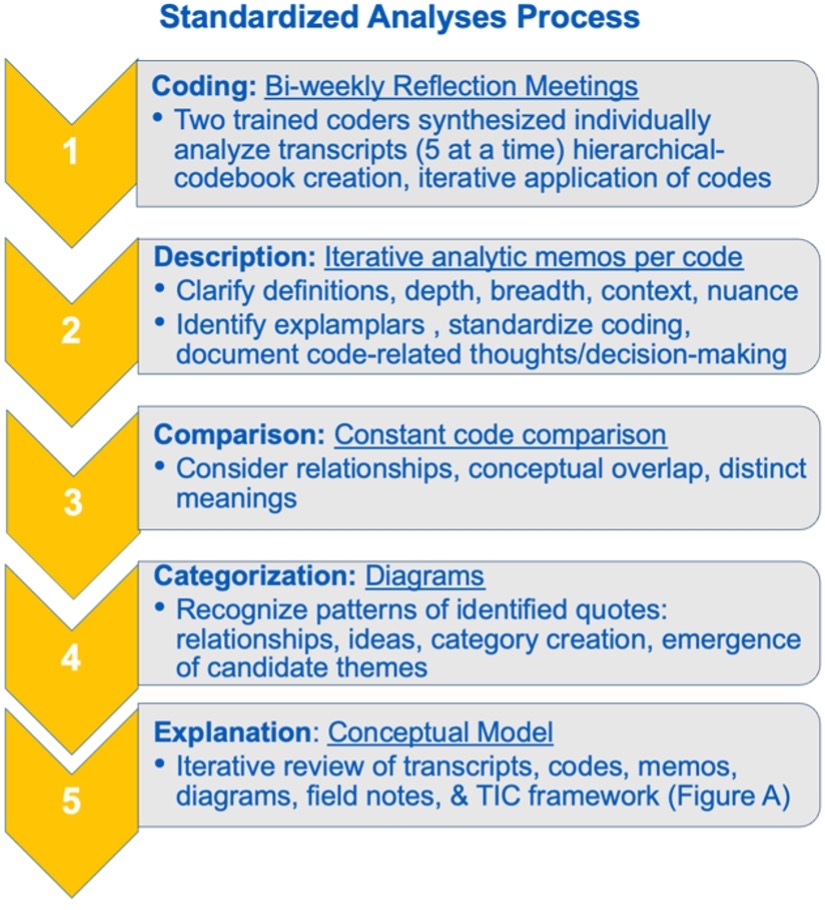
Abstract Body (Do not enter title and authors here): Introduction/Background: Advanced care planning (ACP) is a prophylactic decision-making process on potential palliative and end of life health care, which strengthens individualized patient autonomy and lessens suffering overall. Low-socioeconomic subsidized housing populations face increased morbidity, mortality, adverse childhood events, with decreased ACP rates and health access. Research Question: How would adult subsidized housing residents respond to the Substance Abuse and Mental Health Services Administration’s Trauma-Informed Framework (Trust and Transparency, Collaboration and Mutuality, Peer Support, Empowerment Voice and Choice, and Cultural/Historical/Gender Issues) to an ACP education intervention? Methods: A qualitative descriptive study included 15-minute semi-structured interview debriefs with n=30 participants in a subsidized housing community following Trauma Informed ACP education. Recorded audio was transcribed by an outlying source and uploaded to MAXQDA software for analysis. Two experienced coders coded five themes at a time meeting weekly reaching intercoder agreement and creation of a codebook. Lastly, themes are organized hierarchically and diagrammed appropriately illustrating distinct relationships. Results: Over half of participants (N=30) are black and male with a median age of 60. Major themes and subthemes were identified from direct participant quotations. The characteristics of People (Participant and Interventionist), components of the care Process (Communication, Personalization, Setting), resulted in specific Products (Trust, Safety, and Awareness and Empowerment). Participants emphasized the role of interventionist engagement and the environment as facilitators (trust, comfort, and safety) and barriers (fear, avoidance) to outcomes. Conclusion: Subsidized housing residents with low income voiced appreciation for the Trauma Informed Care approach to the ACP education and key themes and subthemes were identified. Application of the Trauma Informed Framework may prove beneficial in care for low socioeconomic cardio-oncology patient populations. Such individuals lacking social support and experiencing traumatic cancer journeys may positively impact patient engagment in outpatient settings. Further research is recommended to explore the impact of trauma informed personalization of care on patient receptivity for difficult conversations and health outcomes in cardio-oncology.
  • Finamore, Victoria  ( Vanderbilt Ingram Cancer Center , Nashville , Tennessee , United States )
  • Author Disclosures:
    Victoria Finamore: DO NOT have relevant financial relationships
Meeting Info:

Scientific Sessions 2025

2025

New Orleans, Louisiana

More abstracts on this topic:
A Meta-analysis of the Right Ventricle Changes in Cancer Therapy-Induced Cardiotoxicity - The Forgotten Ventricle in Cardio-Oncology

De Oliveira Fischer Bacca Caroline, Huntermann Ramon, Gomes Rodrigo, Alexandrino Francisco, Yoshie Sato Mariane, De Sant Anna Melo Edielle

A Clinical Trial of Healthy Food Subsidies and Behavioral Interventions to Increase Fruit and Vegetable Purchasing in an Online Store

Hua Sophia, Klaiman Tamar, Dixon Erica, Volpp Kevin, Putt Mary, Coratti Samantha, White Jenna, Hossain Mohammad, Posner Hannah, Wang Erkuan, Zhu Jingsan, John Aileen

You have to be authorized to contact abstract author. Please, Login
Not Available