Logo

American Heart Association

  24
  0


Final ID: Sa2028

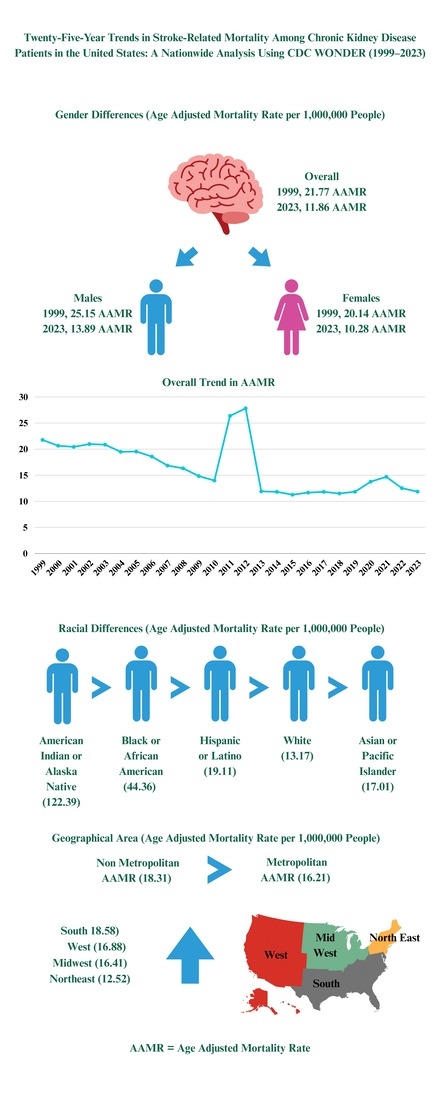
Twenty-Five-Year Trends in Stroke-Related Mortality Among Chronic Kidney Disease Patients in the United States: A Nationwide Analysis Using CDC WONDER (1999–2023)

Abstract Body (Do not enter title and authors here):
Abstract:
Background: Globally, more than 350 million people are affected by chronic kidney disease (CKD), a sinister condition associated with poor cerebrovascular outcomes, such as stroke. They share a number of risk factors, including diabetes mellitus (DM) and hypertension (HTN). The co-occurrence of CKD and stroke are responsible for higher mortality rates and soaring healthcare costs for affectees. The limited understanding of multi-decade linear national mortality trends among stroke patients with CKD leaves a lot to be desired. With an emphasis on socio-demographic stratification and regional inequalities, this study assesses nation-wide trends in mortality among individuals with co-occurring CKD and stroke in the United States (U.S.), from 1999 to 2023.
Methods: Death certificate information from the Centers for Disease Control and Prevention Wide-Ranging Online Data for Epidemiologic Research (CDC WONDER) multiple cause of death database was used in this retrospective observational research. N18 (CKD) and I64 (stroke) were the ICD-10 codes utilized to identify our targeted individuals. We computed and stratified data on the basis of age, sex, race/ethnicity, geographic location and degree of urbanization, to get the age-adjusted mortality rates (AAMR) per 1,000,000 people. The study employed Joinpoint regression to estimate annual percentage changes (APC) with 95% confidence intervals and assess temporal patterns.
Results: The overall mortality rate associated with CKD in stroke patients dropped from 1999 to 2009. It was followed by a period of growth till 2012. A short period of decline (2013-2015) was followed by a progressive increase till 2023 again. The trend for male patients showed a steady decline. However, we note that the temporal swings for women were greater. The highest AAMRs were seen among non-Hispanic (NH) Black people and older persons. Similarly, the non-metropolitan areas and regions in the South were affected to a greater degree. Disparities based on sex, race and geography were persistent over the study period.
Conclusion: The co-existence of stroke and CKD mortality exhibits a complicated temporal pattern with periods of growth and decline. This is underpinned by persistent differences in trends based on geographical and demographic disparities. Our conclusions arrive at the necessity of a targeted public health approach, geared towards reducing the persistent disparities and systemic inequities.
  • Qureshi, Ahmar Jan  ( CMH Institute of Medical Sciences Multan , Multan , Punjab , Pakistan )
  • Saleem, Sehar  ( CMH Institute of Medical Sciences Multan , Multan , Punjab , Pakistan )
  • Butt, Usamah  ( Detroit Medical Center, Wayne State University , Detroit , Michigan , United States )
  • Ashraf, Usama  ( Allied Hospital, Faisalabad , Faisalabad , Pakistan )
  • Singh, Pramod  ( Barabise Primary Health Care Centre, Nepal , Barabise , Nepal )
  • Tariq Tagga, Muhammad Riyyan  ( CMH Institute of Medical Sciences Multan , Multan , Punjab , Pakistan )
  • Athar, Maryam  ( Dow University of Health Sciences , Karachi , Pakistan )
  • Shuja, Hafsa  ( Jinnah Sindh Medical University , Karachi , Pakistan )
  • Wamiq, Umer  ( Jinnah Sindh Medical University , Karachi , Pakistan )
  • Faisal, Abdul Rafae  ( CMH Institute of Medical Sciences Multan , Multan , Punjab , Pakistan )
  • Hafeez, Ali Shan  ( CMH Institute of Medical Sciences Multan , Multan , Punjab , Pakistan )
  • Zaman, Asad  ( CMH Institute of Medical Sciences Multan , Multan , Punjab , Pakistan )
  • Fatima, Waliya  ( CMH Institute of Medical Sciences Multan , Multan , Punjab , Pakistan )
  • Author Disclosures:
    Ahmar Jan Qureshi: DO NOT have relevant financial relationships | Sehar Saleem: No Answer | Usamah Butt: DO NOT have relevant financial relationships | usama ashraf: No Answer | pramod singh: No Answer | Muhammad Riyyan Tariq Tagga: DO NOT have relevant financial relationships | Maryam Athar: DO NOT have relevant financial relationships | Hafsa Shuja: No Answer | Umer Wamiq: DO NOT have relevant financial relationships | Abdul Rafae Faisal: DO NOT have relevant financial relationships | Ali Shan Hafeez: DO NOT have relevant financial relationships | Asad Zaman: DO NOT have relevant financial relationships | Waliya Fatima: No Answer
Meeting Info:

Scientific Sessions 2025

2025

New Orleans, Louisiana

Session Info:

Kidney Health as a Determinant of Cardiovascular Health: Risk, Outcome Trends and Therapeutic Approaches

Saturday, 11/08/2025 , 10:30AM - 11:30AM

Abstract Poster Board Session

More abstracts on this topic:
Acute Effects of Isometric Handgrip Exercise on Cardiac Baroreflex Sensitivity in Chronic Kidney Disease

Sabino-carvalho Jeann, Park Jeanie

A machine learning approach to classifying ischemic stroke etiology using variables available in the Get-with-the-Guidelines Stroke Registry

Lee Ho-joon, Schwamm Lee, Turner Ashby, De Havenon Adam, Kamel Hooman, Brandt Cynthia, Zhao Hongyu, Krumholz Harlan, Sharma Richa

More abstracts from these authors:
Trends in Lipoprotein Metabolism Disorder–Associated Cerebrovascular Disease Mortality in the United States, 1999–2023: An Analysis from the CDC WONDER Database

Zaman Asad, Faizan Muhammad, Ashraf Usama, Singh Pramod, . Abdullah, Aamir Zoya, Butt Usamah, Qureshi Ahmar Jan, Ashraf Saad, Tariq Tagga Muhammad Riyyan, Hafeez Ali Shan, Faisal Abdul Rafae

Mortality Trends in Hypertensive Older Adults with Stroke: A CDC WONDER-Based Analysis (2000–2023)

Kumar Laksh, Ullah Irfan, Hafeez Ali Shan, Ali Talha, Ashraf Saad, Sakarwala Aasiya Shahbaz, Zaman Asad, Tagga Muhammad Riyyan, Qureshi Ahmar Jan, Khan Abdul Wali

You have to be authorized to contact abstract author. Please, Login
Not Available