
Logo

American Heart Association

  17
  0


Final ID: MP957

Contemporary Use Of Parenteral Prostacyclin Administration In Pulmonary Artery Hypertension

Abstract Body (Do not enter title and authors here): Background. Group 1 pulmonary artery hypertension (PAH) is treated with three main drug classes: prostacyclin analogs (PCAs), endothelin receptor antagonists, and nitric oxide pathway drugs. PCAs may be administered via parenteral (intravenous (IV), subcutaneous (SQ)) or oral/inhaled routes. The role of parenteral versus non-parenteral PCAs in contemporary PH practice remains unclear.
Objectives. To compare contemporary hemodynamic and survival outcomes between parenteral and non-parenteral PCA use.
Methods. This retrospective study included patients with WHO Group 1 PAH, who underwent a right heart catheterization (RHC) at Mayo Clinic. Diagnosis required mPAP was ≥25 mm Hg, documented chart diagnosis and initiation of PAH therapy. Echocardiographic and repeat RHC parameters were collected and only patients started on PCA therapy were included. Patients were grouped based on intiiated PCA route: parenteral (IV/SQ) vs non-parenteral routes (oral/inhaled). Hemodynamic changes (post-pretreatment) were compared using t-tests and ANOVA for parenteral vs non-parenteral PCA. Survival was assessed using Kaplan-Meier curves, and Cox proportional hazards models.
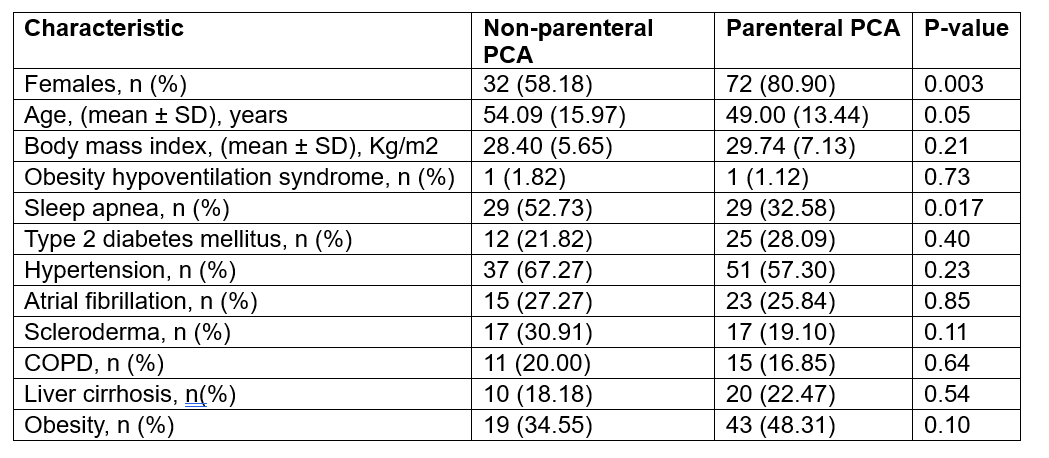
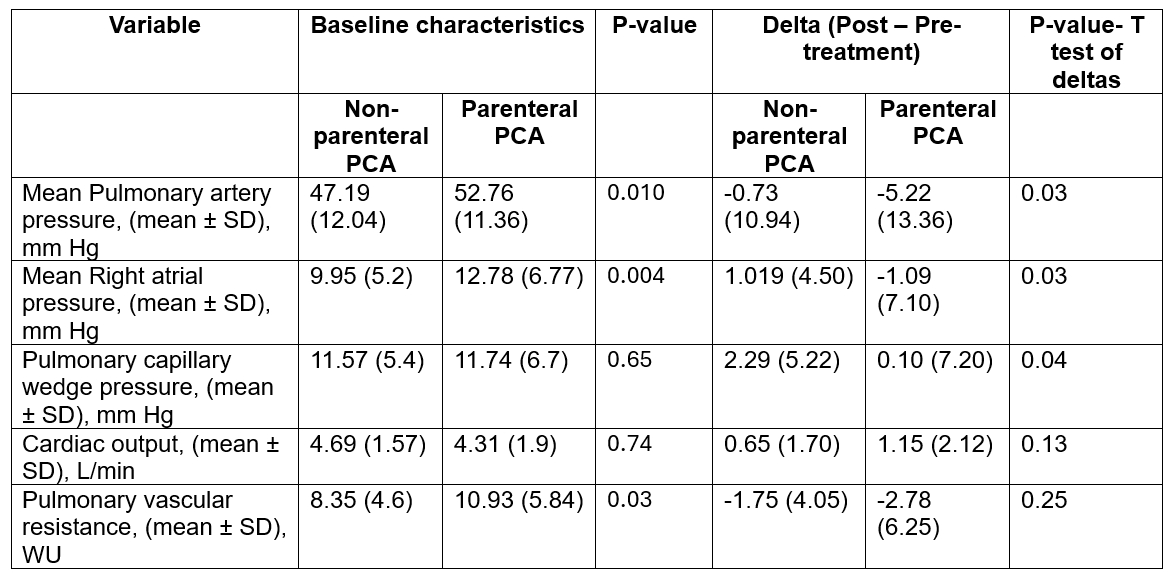
Results. Of 144 patients initiated on PCA after the first RHC, 89 (62%) received parenteral and 55 (38%) non-parenteral PCA.. At baseline, patients who started on parenteral PCA had more severe disease with higher mean PAP, RAP and PVR. On follow-up, parenteral PCAs led to greater reductions in mean PAP and RAP, with no differences in PVR, TPR, or CO changes. Survival was worse with parenteral PCA use even after adjusting for comorbidities and baseline hemodynamics (HR 1.93; 95% CI 1.17-3.18; p=0.009).
Discussion. Parenteral PCAs were more often used in patients with more severe pulmonary vascular disease. Despite greater hemodynamic improvements, parenteral PCAs were associated with worse survival, likely due to more severe disease at baseline. Further research is needed to understand the role of PCA route in guiding treatment strategies.
  • Varma, Revati  ( John H Stroger Hospital , Chicago , Illinois , United States )
  • Reddy, Yogesh  ( Mayo Clinic , Rochester , Minnesota , United States )
  • Author Disclosures:
    Revati Varma: DO NOT have relevant financial relationships | Yogesh Reddy: DO NOT have relevant financial relationships
Meeting Info:

Scientific Sessions 2025

2025

New Orleans, Louisiana

Session Info:

Clinical Decision Making in Pulmonary Hypertension: Navigating the Evolving Landscape

Saturday, 11/08/2025 , 12:15PM - 01:30PM

Moderated Digital Poster Session

More abstracts on this topic:
A refined definition for low-risk pulmonary arterial hypertension patients including mortality and morbidity

Fauvel Charles, Liu Yongqi, Correa-jaque Priscilla, Everett Allen, Kanwar Manreet, Vanderpool Rebecca, Sahay Sandeep, Lin Shili, Benza Raymond

A Novel Cardiac Simulator "ped UT-Heart" to Support Decision-Making in Surgical Procedures for Complex Congenital Heart Disease

Shiraishi Isao, Kurosaki Kenichi, Iwai Shigemitsu, Washio Takumi, Sugiura Seiryo, Hisada Toshiaki

You have to be authorized to contact abstract author. Please, Login
Not Available