
Logo

American Heart Association

  19
  0


Final ID: MP2336

Deep Learning Segmentation for Automated Measurement of Infarct Size in Preclinical Myocardial Infarction Models

Abstract Body (Do not enter title and authors here): Introduction: Myocardial infarct size (IS) is the most robust endpoint for evaluating cardioprotective strategies in preclinical ischemia/reperfusion studies. The gold standard for IS quantification in preclinical studies (triphenyl tetrazolium chloride (TTC) staining) is traditionally performed manually and is prone to inter-operator variability. Here, we propose a deep learning segmentation pipeline to automate IS quantification in TTC-stained rat heart sections.
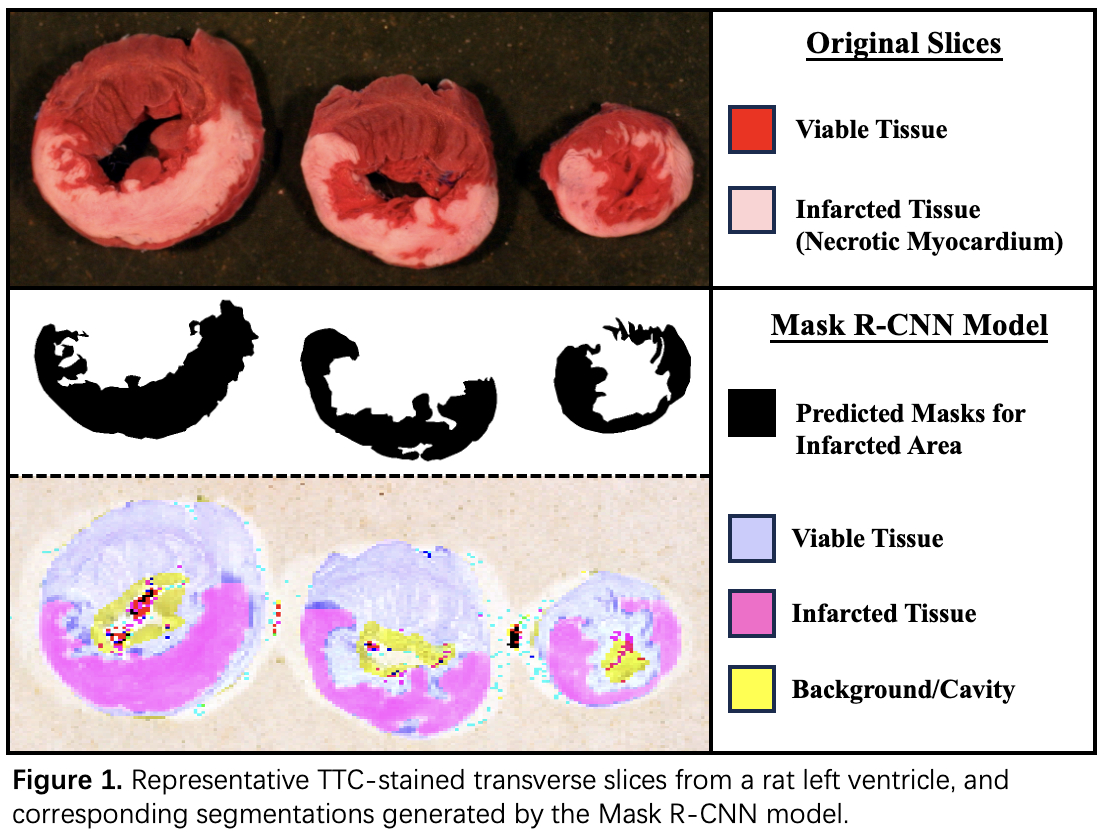
Methods: We used n=165 Sprague-Dawley rats (150–300 g, 1–2 months, 69% female). Myocardial infarction (MI) was induced using a standard occlusion/reperfusion model by occluding the proximal left coronary artery for 30 minutes, followed by 3 hours of reperfusion. After euthanasia, the left ventricle (LV) was excised, transversely sliced, and incubated in 1% TTC at 37 °C for 15 minutes to distinguish necrotic myocardium (pale white) from viable tissues (brick red, Fig. 1). Manual IS was quantified by contouring infarcted and total LV areas in each slice using ImageJ (NIH, USA). To automate the IS measurement from TTC-stained heart slices, we implemented a deep learning segmentation pipeline based on the mask region-based convolutional neural network (Mask R-CNN) architecture. Ground truth masks for infarcted regions and LV area were created using VGG Image Annotator. Images from n=140 rats were used for training, as well as an additional 1,400 images generated by data augmentation. All training and preprocessing pipelines were conducted in Python. Dice similarity coefficient (Dice score) was used to evaluate the model performance. The best-performing Mask R-CNN model was blindly tested on 25 additional MI rats.
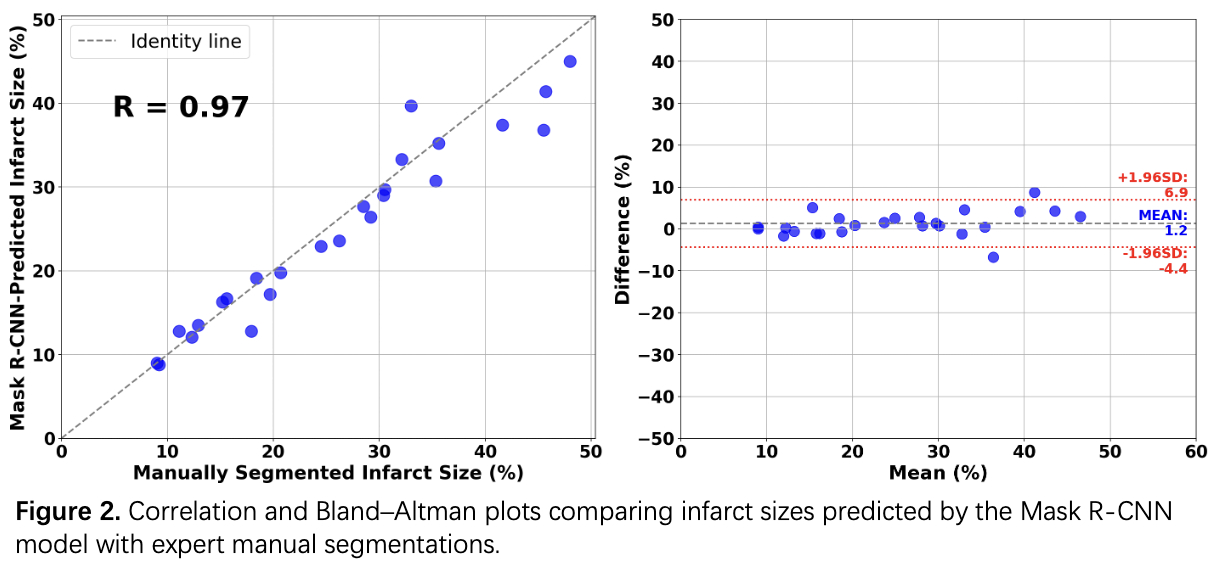
Results: Infarct sizes calculated from Mask R-CNN-generated segmentations showed strong agreement with the ones from expert-annotated manual segmentations from TTC-stained LV slices (R = 0.97, p < 0.0001) when tested on heart slices from 25 additional MI rats, supporting the model’s accuracy and validity.
Conclusions: Our results demonstrate that deep learning segmentation accurately and automatically quantifies infarct size from TTC-stained images without operator input. This automated approach is rapid, reproducible, and unbiased, significantly reducing inter-operator variability and manual workload in preclinical studies. By streamlining infarct size assessment in preclinical cardio-protection studies, it has the potential to improve consistency and translational value in cardiac research.
  • Alavi, Rashid  ( Caltech , Los Angeles , California , United States )
  • Li, Jiajun  ( University of Southern California , Los Angeles , California , United States )
  • Lin, Jason  ( HMRI , Pasadena , California , United States )
  • Dai, Wangde  ( HMRI , Pasadena , California , United States )
  • Pahlevan, Niema  ( University of Southern California , Los Angeles , California , United States )
  • Gharib, Morteza  ( California Institute of Technology , Pasadena , California , United States )
  • Kloner, Robert  ( Huntington Medical Research Inst. , Pasadena , California , United States )
  • Author Disclosures:
    Rashid Alavi: DO NOT have relevant financial relationships | Jiajun Li: DO NOT have relevant financial relationships | Jason Lin: No Answer | Wangde Dai: No Answer | Niema Pahlevan: DO have relevant financial relationships ; Consultant:Avicena LLC (Ventric Health):Active (exists now) ; Ownership Interest:Avicena LLC (Ventric Health):Active (exists now) | Morteza Gharib: No Answer | Robert Kloner: DO have relevant financial relationships ; Consultant:Hoskinson Health Clinic:Active (exists now)
Meeting Info:

Scientific Sessions 2025

2025

New Orleans, Louisiana

Session Info:

AI-Powered Multimodal Imaging and ECG for Disease-Specific Diagnostics

Monday, 11/10/2025 , 12:15PM - 01:25PM

Moderated Digital Poster Session

More abstracts on this topic:
A Machine Learning Readmission Risk Prediction Model for Cardiac Disease

Bailey Angela, Wang Wei, Shannon Clarence, Huling Jared, Tignanelli Christopher

AI-Derived Cardiac Morphometrics from CAC CT for Heart Failure Risk Prediction

Alkhaleefah Mohammad, Balakrishnan Guha, Li Shuo, Nasir Khurram, Al-kindi Sadeer, Gullapelli Rakesh, Bose Budhaditya, Rockers Elijah, Modanwal Gourav, Hoori Ammar, Madabhushi Anant, Wilson David, Patel Kershaw

More abstracts from these authors:
A Novel ECG Time-Frequency Eyeball Method for Robust Detection of Myocardial Infarction from Single-Channel ECG: A Preclinical Study

Alavi Rashid, Li Jiajun, Dai Wangde, Matthews Ray, Pahlevan Niema, Kloner Robert, Gharib Morteza

Alterations in Heart Rate Variability After Ischemic Stroke in Rats: Heart-Brain Connectivity

Alavi Rashid, Dai Wangde, Li Jiajun, Carreno Juan, Pahlevan Niema, Arakaki Xianghong, Gharib Morteza, Kloner Robert

You have to be authorized to contact abstract author. Please, Login
Not Available