
Logo

American Heart Association

  13
  0


Final ID: MP2411

Prognostic Utility of Exercise Pulmonary Artery Pulse Pressure in Ambulatory Patients with Heart Failure with Preserved Ejection Fraction

Abstract Body (Do not enter title and authors here): Introduction:
Exercise testing has been proven to improve phenotypic resolution and risk stratification in patients with heart failure with preserved ejection fraction (HFpEF). We hypothesized that exercise pulmonary artery pulse pressure (PA PP) has the potential to differentiate HFpEF disease states and predict outcomes.

Methods:
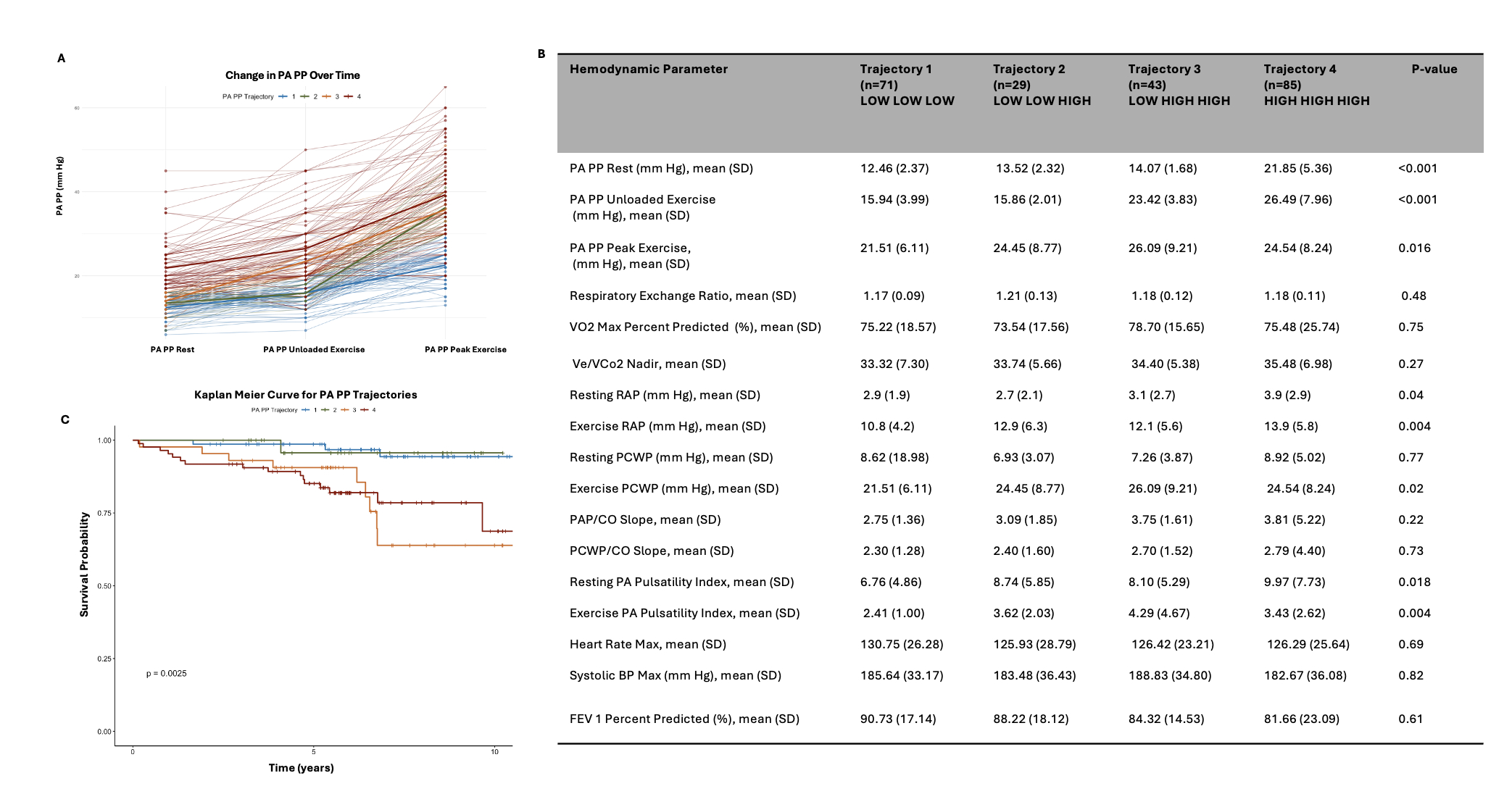
In a single-center cohort of patients referred for invasive cardiopulmonary exercise testing, we identified patients with hemodynamically confirmed HFpEF (resting pulmonary capillary wedge pressure (PCWP) ≥ 15 mmHg or PCWP/cardiac output (CO) slope > 2 mmHg/L/min, and left ventricular ejection fraction > 50%). Patients with respiratory exchange ratio < 1 indicating submaximal exercise and < 2 years of follow-up were excluded. We measured PA PP at 3 time points: rest, end of unloaded exercise, and peak exercise. Patients were categorized as having a low versus high PA PP at each time point based on the median value of our cohort, as no cutoff values for PA PP have been defined in the literature thus far. We identified four distinct phenotypes based on PA PP at each time point: Low-Low-Low (Trajectory 1, n=71); Low-Low-High (Trajectory 2, n=29); Low-High-High (Trajectory 3, n=43); and High-High-High (Trajectory 4, n=85) (Figure Panel A). Survival was assessed by Kaplan-Meier analysis and Cox proportional hazards analysis adjusted for age, sex, body mass index, peak oxygen consumption, and ventilation/carbon dioxide production slope.

Results:
Baseline characteristics were similar across PA PP trajectories. Rest and exercise hemodynamics are shown in Panel B. We found that higher PA PP trajectory was associated with worse survival (log rank p=0.0025, Panel C). Specifically, survival in patients who had a rise in PA PP at the end of unloaded exercise (Trajectory 3) was similar to patients with high PA PP throughout (Trajectory 4). In a multivariate Cox proportional hazards model, PA PP trajectory remained a significant predictor of survival (HR 1.58, 95% CI [1.12-2.25], p=0.009).

Conclusion:
We identified four clinically distinct phenotypes of HFpEF based on PA PP trajectory during exercise. In our single-center cohort, exercise PA PP trajectory predicted all-cause mortality in hemodynamically defined HFpEF and may be an early indicator of abnormal pulmonary vasculature. Future studies are needed to correlate PA PP with known measures of ventricular-vascular coupling.
  • Ramesh, Ashvita  ( Massachusetts General Hospital , Boston , Massachusetts , United States )
  • Landsteiner, Isabela  ( MASSACHUSETTS GENERAL HOSPITAL , Boston , Massachusetts , United States )
  • Malhotra, Rajeev  ( MASSACHUSETTS GENERAL HOSPITAL , Boston , Massachusetts , United States )
  • Lewis, Gregory  ( MASSACHUSETTS GENERAL HOSPITAL , Boston , Massachusetts , United States )
  • Yang, Bin  ( MASSACHUSETTS GENERAL HOSPITAL , Boston , Massachusetts , United States )
  • Author Disclosures:
    Ashvita Ramesh: DO NOT have relevant financial relationships | Isabela Landsteiner: DO NOT have relevant financial relationships | Rajeev Malhotra: DO have relevant financial relationships ; Consultant:Pharmacosmos:Active (exists now) ; Consultant:Rocket Pharma:Active (exists now) ; Royalties/Patent Beneficiary:CardioText:Active (exists now) ; Royalties/Patent Beneficiary:Up to Date:Active (exists now) ; Research Funding (PI or named investigator):Ledicq Foundation:Active (exists now) ; Research Funding (PI or named investigator):AHA:Active (exists now) ; Research Funding (PI or named investigator):NHLBI:Active (exists now) ; Research Funding (PI or named investigator):Amgen:Active (exists now) ; Royalties/Patent Beneficiary:Keros Therapeutics:Active (exists now) ; Consultant:Epizon Pharma:Active (exists now) ; Consultant:Third Pole:Past (completed) ; Consultant:MyoKardia/BMS:Active (exists now) ; Consultant:Kardigan:Active (exists now) | Gregory Lewis: No Answer | Bin Yang: No Answer
Meeting Info:

Scientific Sessions 2025

2025

New Orleans, Louisiana

Session Info:

Stiff Hearts, Big Questions: HFpEF from Molecules to Management

Monday, 11/10/2025 , 12:15PM - 01:30PM

Moderated Digital Poster Session

More abstracts on this topic:
Characterizing Exercise-Induced Myocardial Perfusion Response in Hypertrophic Cardiomyopathy and Heart Failure with Preserved Ejection Fraction

Schulz Alexander, Nezafat Reza, Wallace Tess, Ghanbari Fahime, Rodriguez Jennifer, Chow Kelvin, Kellman Peter, Rowin Ethan, Maron Martin, Manning Warren

Effect of Medical-Grade Mask Use on Exercise Physiology in Healthy Adults: A Randomized Crossover Study

Lee Ju-hee, Lee Goo Joo, Kang Mingyu, Eom Sang Yong

More abstracts from these authors:
Interaction of Multiorgan Reserve Components Contributing to Exercise Intolerance in Heart Failure Patients: A Clinical Profiling Study

Landsteiner Isabela, Campain Joseph, Griskowitz Catharine, Malhotra Rajeev, Lewis Gregory

Hemodynamic Determinants of Exercise Oxygen Uptake in Patients with Heart Failure with Preserved Ejection Fraction and Obesity

Ikoma Takenori, Lewis Gregory, Newlands Chloe, Mcginnis Shaina, Minasian Alexandra, Moreno Fabely, Iskenderian Nicholas, Gupta Paridhi, Landsteiner Isabela, Malhotra Rajeev

You have to be authorized to contact abstract author. Please, Login
Not Available