Logo

American Heart Association

  15
  0


Final ID: MP2413

Hemodynamic Determinants of Exercise Oxygen Uptake in Patients with Heart Failure with Preserved Ejection Fraction and Obesity

Abstract Body (Do not enter title and authors here): Background
Severely limited exercise tolerance is a hallmark of patients with heart failure with preserved ejection fraction (HFpEF) and obesity. Stroke volume (SV) and heart rate (HR) rise coordinately during exertion, thereby increasing oxygen uptake (VO2). However, how obesity modifies the relative contributions of these VO2 component variables remains unclear.
Hypothesis
In patients with HFpEF, the augmentation of VO2 to meet the metabolic demands of exercise—as reflected by relative increases in SV and HR—differs according to the presence or absence of obesity.
Methods
We retrospectively analyzed 393 patients with HFpEF who underwent invasive cardiopulmonary exercise testing (iCPET), comprised of CPET with simultaneous invasive hemodynamic monitoring, at Massachusetts General Hospital. We calculated the changes in direct Fick stroke volume (△SV) and heart rate (△HR) from rest to peak exercise from the iCPET data. The primary analysis examined the association between body-mass index (BMI) and the natural-log–transformed SV-to-HR augmentation ratio [ln(△SV/△HR)]. We also computed the change in O2 pulse (VO2/HR) from rest to peak exercise (△O2 pulse) and evaluated its associations with both BMI and ln(△SV/△HR) to determine whether O2 pulse can serve as a noninvasive surrogate to derive relative SV vs. HR augmentation patterns.
Results
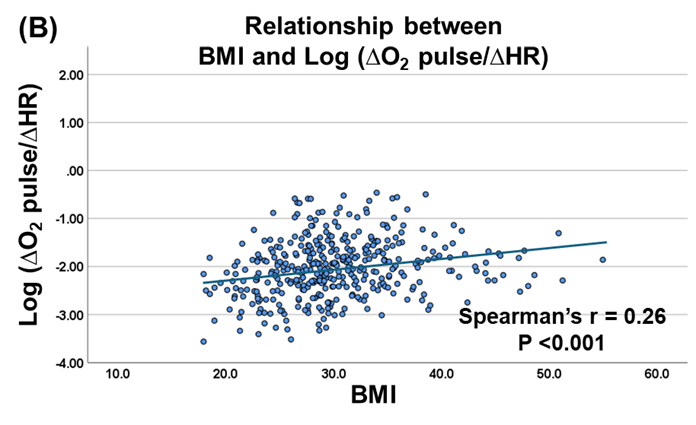
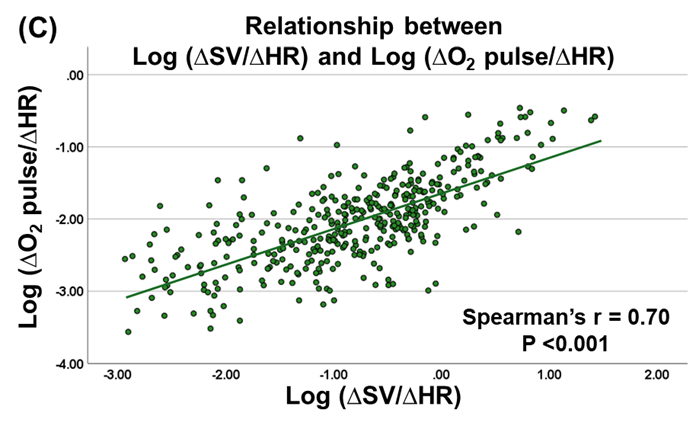
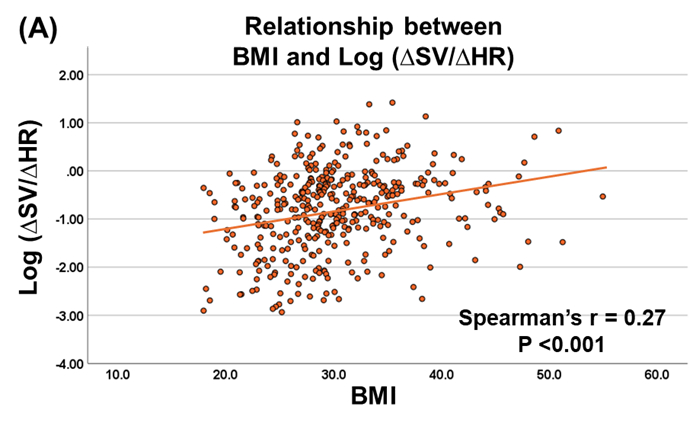
The cohort’s median age was 65 years, and 52.4 % were female. Median BMI was 29.3 kg/m2, with 43.5% classified as obese (BMI ≧ 30 kg/m2). BMI correlated positively with ln(△SV/△HR) (r = 0.27, P <0.001). Median ln(△SV/△HR) was −0.90 (IQR −1.61 to -0.32) in non-obese versus −0.53 (IQR −1.02 to -1.12) in obese patients, indicating a more predominant SV reserve in the obese HFpEF group (P <0.001). Across the cohort, ln(△O2 pulse/△HR) was also positively associated with BMI (r = 0.26, P <0.001) and had moderately strong correlation with ln(△SV/△HR) (r = 0.70, P <0.001).
Conclusions
In patients with HFpEF, obesity is linked to a hemodynamic shift toward greater reliance on SV reserve and diminished HR contribution during exercise. Moreover, O2 pulse appears to be a practical non-invasive surrogate for SV. These findings have implications for exercise-based phenotyping and individualized interventions that aim to augment exercise capacity in obese HFpEF populations.
  • Ikoma, Takenori  ( Massachusetts General Hospital , Boston , Massachusetts , United States )
  • Lewis, Gregory  ( Massachusetts General Hospital , Boston , Massachusetts , United States )
  • Newlands, Chloe  ( Massachusetts General Hospital , Boston , Massachusetts , United States )
  • Mcginnis, Shaina  ( Massachusetts General Hospital , Boston , Massachusetts , United States )
  • Minasian, Alexandra  ( Massachusetts General Hospital , Boston , Massachusetts , United States )
  • Moreno, Fabely  ( Massachusetts General Hospital , Boston , Massachusetts , United States )
  • Iskenderian, Nicholas  ( Massachusetts General Hospital , Boston , Massachusetts , United States )
  • Gupta, Paridhi  ( Massachusetts General Hospital , Boston , Massachusetts , United States )
  • Landsteiner, Isabela  ( Massachusetts General Hospital , Boston , Massachusetts , United States )
  • Malhotra, Rajeev  ( Massachusetts General Hospital , Boston , Massachusetts , United States )
  • Author Disclosures:
    Takenori Ikoma: DO NOT have relevant financial relationships | Gregory Lewis: No Answer | Chloe Newlands: DO NOT have relevant financial relationships | Shaina McGinnis: No Answer | Alexandra Minasian: DO NOT have relevant financial relationships | Fabely Moreno: DO NOT have relevant financial relationships | Nicholas Iskenderian: DO NOT have relevant financial relationships | Paridhi Gupta: No Answer | Isabela Landsteiner: DO NOT have relevant financial relationships | Rajeev Malhotra: DO have relevant financial relationships ; Consultant:Pharmacosmos:Active (exists now) ; Consultant:Rocket Pharma:Active (exists now) ; Royalties/Patent Beneficiary:CardioText:Active (exists now) ; Royalties/Patent Beneficiary:Up to Date:Active (exists now) ; Research Funding (PI or named investigator):Ledicq Foundation:Active (exists now) ; Research Funding (PI or named investigator):AHA:Active (exists now) ; Research Funding (PI or named investigator):NHLBI:Active (exists now) ; Research Funding (PI or named investigator):Amgen:Active (exists now) ; Royalties/Patent Beneficiary:Keros Therapeutics:Active (exists now) ; Consultant:Epizon Pharma:Active (exists now) ; Consultant:Third Pole:Past (completed) ; Consultant:MyoKardia/BMS:Active (exists now) ; Consultant:Kardigan:Active (exists now)
Meeting Info:

Scientific Sessions 2025

2025

New Orleans, Louisiana

Session Info:

Stiff Hearts, Big Questions: HFpEF from Molecules to Management

Monday, 11/10/2025 , 12:15PM - 01:30PM

Moderated Digital Poster Session

More abstracts on this topic:
More abstracts from these authors:
Evaluation of the Prognostic Value of Resting Fick and Thermodilution Cardiac Output and Exercise Cardiac Output Measurements in Heart Failure

Iskenderian Nicholas, Wallace Dayquan, Ikoma Takenori, Malhotra Rajeev, Lewis Gregory, Landsteiner Isabela, Minasian Alexandra, Gupta Paridhi, Moreno Fabely, Newlands Chloe, Mcginnis Shaina, Rouvina Jennifer, Oloughlin Joseph

Feasibility and Reproducibility of Cardiopulmonary Exercise Testing with Addition of Invasive Hemodynamics

Landsteiner Isabela, Malhotra Rajeev, Lewis Gregory, Newlands Chloe, Griskowitz Catharine, Mcginnis Shaina, Minasian Alexandra, Moreno Fabely, Campain Joseph, Ikoma Takenori, Rouvina Jennifer

You have to be authorized to contact abstract author. Please, Login
Not Available