
Logo

American Heart Association

  19
  0


Final ID: MP467

Sex-Based Differences in Atrial Fibrillation Catheter Ablation among Patients with Heart Failure

Abstract Body (Do not enter title and authors here): Introduction: Clinical trial data and professional guidelines support rhythm control strategies over rate control in patients with comorbid atrial fibrillation (AF) and heart failure (HF). Studies have also shown that males and females experience differences in symptom burden, comorbidities, management strategies, and outcomes. Catheter ablation utilization between sex has not been well described.

Research Questions: We sought to analyze rates of catheter ablation for comorbid AF and HF by patient-reported sex.

Methods: Using the Epic Cosmos database, which provides nationally-representative data by combining electronic health record data from over 1,500 electronic health record systems, we examined trends in catheter ablation rates over time, stratified by sex. Patients were identified if they had at least two encounters between 2015 and 2024 with ICD-10 codes for each of AF and HF. The primary outcome was catheter ablation for AF. Patients were followed until the outcome of interest or 12/31/2024, whichever was earlier.

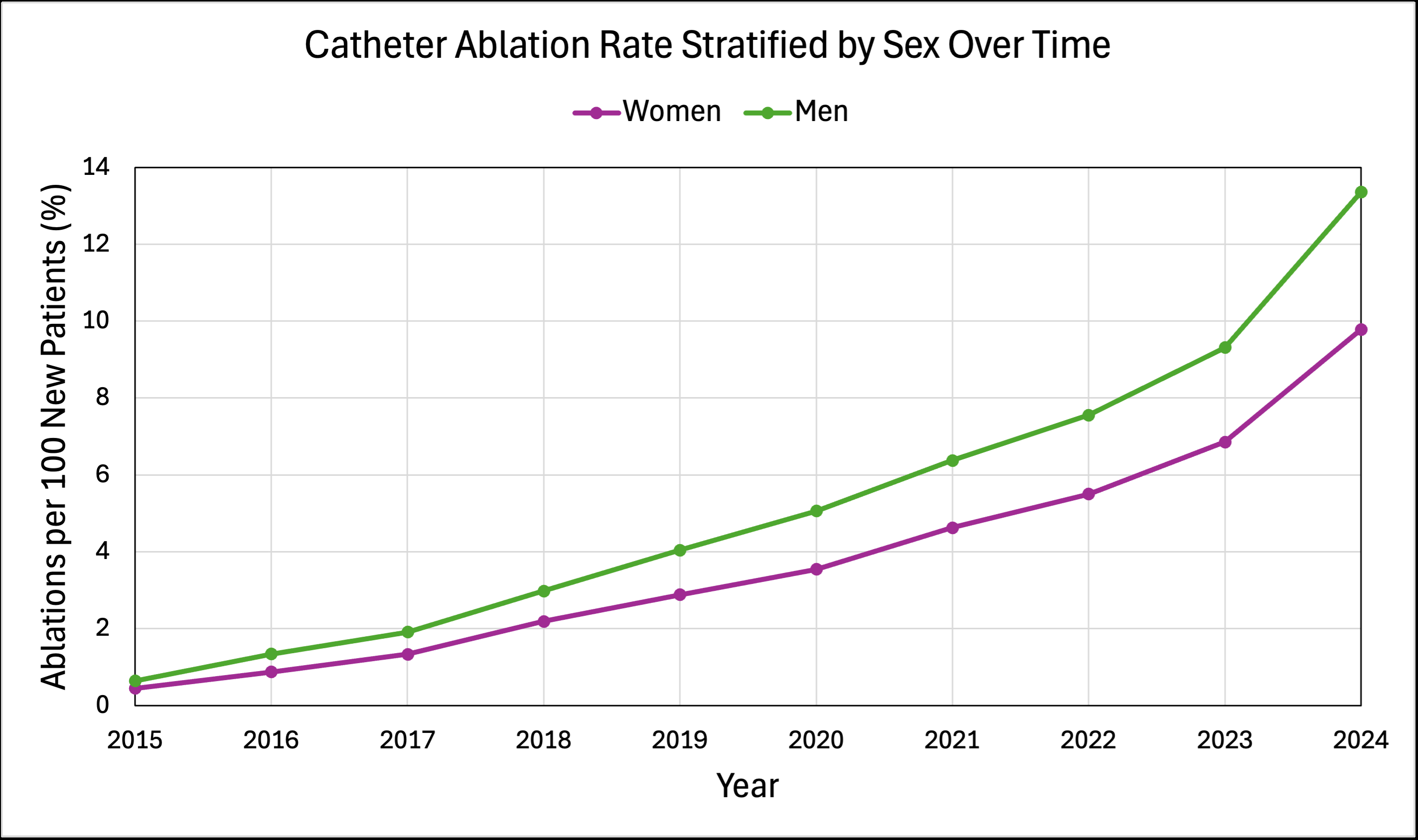
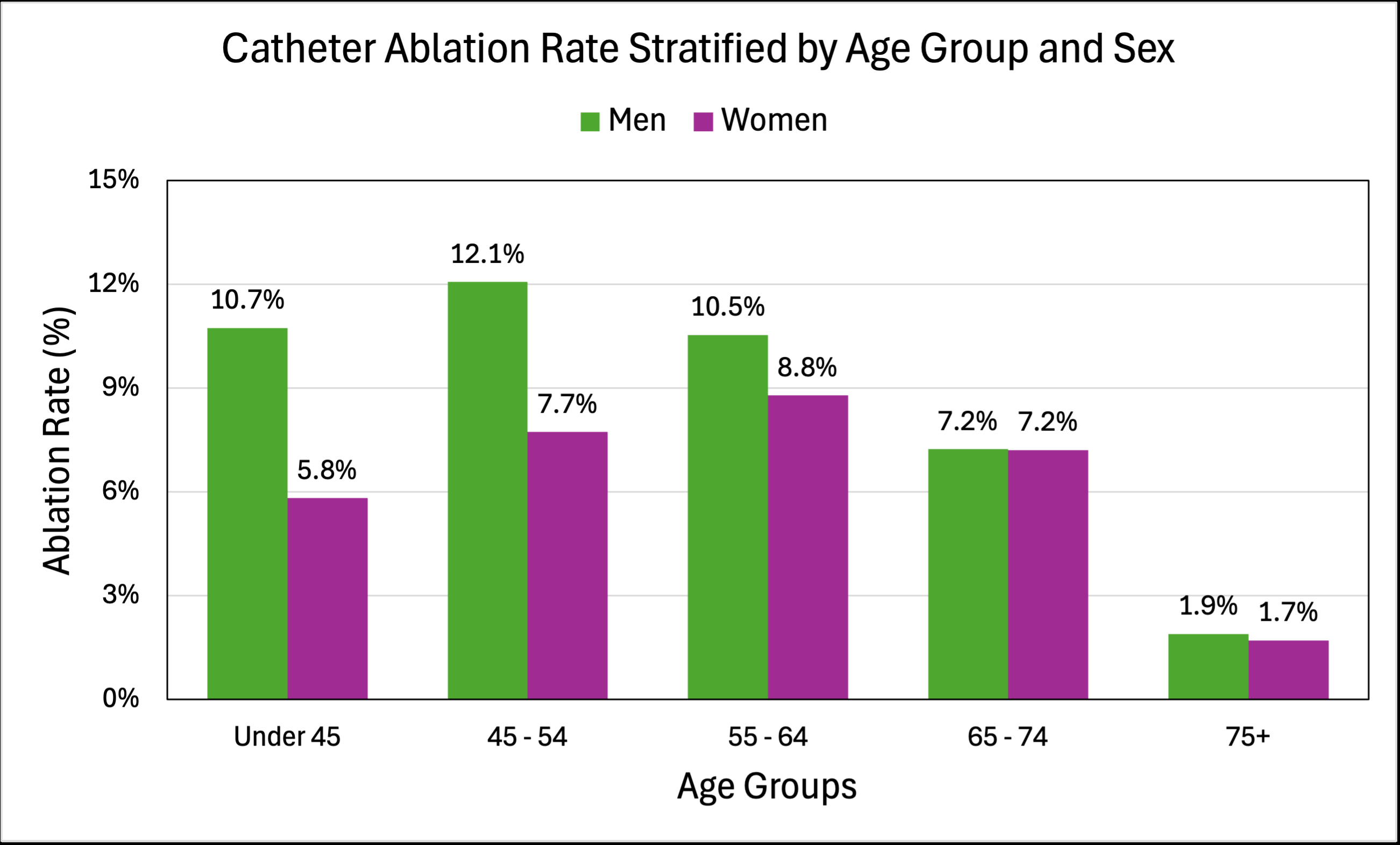
Results: A total of 2,646,219 patient records with comorbid AF and HF were identified, of which 44.3% were women. There were 137,260 catheter ablations (5.2%). Overall, 5.9% of men and 4.2% of women underwent catheter ablation. Women were 29% less likely to receive catheter ablation (RR = 0.713; 95% CI = 0.705 - 0.721). The catheter ablation rate per 100 new AF diagnoses per year increased by 1.3% among men and 0.9% among women from 2015 to 2024 (p = 0.045) (Figure 1). Under the age of 65, men are significantly more likely to undergo ablation than are women of similar age (p < 0.05) (Figure 2). Above the age of 65, the overall ablation rate decreases, and there is no apparent difference by sex (Figure 2).

Conclusion: Men undergo catheter ablation more frequently than women. Moreover, the difference in ablation rates persists over time despite increasing use of AF ablation overall. Ablation rates are attenuated > 65 years of age, partially masking marked sex-based differences in ablation rates among younger patients, especially those <55 years.
  • Rizvi, Syed Muhammad Musa Ali  ( University of Texas Southwestern , Dallas , Texas , United States )
  • Talbot, Nicholas  ( University of Texas Southwestern , Dallas , Texas , United States )
  • Aggarwal, Sachin  ( University of Texas Southwestern , Dallas , Texas , United States )
  • Hu, Gene  ( University of Texas Southwestern , Dallas , Texas , United States )
  • Basit, Mujeeb  ( University of Texas Southwestern , Dallas , Texas , United States )
  • Das, Sandeep  ( University of Texas Southwestern , Dallas , Texas , United States )
  • Author Disclosures:
    Syed Muhammad Musa Ali Rizvi: DO NOT have relevant financial relationships | Nicholas Talbot: DO NOT have relevant financial relationships | Sachin Aggarwal: DO NOT have relevant financial relationships | Gene Hu: No Answer | Mujeeb Basit: DO have relevant financial relationships ; Advisor:Pfizer:Active (exists now) | Sandeep Das: DO NOT have relevant financial relationships
Meeting Info:

Scientific Sessions 2025

2025

New Orleans, Louisiana

Session Info:

Arrhythmias Unplugged: Equity, Innovation, and Risk in the Real World

Saturday, 11/08/2025 , 09:15AM - 10:30AM

Moderated Digital Poster Session

More abstracts from these authors:
Racial Disparities in Catheter Ablation for Atrial Fibrillation and Heart Failure

Aggarwal Sachin, Rizvi Syed Muhammad Musa Ali, Talbot Nicholas, Hu Gene, Basit Mujeeb, Das Sandeep

Rural-Urban Disparities in Catheter Ablation for Atrial Fibrillation and Heart Failure

Talbot Nicholas, Aggarwal Sachin, Rizvi Syed Muhammad Musa Ali, Hu Gene, Basit Mujeeb, Das Sandeep

You have to be authorized to contact abstract author. Please, Login
Not Available