Ambulatory Atrial Fibrillation Ablation is Underutilized Among Women and Racial/Ethnic Minority Groups
Abstract Body (Do not enter title and authors here): Background Catheter ablation (Abl) is an effective rhythm control strategy for atrial fibrillation (AF). In recent years there has been a growing trend toward performing AF Abl as an ambulatory procedure, defined by either same day discharge or single overnight observation. Prior studies have highlighted disparities related to AF management. However, there is limited data regarding patient characteristics and utilization patterns of AF Abl as an ambulatory procedure.
Objectives To evaluate national utilization patterns of ambulatory AF Abl and assess potential disparities by sex, race/ethnicity, and socioeconomic status.
Methods Ambulatory AF Abl encounters were identified from the 2020–2022 Nationwide Ambulatory Surgery Sample datasets using CPT code. The United States Census data were used as the population denominator. Crude rates were age-standardized (ASR) for the 2000 U.S. standard population. Standardized rate ratios (SRR) were used to compare demographic groups.
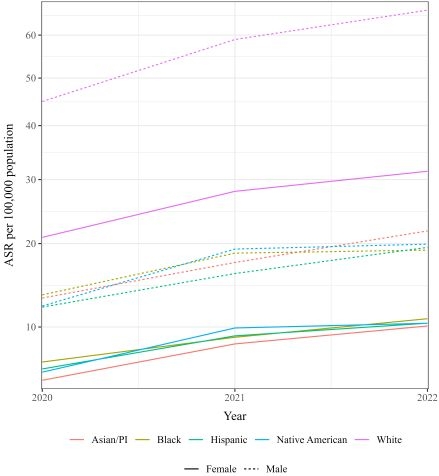
Results We identified a total of 326,032 weighted ambulatory AF Abl encounters in patients aged ≥18 years. Mean age was 65.7 years, 35% were females, and 87.5% were White. Mortality was low, with ≤11 deaths recorded each year. There was an increase of nearly 54% in procedural volume, with 49.5% increase in the national ASR, from 26.4 to 39.5 per 100,000. The ASR for females increased by 52.3%, from 17.1 to 26 per 100,000, and the rate for males rose by 48.4%, from 36.4 to 54.1 per 100,000. Asian females demonstrated the largest increase in ASR, rising by 86.7% from 5.4 to 10.1 per 100,000, whereas Black males exhibited the smallest increase, rising by 41.9% from 13.5 to 19.1 per 100,000. Rates were considerably lower among Blacks, Asians, Hispanics and Indigenous. Nonetheless, no single racial/ethnic minority was disproportionately more affected than the others. Relative differences in ASR, with Whites as reference, improved slightly between 2020 and 2022, and were most pronounced among Asian females in 2020 (SRR: 0.26; 95% confidence interval (CI): 0.26–0.26), Hispanic males in 2021 (SRR: 0.27; 95% CI: 0.27–0.27), and Hispanic and Black males in 2022 (SRR: 0.29; 95% CI: 0.29–0.29). Roughly one-third of AF Abl were delivered to the top income quartile, while 17.2% to the lowest.
Conclusions Ambulatory AF Abl rates increased substantially between 2020 and 2022 across all demographic groups. However, significant disparities were noted, with lower utilization in females and racial/ethnic minorities.
Makmal, Noam
(
Harvard T.H. Chan School of Public Health
, Boston , Massachusetts , United States )
Koplan, Bruce
(
Brigham and Women's Hospital
, Boston , Massachusetts , United States )
Author Disclosures:
Noam Makmal:DO NOT have relevant financial relationships
| Bruce Koplan:DO have relevant financial relationships
;
Consultant:GE Healthcare:Active (exists now)
; Consultant:J&J:Past (completed)