
Logo

American Heart Association

  19
  0


Final ID: MP2644

Atypical Approach to Typical AVNRT Ablation in Patients with Persistent Left Superior Vena Cava: A Single-Centre Experience

Abstract Body (Do not enter title and authors here): Background:
Persistent left superior vena cava (PLSVC) is a rare congenital venous anomaly that can complicate the anatomy of the right atrium and coronary sinus, posing technical challenges during catheter ablation of atrioventricular nodal reentrant tachycardia (AVNRT). Optimal ablation strategies in this subset remain poorly defined.

Methods:
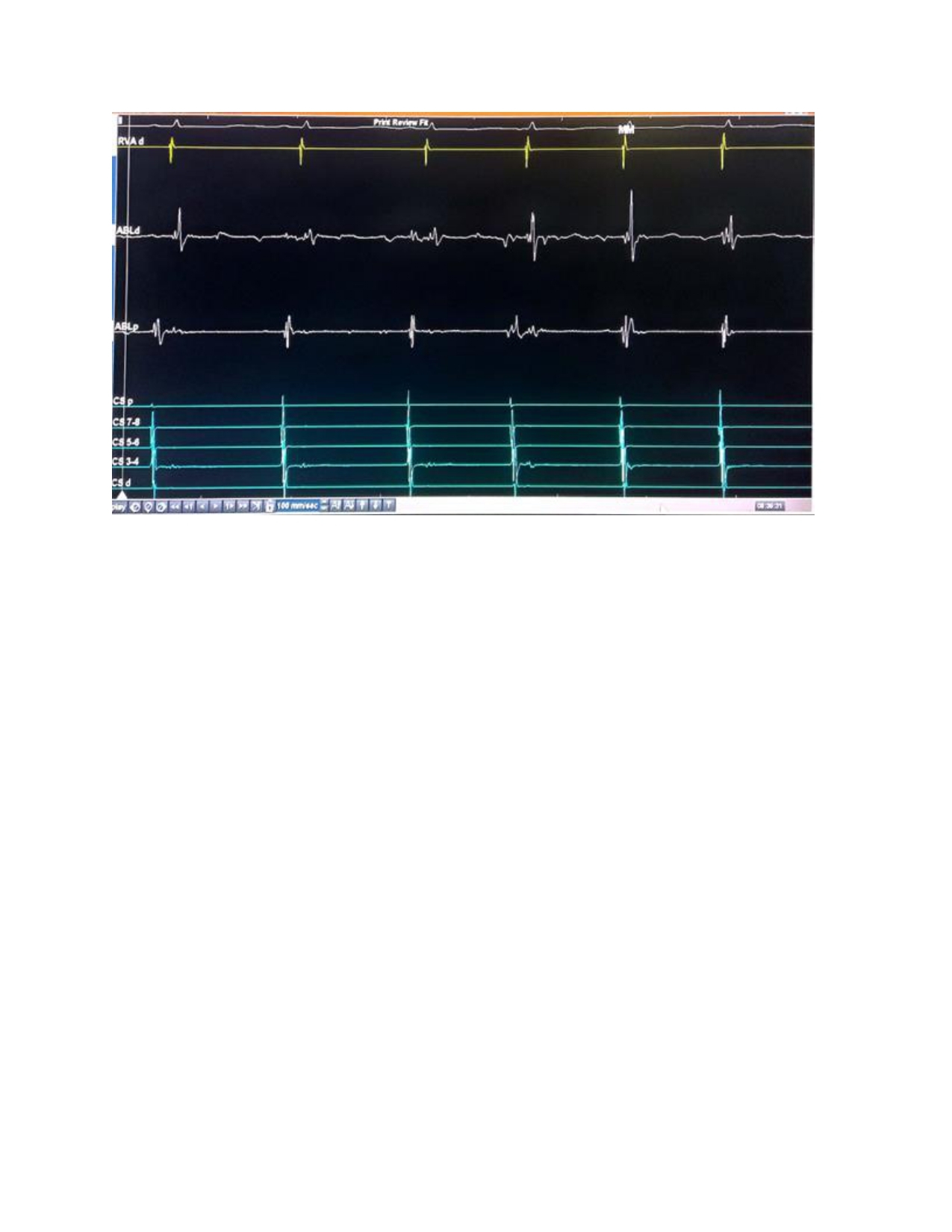
We retrospectively analysed 11 patients with PLSVC who underwent typical AVNRT ablation at our centre between 2015 and 2024, identified from a cohort of 2,030 ablations (0.54%). PLSVC was suspected by dilated coronary sinus on transthoracic echocardiogram and confirmed by coronary sinus catheter manipulation or coronary sinus venography. All procedures were performed using the Claris EP Workmate system with right femoral vein access. Due to unstable His catheter positioning from distorted anatomy, fluoroscopic landmarks in the left anterior oblique (LAO 30°) view were used in review screen during radiofrequency ablation. Radiofrequency ablation (RFA) was delivered using a 4-mm non-irrigated Blazer™ catheter (max 40W, 60°C) targeting the slow pathway, guided either by low-amplitude electrograms or anatomical landmarks—primarily the anterior lip of the mid coronary sinus ostium (CSOS). A long sheath (SR0) was used in 5 patients for better catheter stability.

Results:
The mean age was 38 ± 11 years; 8 were female. Typical AVNRT was inducible in all 11 patients. Immediate procedural success was achieved in 100%, defined by non-inducibility of AVNRT post-ablation with and without isoproterenol. Junctional ectopy during energy delivery was used as a surrogate marker when slow pathway potentials were absent (8/11 patients). Long-term success at 24-month follow-up was 91%, with one recurrence. There were no major complications. In 3 patients, the slow pathway was localized to the posteroinferior septum; in the remainder, ablation was successful within the coronary sinus ostium.

Conclusion:
In patients with PLSVC, right-sided ablation of typical AVNRT remains effective, despite anatomical distortion. Atypical anterior ablation targets mostly within the Coronary sinus ostium, fluoroscopic guidance, and long sheath support facilitate successful outcomes. Awareness of these adaptations may reduce recurrence and procedural risk in this challenging subset.
  • Awais, Muhammad  ( Pak Internation Medical College , Peshawar , Pakistan )
  • Ikram, Jibran  ( Cleveland Clinic Foundation , Cleveland , Ohio , United States )
  • Zahid, Ayesha  ( Cleveland Clinic Foundation , Cleveland , Ohio , United States )
  • Awan, Zahid Aslam  ( Pak Internation Medical College , Peshawar , Pakistan )
  • Author Disclosures:
    Muhammad Awais: DO NOT have relevant financial relationships | Jibran Ikram: DO NOT have relevant financial relationships | Ayesha Zahid: DO NOT have relevant financial relationships | Zahid Aslam Awan: DO NOT have relevant financial relationships
Meeting Info:

Scientific Sessions 2025

2025

New Orleans, Louisiana

Session Info:

Tailored Ablation: From Substrate Mapping to Long-Term Management

Monday, 11/10/2025 , 10:45AM - 11:45AM

Moderated Digital Poster Session

More abstracts from these authors:
Trends and Disparities in Ischemic Heart Disease and Sleep Apnea–Related Mortality in the United States (1999–2020): A CDC WONDER Study.

Ikram Jibran, Wang Tom Kai Ming, Klein Allan, Ehsan Muhammad, Kakakhel Mian Zahid Jan, Mansoor Fatima, Massad Faysal, Safdar Ahmad, Motairek Issam, Al-dalakta Astefanos, Tabaja Chadi

Repetitive Ventricular Response During Radiofrequency Ablation of Left Posterior Fascicular Ventricular Tachycardia: A Reliable Indicator of Success or Mere Observation?

Awais Muhammad, Zahid Ayesha, Ikram Jibran, Awan Zahid Aslam

You have to be authorized to contact abstract author. Please, Login
Not Available