
Logo

American Heart Association

  20
  0


Final ID: MP2430

Post-Exercise Heart Rate Recovery Phenotypes in Congenital Heart Disease

Abstract Body (Do not enter title and authors here): Background:
Heart rate recovery (HRR) after exercise, a measure of autonomic function, is associated with adverse outcomes in adults with heart disease. However, HRR phenotypes in pediatric congenital heart disease (CHD) are not well characterized. This study aimed to characterize pediatric HRR patterns and their associated factors especially residual physiology.
Methods: We performed a retrospective analysis of 417 patients, 136 CHD and 281 controls (controlled for age, sex, BMI, and baseline HR), who underwent exercise testing at two academic children’s hospitals (2016- 2020). CHD patients were classified as simple, moderate, severe, and single ventricle anatomy and residual physiology A-C. HR was recorded at baseline, peak, and 1–6 minutes post-exercise. Chronotropic index (CI) was calculated using Mahon’s predicted maximal HR. Mixed effects models evaluated HRR trajectories. Unsupervised K-means clustering identified functional HRR phenotypes.
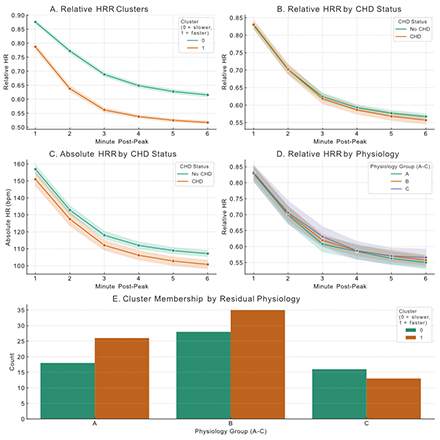
Results: CHD patients had lower CI (0.85 ± 0.15 vs 0.93 ± 0.12, p < 0.001) and peak HR (181 ± 17 bpm vs 189 ± 14 bpm, p < 0.001). CHD patients had a 5.5 bpm lower absolute HRR at minute 6 (p < 0.04), but relative HRR curves were similar in shape (CHD x time interaction not significant). Physiology Group C exhibited slower recovery with higher relative HR. Residual physiology was associated with cluster membership, with Physiology Group C patients more likely to exhibit the slower recovery phenotype (Cluster 0), while Groups A and B were more likely to exhibit the faster recovery phenotype (Cluster 1) (Figure1).
Conclusion: Pediatric patients with CHD have distinct HRR phenotypes driven by residual physiology and CI. While relative HRR provides consistent recovery slopes, absolute HRR may better capture exertional limitations in pediatric CHD. Physiology-driven HRR phenotyping may enhance risk stratification and exercise interpretation in pediatric CHD.
  • Rohlman, Aaron  ( UT Southwestern Medical Center , Dallas , Texas , United States )
  • Romme, Angela  ( Rush University Medical Center , Chicago , Illinois , United States )
  • Kohli, Utkarsh  ( Nicklaus Children's Hospital , Miami , Florida , United States )
  • Hansen, Katherine  ( UT Southwestern Medical Center , Dallas , Texas , United States )
  • Nguyen, Hoang  ( UT Southwestern Medical Center , Dallas , Texas , United States )
  • Author Disclosures:
    Aaron Rohlman: No Answer | Angela Romme: No Answer | Utkarsh Kohli: No Answer | Katherine Hansen: DO NOT have relevant financial relationships | Hoang Nguyen: DO NOT have relevant financial relationships
Meeting Info:

Scientific Sessions 2025

2025

New Orleans, Louisiana

Session Info:

From Risk to Response: Implementing Preventive and Systems-Based Strategies in Cardiovascular Care

Monday, 11/10/2025 , 09:15AM - 10:15AM

Moderated Digital Poster Session

More abstracts on this topic:
More abstracts from these authors:
You have to be authorized to contact abstract author. Please, Login
Not Available