
Logo

American Heart Association

  17
  0


Final ID: Mo3105

Impact of Aortic Annular Area on Outcomes Following Balloon-Expandable vs. Self-Expandable Valve-in-Valve Transcatheter Aortic Valve Replacement

Abstract Body (Do not enter title and authors here): Background: Valve-in-valve transcatheter aortic valve replacement (ViV-TAVR) is an increasingly preferred strategy for managing failed surgical bioprosthetic valves, especially in high-risk patients. However, limited data exist comparing outcomes between balloon-expandable (BE) and self-expandable (SE) transcatheter heart valves (THVs) in this setting. The influence of aortic annular area on outcomes by valve type remains poorly understood. This study evaluated the impact of annular area on clinical outcomes following ViV-TAVR with BE vs. SE valves.
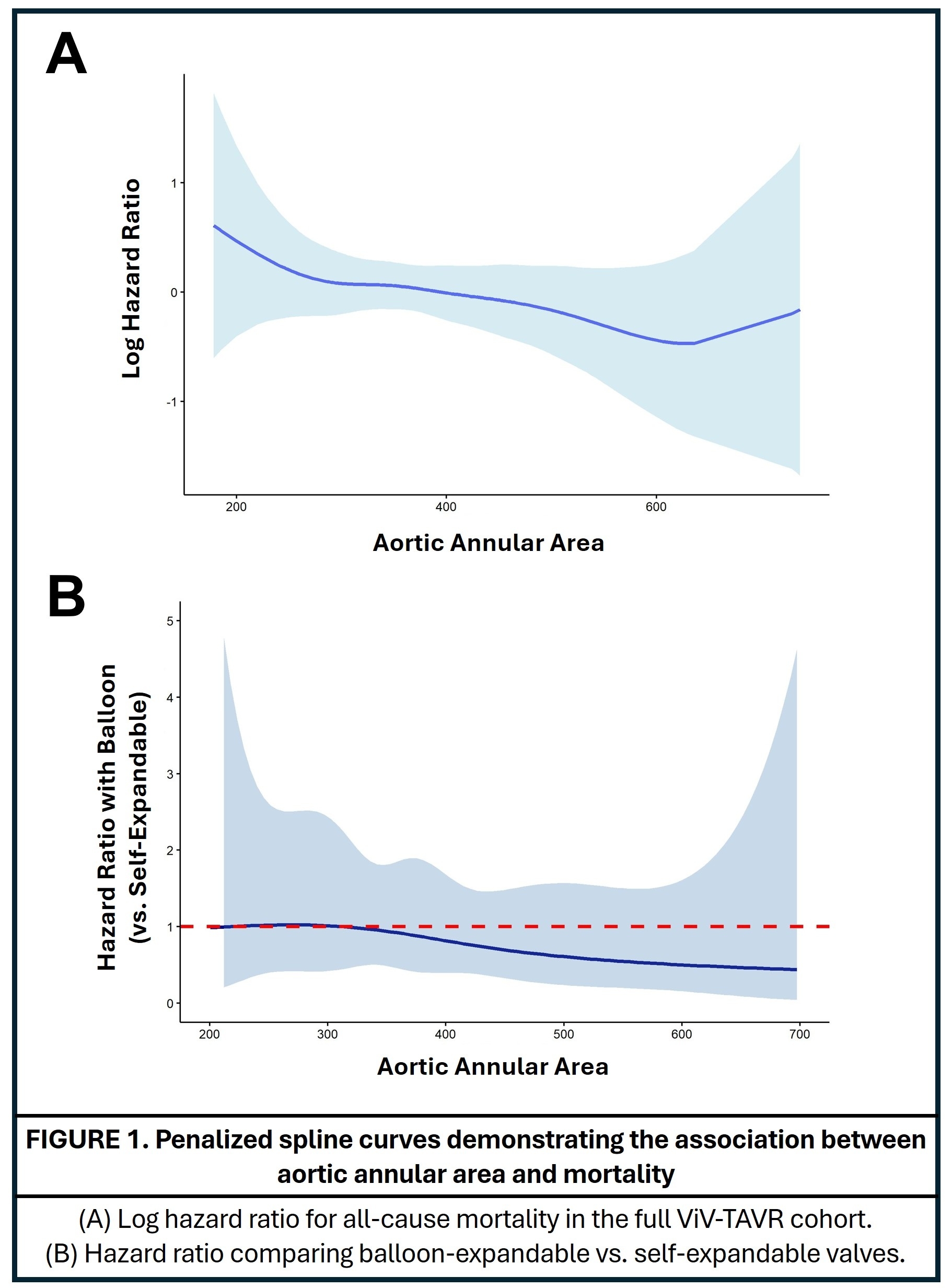
Methods: We conducted a retrospective, single-center analysis of 353 patients who underwent ViV-TAVR between 2012 and 2024. All had prior surgical bioprosthetic AVR and received either BE (n=267) or SE (n=86) valves. Preprocedural multidetector CT was used to quantify aortic annular area. Transthoracic echocardiography was performed before and after the procedure to assess transvalvular gradients and hemodynamics. The primary endpoint was all-cause mortality. Penalized spline regression was used to model the nonlinear relationship between annular area and mortality and assess interaction by valve type.
Results: Median age was 79 (IQR: 72–83) in the BE group and 80 (IQR: 76–85) in the SE group (p=0.07). Female sex was more common in the SE group (32% vs. 22%, p=0.047). Median annular area was 374 mm2 (IQR: 316–440) for BE and 365 mm2 (IQR: 308–432) for SE (p=0.081). Preprocedural gradient and effective orifice area index were 36 mm Hg (IQR: 28–46) and 0.6 cm2/m2 (IQR: 0.5–0.9), respectively, with no significant differences. Median hospital stay was 2 vs. 3 days (p=0.68). Thirty-day mortality was low (1 per group, p=0.36). Median follow-up was 4.0 years (IQR: 1.6–6.4). One- and 5-year survival rates were 94.75% and 61.7%, respectively (p=0.20). Penalized spline analysis showed a nonlinear association between annular area and mortality. The hazard ratio for BE valves declined with increasing annular area and fell below SE valves beyond ~400 mm2.
Conclusion: ViV-TAVR is a safe and effective treatment for failed surgical bioprostheses. Smaller annular areas were associated with higher mortality. Outcomes with BE valves improved in larger annuli, suggesting annular area could guide valve selection. Further studies are warranted to validate these observations.
  • Danesh, Sina  ( Mayo Clinic , Rochester , Minnesota , United States )
  • Sawma, Tedy  ( Mayo Clinic , Rochester , Minnesota , United States )
  • Banivaheb, Behrooz  ( Mayo Clinic , Rochester , Minnesota , United States )
  • Herrera, Harrison  ( Mayo Clinic , Rochester , Minnesota , United States )
  • Todd, Austin  ( Mayo Clinic , Rochester , Minnesota , United States )
  • Tang, Paul  ( Mayo Clinic , Rochester , Minnesota , United States )
  • Author Disclosures:
    Sina Danesh: DO NOT have relevant financial relationships | Tedy Sawma: No Answer | Behrooz Banivaheb: No Answer | Harrison Herrera: DO NOT have relevant financial relationships | Austin Todd: No Answer | Paul Tang: DO NOT have relevant financial relationships
Meeting Info:

Scientific Sessions 2025

2025

New Orleans, Louisiana

Session Info:

Aortic Valve Under Pressure: Mechanisms, Models, and Molecular Insights

Monday, 11/10/2025 , 10:30AM - 11:30AM

Abstract Poster Board Session

More abstracts on this topic:
A Meta-Analysis Comparing Same-Day Discharge to Later-Day Discharge in Transcatheter Aortic Valve Replacement

Jain Hritvik, Passey Siddhant, Jain Jyoti, Goyal Aman, Wasir Amanpreet, Ahmed Mushood, Patel Nandan, Yadav Ashish, Shah Janhvi, Mehta Aryan

Clinical Effectiveness of Cerebral Embolic Protection (CEP) Devices During Transcatheter Aortic Valve Replacement: A Systematic Review and Meta-Analysis

Akhter Haji Abdul Rehman, Khalid Maliha, Italiya Kevin, Sivasubramanian Dhiran, Hassaan Muhammad

More abstracts from these authors:
You have to be authorized to contact abstract author. Please, Login
Not Available