Deep Learning–Based Continuous QT Monitoring Identifies High-Risk Prolongation Events After Class III Antiarrhythmic Initiation
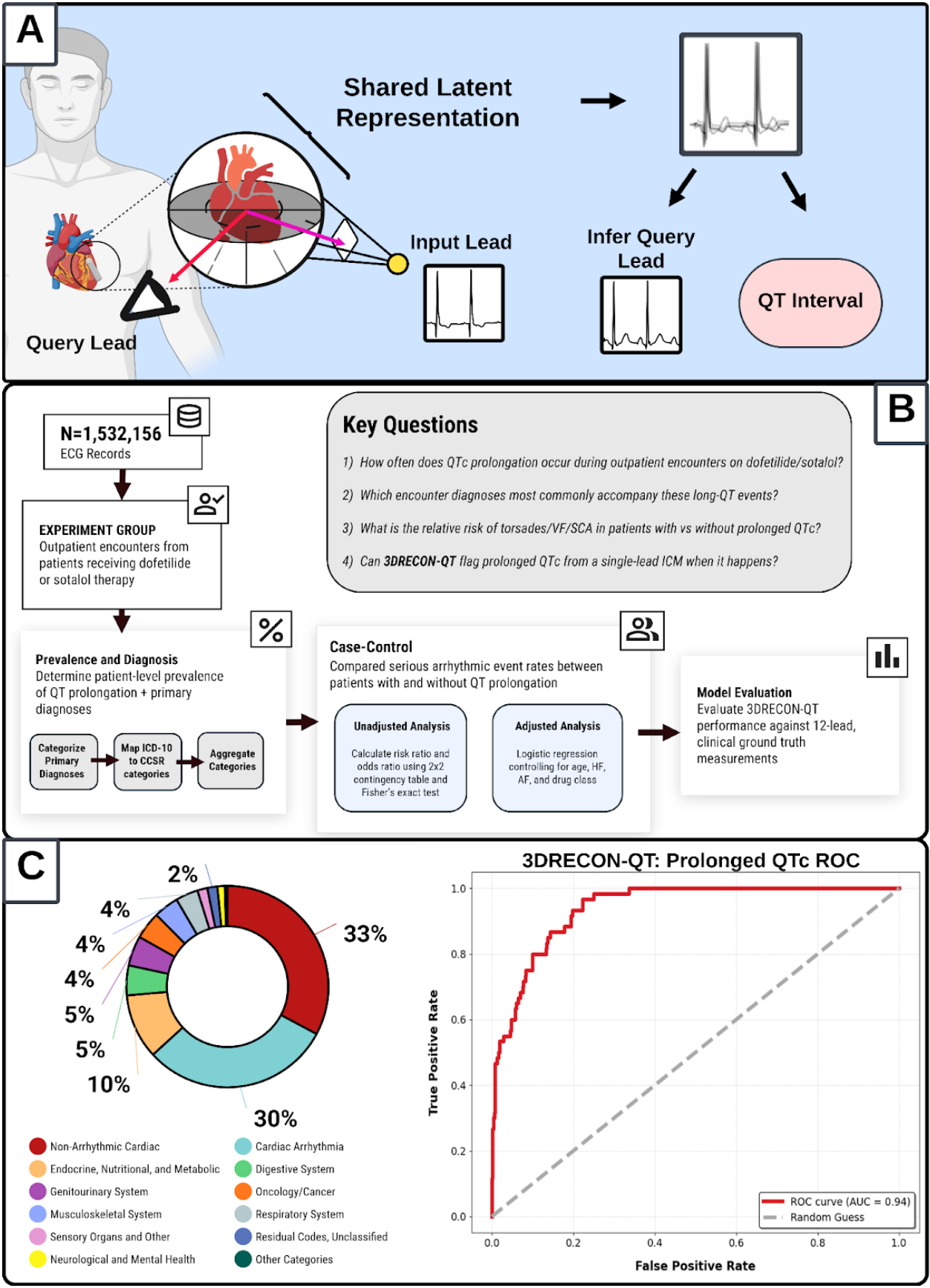
Abstract Body (Do not enter title and authors here): Background: The QT interval is a critical marker for life-threatening arrhythmic risk. Class III antiarrhythmics require inpatient QTc monitoring during initiation, but patients are discharged without continuous surveillance. While implantable cardiac monitors (ICMs) offer continuous recording, they cannot measure QTc due to the lack of standard spatial vectors. We hypothesized that outpatients experience undetected QTc prolongation with serious arrhythmic consequences, detectable by 3DRECON-QT—a spatially encoded deep-learning model developed to extract QT from single-lead ICM signals (fig. A). Methods: We retrospectively analyzed 72,919 outpatient ECGs from 1,676 patients who were on dofetilide or sotalol across 2,083 unique outpatient encounters (Stanford, 2008–2024). We: (1) characterized the burden of outpatient QTc prolongation, (2) identified the primary diagnoses prompting outpatient visits, (3) quantified the associated arrhythmic risk, and (4) validated 3DRECON-QT’s ability to detect prolonged QTc from derived ICM signals. QTc prolongation was defined as >500 ms (narrow QRS) or >550 ms (wide QRS). Serious events included torsades, VF, and sudden cardiac death (fig. B). Analyses included prevalence, encounter diagnosis, event rates (Fisher’s exact test, multivariable regression), and NEF-QT performance assessment (Pearson correlation, AUROC, sensitivity, specificity). Results: Despite initial inpatient drug initiation, 277/1,676 patients (16.5%) developed outpatient QT prolongation during a subsequent visit (fig. C). The 2,083 outpatient encounters presented for diverse reasons beyond arrhythmia management. At the encounter level, prolonged QTc was associated with significantly higher risk, with serious arrhythmic events occurring in 4.15% for patients presenting with prolonged-QTc vs 0.90% for normal QTc encounters (OR 4.75, p<0.05; AOR 4.24, 95% CI 1.81–9.90, p<0.05). 3DRECON-QT identified these episodes with AUROC = 0.94, sensitivity = 80%, specificity = 90%, negative predictive value = 97%, and correlation = 0.82. Conclusions: One in six patients had documented QTc prolongation after discharge and had a fourfold increase of critical ventricular arrhythmia risk. 3DRECON-QT accurately identified these events from single-lead derived ICM signals, supporting its potential to close the outpatient surveillance gap in QT interval/risk monitoring.
Rogers, Albert
(
Stanford University School of Medicine
, Stanford , California , United States )
Ansari, Rayan
(
Stanford University School of Medicine
, Stanford , California , United States )
Bandyopadhyay, Sabyasachi
(
Stanford University School of Medicine
, Stanford , California , United States )
Trivedi, Rishi
(
Cedars Sinai Medical Center
, Los Angeles , California , United States )
Brennan, Kelly
(
Stanford University School of Medicine
, Stanford , California , United States )
Ganesan, Prasanth
(
Stanford University School of Medicine
, Stanford , California , United States )
Perino, Alexander
(
Stanford University School of Medicine
, Stanford , California , United States )
Ashley, Euan
(
Stanford University School of Medicine
, Stanford , California , United States )
Wang, Paul
(
Stanford University School of Medicine
, Stanford , California , United States )
Perez, Marco
(
Stanford University School of Medicine
, Stanford , California , United States )
Ouyang, David
(
Kaiser Permanente
, Pleasanton , California , United States )
Narayan, Sanjiv
(
Stanford University School of Medicine
, Stanford , California , United States )
Author Disclosures:
Albert Rogers:DO have relevant financial relationships
;
Research Funding (PI or named investigator):National Institutes of Health:Active (exists now)
; Advisor:YorLabs Inc:Active (exists now)
; Advisor:WearLinq Inc.:Active (exists now)
; Research Funding (PI or named investigator):American Heart Association:Active (exists now)
| Marco Perez:DO have relevant financial relationships
;
Research Funding (PI or named investigator):NIH/NHLBI:Active (exists now)
; Ownership Interest:QALY Inc.:Active (exists now)
; Ownership Interest:Pacegenix:Active (exists now)
; Consultant:Pacegenix:Active (exists now)
; Consultant:Simplex Quantum:Active (exists now)
; Consultant:Thryv:Active (exists now)
; Consultant:Boston Scientific:Active (exists now)
; Consultant:Johnson and Johnson:Active (exists now)
; Consultant:Apple Inc.:Active (exists now)
; Research Funding (PI or named investigator):Johnson and Johnson:Active (exists now)
; Research Funding (PI or named investigator):Lexeo Therapeutics:Active (exists now)
; Research Funding (PI or named investigator):Apple Inc.:Active (exists now)
| David Ouyang:DO have relevant financial relationships
;
Consultant:InVision:Active (exists now)
; Consultant:Pfizer:Past (completed)
; Consultant:Ultromics:Past (completed)
; Consultant:EchoIQ:Past (completed)
; Consultant:AstraZeneca:Active (exists now)
| Sanjiv Narayan:No Answer
| Rayan Ansari:DO NOT have relevant financial relationships
| Sabyasachi Bandyopadhyay:DO have relevant financial relationships
;
Consultant:Linus Health Inc.:Past (completed)
| Rishi Trivedi:No Answer
| Kelly Brennan:DO NOT have relevant financial relationships
| Prasanth Ganesan:DO have relevant financial relationships
;
Royalties/Patent Beneficiary:Florida Atlantic University:Active (exists now)
| Alexander Perino:DO have relevant financial relationships
;
Consultant:J&J Medtech:Active (exists now)
; Research Funding (PI or named investigator):Orchestra Med:Active (exists now)
; Research Funding (PI or named investigator):Boston Scientific:Active (exists now)
; Consultant:Biotronik:Past (completed)
; Other (please indicate in the box next to the company name):Medtronic: Episode Review Committee:Past (completed)
; Other (please indicate in the box next to the company name):Abbott: Speaker, Research funding:Active (exists now)
| Euan Ashley:No Answer
| Paul Wang:DO have relevant financial relationships
;
Individual Stocks/Stock Options:Soneira:Active (exists now)
; Ownership Interest:EndoEpiAF:Active (exists now)
; Ownership Interest:HrtEx:Active (exists now)