Logo

American Heart Association

  24
  0


Final ID: MP334

Predicting Peak Heart Rate from Resting 12-Lead ECGs in Patients Undergoing Stress Testing using Deep Learning

Abstract Body (Do not enter title and authors here):
Introduction: Cardiovascular stress testing is crucial for the evaluation of ischemic cardiomyopathy and inducible arrhythmias. Inappropriate heart rate (HR) response during stress, or chronotropic incompetence, is associated with sinus node disease, conduction system abnormalities, and decreased functional capacity. However, inappropriate exercise tolerance often presents during stress testing, necessitating early termination. Early identification of those who are unable to complete testing due to exercise intolerance or chronotropic incompetence could streamline subsequent testing and management. This study investigates the feasibility of using deep learning models to predict peak HR using resting 12-lead electrocardiogram (ECG).
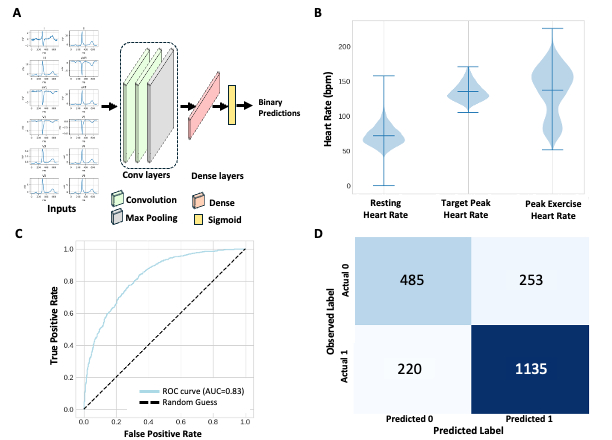
Research Questions: Can a deep learning model effectively learn from resting 12-lead ECG waveforms to: (1) classify whether a patient's peak heart rate will exceed predicted peak HR defined as (230-age) × 0.8, and (2) predict the peak heart rate achieved during a stress test?
Methods: A total of 7,625 stress test records were obtained from a single institution, from which 6986 samples (4893 training/validation, 2093 test) were included. Preprocessing involved extracting 12-lead ECG signals, identifying the resting waveform and the peak HR during stress. All 12 standard leads were required for inclusion, and ECG waveforms were padded to a uniform sequence length. The processed data was used to train two separate convolutional neural networks for predicting appropriate stress response and the peak HR.
Results: The training/validation set had a mean peak HR of 137.5 beats per minute (SD = 34.9) and the testing set had a mean peak HR of 137.0 (SD = 35.3). The proportion of samples that met age-based peak HR threshold in the training/validation and testing set is 64.7% and 65.9% respectively. The model achieved an AUROC of 0.83 (95% CI 0.81-0.85) and an F1-score of 0.85 for the classification task. A separate model with similar architecture predicted peak HR with an R-value of 0.69 (95% CI 0.67-0.72) and root mean square error of 26.2 beats per minute (95% CI 25.3-27.2).
Conclusion: Our findings show that the resting ECG can be leveraged for the prediction of HR response prior to stress testing. Successful models could offer clinicians a valuable non-invasive tool for early risk stratification, guiding patient management in the evaluation of ischemic heart disease, and identifying those at risk for chronotropic incompetence.
  • Liu, Xichong  ( Stanford Health Care , Stanford , California , United States )
  • Ashley, Euan  ( Stanford University , Stanford , California , United States )
  • Perez, Marco  ( Stanford University , Stanford , California , United States )
  • Narayan, Sanjiv  ( Stanford University , Stanford , California , United States )
  • Rogers, Albert  ( Stanford University , Stanford , California , United States )
  • Bandyopadhyay, Sabyasachi  ( Stanford University , Stanford , California , United States )
  • Ganesan, Prasanth  ( Stanford University , Stanford , California , United States )
  • Somani, Sulaiman  ( Stanford Health Care , Stanford , California , United States )
  • Brennan, Kelly  ( Stanford University , Stanford , California , United States )
  • Karius, Alexander  ( Stanford Health Care , Stanford , California , United States )
  • Baykaner, Tina  ( Stanford University , Stanford , California , United States )
  • Perino, Alexander  ( Stanford University , Stanford , California , United States )
  • Wang, Paul  ( Stanford University , Stanford , California , United States )
  • Author Disclosures:
    Xichong Liu: DO NOT have relevant financial relationships | Euan Ashley: No Answer | Marco Perez: DO have relevant financial relationships ; Research Funding (PI or named investigator):NIH/NHLBI:Active (exists now) ; Ownership Interest:QALY Inc.:Active (exists now) ; Ownership Interest:Pacegenix:Active (exists now) ; Consultant:Pacegenix:Active (exists now) ; Consultant:Simplex Quantum:Active (exists now) ; Consultant:Thryv:Active (exists now) ; Consultant:Boston Scientific:Active (exists now) ; Consultant:Johnson and Johnson:Active (exists now) ; Consultant:Apple Inc.:Active (exists now) ; Research Funding (PI or named investigator):Johnson and Johnson:Active (exists now) ; Research Funding (PI or named investigator):Lexeo Therapeutics:Active (exists now) ; Research Funding (PI or named investigator):Apple Inc.:Active (exists now) | Sanjiv Narayan: DO have relevant financial relationships ; Consultant:Lifesignals.ai:Active (exists now) ; Consultant:Abbott, Inc.:Past (completed) ; Consultant:PhysCade, Inc.:Active (exists now) | Albert Rogers: DO have relevant financial relationships ; Research Funding (PI or named investigator):National Institutes of Health:Active (exists now) ; Advisor:YorLabs Inc:Active (exists now) ; Advisor:WearLinq Inc.:Active (exists now) ; Research Funding (PI or named investigator):American Heart Association:Active (exists now) | Sabyasachi Bandyopadhyay: DO have relevant financial relationships ; Consultant:Linus Health Inc.:Past (completed) | Prasanth Ganesan: DO have relevant financial relationships ; Royalties/Patent Beneficiary:Florida Atlantic University:Active (exists now) | Sulaiman Somani: DO NOT have relevant financial relationships | Kelly Brennan: DO NOT have relevant financial relationships | Alexander Karius: DO NOT have relevant financial relationships | Tina Baykaner: DO NOT have relevant financial relationships | Alexander Perino: DO have relevant financial relationships ; Consultant:J&J Medtech:Active (exists now) ; Research Funding (PI or named investigator):Orchestra Med:Active (exists now) ; Research Funding (PI or named investigator):Boston Scientific:Active (exists now) ; Consultant:Biotronik:Past (completed) ; Other (please indicate in the box next to the company name):Medtronic: Episode Review Committee:Past (completed) ; Other (please indicate in the box next to the company name):Abbott: Speaker, Research funding:Active (exists now) | Paul Wang: DO have relevant financial relationships ; Individual Stocks/Stock Options:Soneira:Active (exists now) ; Ownership Interest:EndoEpiAF:Active (exists now) ; Ownership Interest:HrtEx:Active (exists now)
Meeting Info:

Scientific Sessions 2025

2025

New Orleans, Louisiana

Session Info:

Stress Matters: Innovations in Physiologic Testing Across Multimodality Imaging

Saturday, 11/08/2025 , 03:15PM - 04:25PM

Moderated Digital Poster Session

More abstracts on this topic:
A Novel ECG Time-Frequency Eyeball Method for Robust Detection of Myocardial Infarction from Single-Channel ECG: A Preclinical Study

Alavi Rashid, Li Jiajun, Dai Wangde, Matthews Ray, Pahlevan Niema, Kloner Robert, Gharib Morteza

9-Year Longitudinal Assessment of the 12-lead Electrocardiogram of Volunteer Firefighters

Bae Alexander, Dzikowicz Dillon, Lai Chi-ju, Brunner Wendy, Krupa Nicole, Carey Mary, Tam Wai Cheong, Yu Yichen

More abstracts from these authors:
Non-Contact Magnetocardiography Localizes Atrial Foci as Accurately as High-Resolution Contact ECG

Brennan Kelly, Narayan Sanjiv, Rogers Albert, Bandyopadhyay Sabyasachi, Ganesan Prasanth, Ansari Rayan, Somani Sulaiman, Liu Xichong, Baykaner Tina, Perino Alexander, Wang Paul

Automated End-to-End Framework for Extracting Raw ECG Waveforms and ST Segment Values from ECG Reports and Predicting ST Elevation by Machine Learning

Ganesan Prasanth, Wang Paul, Ashley Euan, Perez Marco, Narayan Sanjiv, Rogers Albert, Liu Xichong, Bandyopadhyay Sabyasachi, Ansari Rayan, Somani Sulaiman, Brennan Kelly, Karius Alexander, Baykaner Tina, Perino Alexander

You have to be authorized to contact abstract author. Please, Login
Not Available