Impacts of perioperative cyclohexanone exposure on systemic inflammatory response
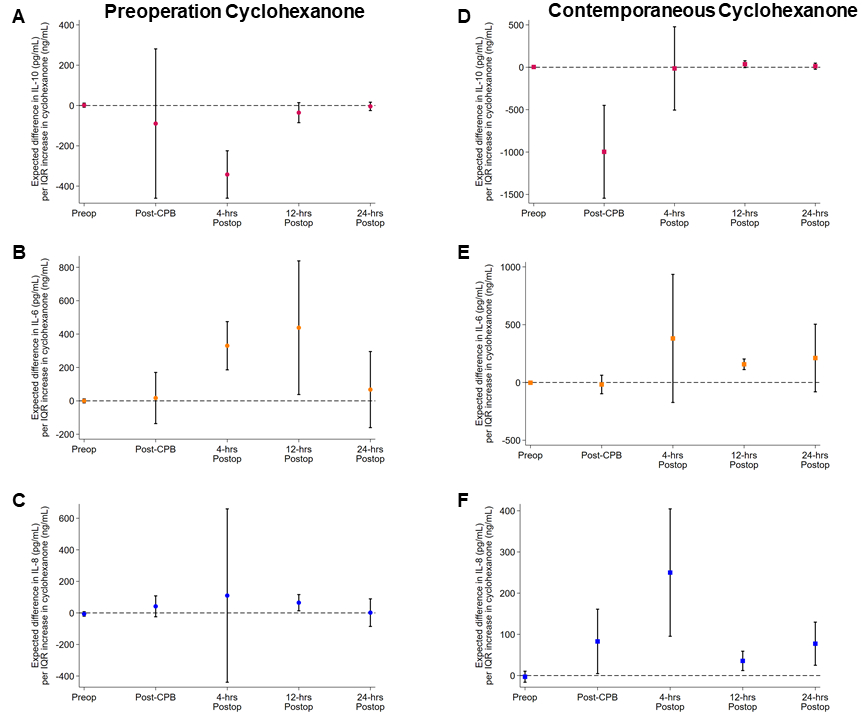
Abstract Body (Do not enter title and authors here): Background: Exposure to cyclohexanone, an industrial solvent used to soften medical plastics, has been associated with unfavorable outcomes for neonates undergoing congenital heart surgery. Yet, the underlying physiologic mechanisms remain unclear. Hypothesis: Cyclohexanone exposure induces a systemic inflammatory response following cardiopulmonary bypass (CPB) in neonates undergoing congenital heart surgery. Methods: We analyzed data from 70 neonates enrolled in the placebo group of the Corticosteroid Therapy in Neonates Undergoing Cardiopulmonary Bypass trial. Serum samples were collected at five time points: preoperatively, immediately after CPB cessation, and at 4, 12, and 24 hours postoperation. Serum cyclohexanone and cytokine concentrations were measured using gas chromatography tandem mass spectrometry and multiplex enzyme-linked immunoassays, respectively. We used covariate-adjusted longitudinal quantile regression to separately estimate the expected differences in 75th percentile cytokine concentrations (and 95% CIs) per interquartile range (IQR) increase in preoperation serum cyclohexanone concentration as well as contemporaneous, perioperative cyclohexanone concentrations. Covariates included age and weight at surgery, STAT mortality risk category, cytokine assay batch, and total CPB duration. Results: In covariate-adjusted models, an IQR increase in preoperation cyclohexanone concentration was associated with a 342.3 pg/mL (-460.0, -224.5) lower IL-10 concentration at 4 hours postoperation, 330.3 pg/mL (185.8, 474.8) higher IL-6 concentration at 4 hours and 438.2 pg/mL (37.9, 838.4) higher concentration at 12 hours postoperation, and 64.9 pg/mL (13.4, 116.5) higher IL-8 at 12 hours postoperation. An IQR increase in contemporaneous cyclohexanone concentration was associated with lower IL-10 levels after CPB cessation (-997 pg/mL; 95%CI: -1545, -449), whereas IL-8 was significantly higher after CPB cessation (83 pg/mL; 95%CI: 4.64, 161) and 4 hours (250 pg/mL; 95%CI: 95.3, 405), 12 hours (35.6 pg/mL; 95%CI: 12.1, 59.1), and 24 hours (77.3 pg/mL; 95%CI: 24.9, 130) postoperation. Conclusions: Perioperative cyclohexanone exposure is associated with a proinflammatory response. These results suggest that cyclohexanone may contribute to postoperative inflammation following CPB and further potentiate adverse postoperative outcomes. Further studies are needed to develop strategies to reduce cyclohexanone exposure in the perioperative environment.
Zheng, Christie
(
Johns Hopkins University
, Baltimore , Maryland , United States )
Helmbrecht, Hawley
(
Johns Hopkins University
, Baltimore , Maryland , United States )
Ellis, Greg
(
All Childrens Hospital
, St Petersburg , Florida , United States )
Everett, Allen
(
Johns Hopkins University
, Baltimore , Maryland , United States )
Graham, David
(
Johns Hopkins University
, Baltimore , Maryland , United States )
Jantzie, Lauren
(
Johns Hopkins University
, Baltimore , Maryland , United States )
Graham, Eric
(
Medical University of South Carolina
, Charleston , South Carolina , United States )
Kuiper, Jordan
(
The George Washington University
, Washington , District of Columbia , United States )
Author Disclosures:
Christie Zheng:DO NOT have relevant financial relationships
| Hawley Helmbrecht:DO NOT have relevant financial relationships
| Greg Ellis:No Answer
| Allen Everett:DO NOT have relevant financial relationships
| David Graham:No Answer
| Lauren Jantzie:DO NOT have relevant financial relationships
| Eric Graham:DO NOT have relevant financial relationships
| Jordan Kuiper:DO NOT have relevant financial relationships