Outcomes of Tirzepatide vs Semaglutide in Patients with Type 2 Diabetes and Heart Failure with Preserved Ejection Fraction: A Retrospective Cohort Analysis
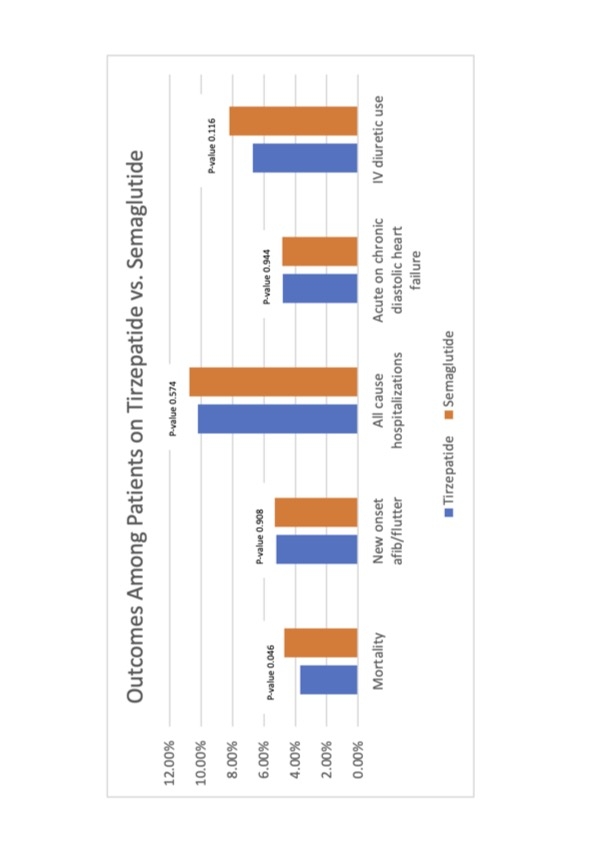
Abstract Body (Do not enter title and authors here): Background: Semaglutide, a GLP-1 receptor agonist, has demonstrated benefit in patients with heart failure with preserved ejection fraction (HFpEF). Tirzepatide, a dual GIP/GLP-1 receptor agonist with superior metabolic effects including weight loss, may provide additional advantages. Given limited head-to-head data, we evaluated clinical outcomes associated with Tirzepatide versus Semaglutide in patients with type 2 diabetes (T2D) and HFpEF. Methods: A retrospective, multicenter cohort study was conducted using TriNetX, a federated network of deidentified electronic health records from over 180 healthcare organizations. Adults with T2D and HFpEF (defined as left ventricular ejection fraction >40%) who initiated either Tirzepatide or Semaglutide between June 2022 and April 2024 were identified. After assessing baseline characteristics, 1:1 propensity score matching was performed to balance cohorts. The primary outcome was all-cause mortality. Secondary outcomes included new-onset atrial fibrillation/flutter, hospitalizations, episodes of acute-on-chronic diastolic heart failure, and intravenous diuretic use. Results: Among 14,157 patients on Semaglutide and 2,222 on Tirzepatide, 2,222 matched pairs were analyzed. All-cause mortality occurred in 81 patients treated with Tirzepatide versus 108 in the Semaglutide group (3.7% vs. 4.9%; risk difference -1.2%; 95% CI, -2.4 to -0.0; p=0.046). There were no significant differences in new-onset atrial fibrillation/flutter (3.3% vs. 3.4%; p=0.908), hospitalizations (3.1% vs. 3.0%; p=0.574), acute-on-chronic diastolic HF episodes (3.3% vs. 3.3%; p=0.944), or intravenous diuretic use (4.4% vs. 5.4%; p=0.116). Conclusions: In this real-world cohort of patients with T2D and HFpEF, Tirzepatide was associated with a statistically significant reduction in all-cause mortality compared to Semaglutide, without significant differences in other clinical outcomes. These findings support the potential cardiovascular benefit of Tirzepatide in this population and highlight the need for prospective studies to validate its long-term effects.
Murshid, Abdulrahman
(
West Virginia University
, Morgantown , West Virginia , United States )
Awad, Maan
(
West Virginia University
, Morgantown , West Virginia , United States )
Ahmad, Syed
(
West Virginia University
, Morgantown , West Virginia , United States )
Alawad, Saud
(
West Virginia University
, Morgantown , West Virginia , United States )
Thyagaturu, Harshith
(
West Virginia University
, Morgantown , West Virginia , United States )
Author Disclosures:
Abdulrahman Murshid:No Answer
| Maan Awad:DO NOT have relevant financial relationships
| Syed Ahmad:DO NOT have relevant financial relationships
| Saud Alawad:No Answer
| Harshith Thyagaturu:DO NOT have relevant financial relationships