
Logo

American Heart Association

  16
  0


Final ID: MP1915

Chronic Migraine Alters Heart-Brain Connectivity: Insights from Fragmentation Analysis of Heart Rate Variability

Abstract Body (Do not enter title and authors here): Introduction: Heart rate fragmentation (HRF) is an inter-beat interval dynamics approach that enhances the analysis of short-term heart rate variability. HRF has been shown to reflect disruptions in the neuroautonomic-electrophysiologic control of the sino-atrial node. Migraine, the fifth leading cause of disability worldwide, is increasingly recognized as a neurovascular disorder with significant autonomic dysfunction. However, HRF signatures in the context of migraine remain unexplored. Here, we investigate HRF dynamics in a validated rodent model of chronic migraine to identify electrophysiological correlates of altered heart-brain connectivity.
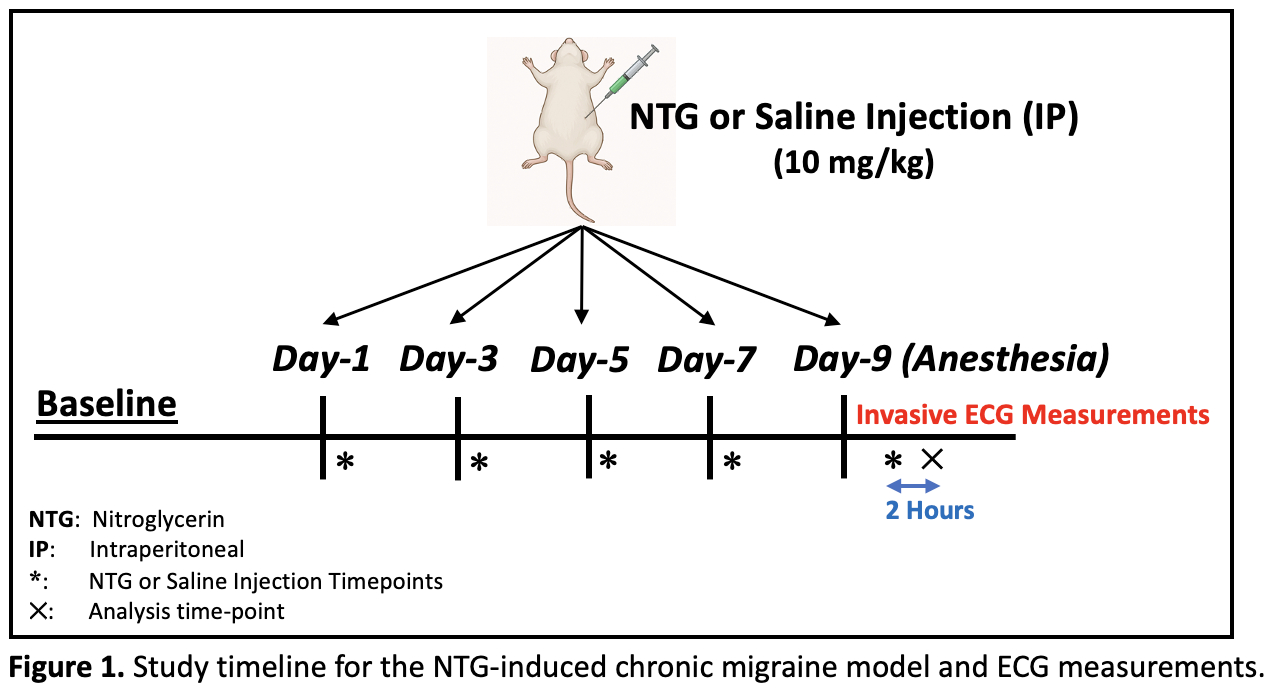
Methods: We used a total number of n=20 Sprague-Dawley rats (50% female; 150-250g; 6-8 weeks), which were randomized into two groups: (1) Chronic migraine Group (n=10, 50% female): rats received repeated intraperitoneal (IP) administration of Nitroglycerin (NTG, 10 mg/kg), a well-established migraine trigger, every other day over a nine-day period (Fig1); (2) Control Group (n=10, 50% female): rats received an equivalent volume of saline at the same regime. At the last injection day, rats were anesthetized prior to NTG or saline injection for invasive electrocardiogram (ECG) recording via subcutaneous needle electrodes. HRF metrics were computed using a 2-minute ECG recording at 2 hours after NTG/saline administration. These included quantification of soft and hard inflection points (Soft: transitions between steady and accelerating/decelerating heart rate; Hard: abrupt switches between acceleration and deceleration).
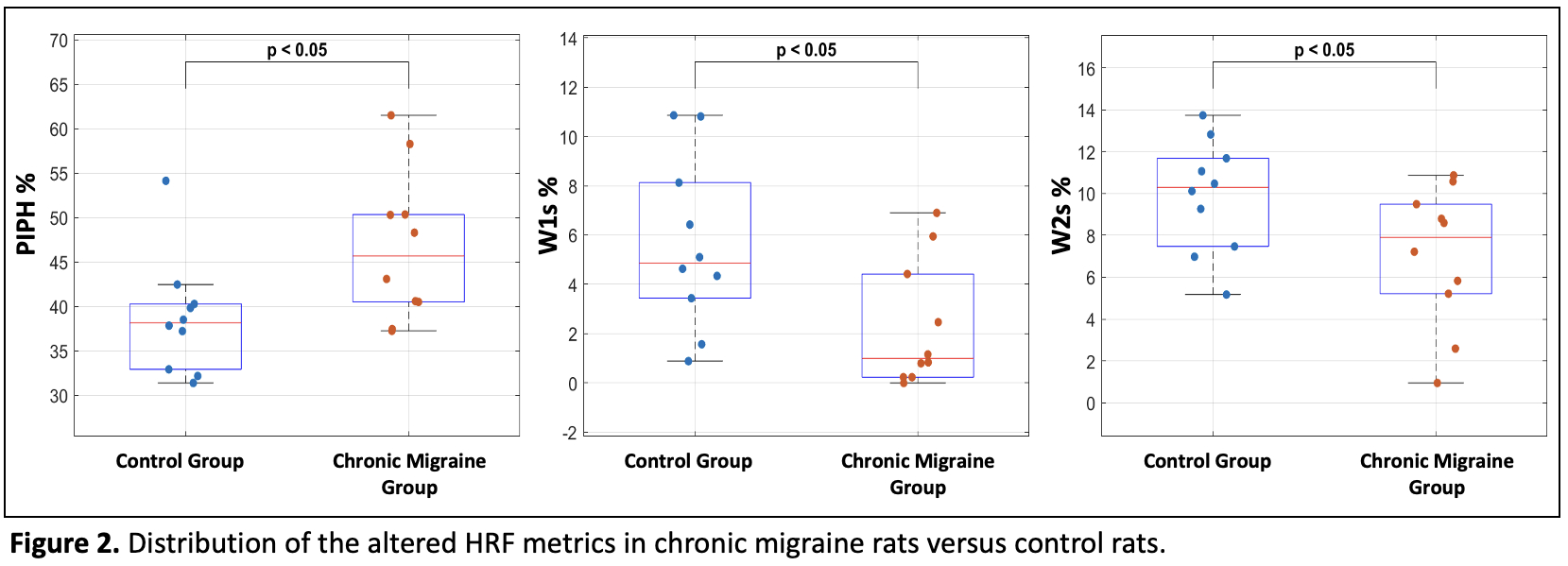
Results: Significant differences were observed between the control and chronic migraine groups (Fig.2) for three HRF metrics. PIPH% (percentage of hard inflection points in heart rate acceleration sign throughout the ECG recording) was significantly increased in the migraine group. W1s% and W2s% (percentages of only one and only two soft inflection points, respectively, in sequences of five consecutive heart rate intervals) were both significantly decreased in the migraine group.
Conclusions: Our findings suggest alterations in heart-brain connectivity in rats with chronic migraine, as evidenced by distinct changes in the HRF. The results also indicate that HRF metrics may serve as novel, noninvasive biomarkers for detecting and monitoring migraine-related autonomic dysfunction. Future studies may explore the clinical utility of HRF-based techniques in management and monitoring of migraine patients.
  • Alavi, Rashid  ( Caltech , Los Angeles , California , United States )
  • Li, Jiajun  ( University of Southern California , Los Angeles , California , United States )
  • Dai, Wangde  ( HMRI , Pasadena , California , United States )
  • Carreno, Juan  ( HMRI , Pasadena , California , United States )
  • Al-ezzi, Abdulhakim  ( Huntington Medical Research Institu , Pasadena , California , United States )
  • Pahlevan, Niema  ( University of Southern California , Los Angeles , California , United States )
  • Gharib, Morteza  ( California Institute of Technology , Pasadena , California , United States )
  • Arakaki, Xianghong  ( Huntington Med. Res. Inst. , Pasadena , California , United States )
  • Kloner, Robert  ( Huntington Medical Research Inst. , Pasadena , California , United States )
  • Author Disclosures:
    Rashid Alavi: DO NOT have relevant financial relationships | Jiajun Li: DO NOT have relevant financial relationships | Wangde Dai: No Answer | Juan Carreno: DO NOT have relevant financial relationships | Abdulhakim Al-Ezzi: No Answer | Niema Pahlevan: DO have relevant financial relationships ; Consultant:Avicena LLC (Ventric Health):Active (exists now) ; Ownership Interest:Avicena LLC (Ventric Health):Active (exists now) | Morteza Gharib: No Answer | Xianghong Arakaki: DO NOT have relevant financial relationships | Robert Kloner: DO have relevant financial relationships ; Consultant:Hoskinson Health Clinic:Active (exists now)
Meeting Info:

Scientific Sessions 2025

2025

New Orleans, Louisiana

Session Info:

Heart-Brain Axis in Stroke, Recovery, and Cognitive Resilience

Monday, 11/10/2025 , 10:45AM - 12:00PM

Moderated Digital Poster Session

More abstracts on this topic:
Central Vascular Implication in Neurocognitive Functioning among Men Living with and without HIV

Jones Ray, Palella Frank, Mimiaga Matthew, Witt Mallory, Peven Jamie, Haberlen Sabina, Aziz Mariam, Thorpe Roland, Levitan Emily, Buford Thomas, Blair Jessica, Causey Pruitt Zenoria, Hankes Michael, Vance David, Willig Amanda, Huck Daniel, Post Wendy, Masters Mary

Alterations in Heart Rate Variability After Ischemic Stroke in Rats: Heart-Brain Connectivity

Alavi Rashid, Dai Wangde, Li Jiajun, Carreno Juan, Pahlevan Niema, Arakaki Xianghong, Gharib Morteza, Kloner Robert

More abstracts from these authors:
New Insights from Time-Frequency Analysis of Electroencephalogram throughout Ischemic Stroke in Rats

Alavi Rashid, Li Jiajun, Dai Wangde, Carreno Juan, Arakaki Xianghong, Pahlevan Niema, Gharib Morteza, Kloner Robert

Alterations in Heart Rate Variability After Ischemic Stroke in Rats: Heart-Brain Connectivity

Alavi Rashid, Dai Wangde, Li Jiajun, Carreno Juan, Pahlevan Niema, Arakaki Xianghong, Gharib Morteza, Kloner Robert

You have to be authorized to contact abstract author. Please, Login
Not Available