
Online Cognitive Behavioral Therapy for Depressive Symptoms in Rural Patients with Cardiac Disease: Impact on Hospitalizations and Mortality
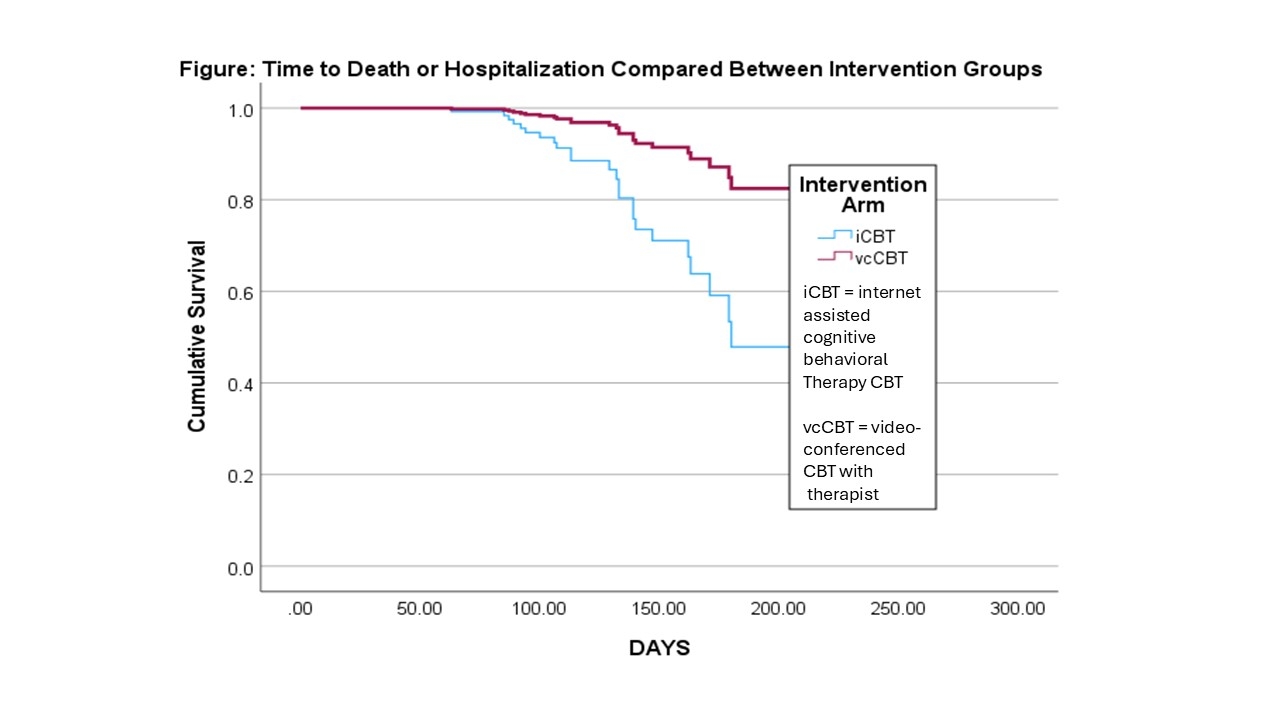
Abstract Body (Do not enter title and authors here): Introduction: Rural areas experience marked disparities in cardiac and mental health, and in access to healthcare, with higher levels of cardiac disease and depression than urban areas. Rural cardiac patients with depressive symptoms usually do not receive needed therapy because of lack of mental health providers and difficulty accessing mental health care, putting them at excess risk for progression of cardiac disease, hospitalization and death. Cognitive behavioral therapy (CBT) reduces depressive symptoms in cardiac patients, but in its traditional form (in-person) is inaccessible to most rural patients. Wireless internet technology can make CBT accessible. In a recent randomized controlled comparative effectiveness trial we demonstrated the similar efficacy of two types of online CBT: 1) real-time, video-conferenced CBT with a therapist (vcCBT); and 2) self-administered internet-based CBT without a therapist (iCBT). Both therapies resulted in statistically and clinically significant reductions in depressive symptoms, but we do not yet know the impact on hospitalization and mortality. Purpose: Our aim was to compare the impact of vcCBT vs iCBT, 6 months after therapy, on the combined end-point of all-cause hospitalization and mortality. Methods: In this randomized controlled trial (N = 303, mean age 58 ± 12 years, 49% women) rural cardiac patients who had at least moderate depressive symptoms underwent 6-8 weeks of CBT delivered as either vcCBT or iCBT. Depressive symptoms were measured using the Patient Health Questionnare-9. Hospitalization and mortality were measured using patient and family interviews and electronic health records. Data were analyzed using Cox regression with a time-dependent covariant (i.e., depressive symptoms). Results: Patients in the vcCBT compared to iCBT group had similar levels of depressive symptoms at baseline (11.2±5 vs 11.3±5, p=0.45; respectively). Both groups experienced reductions in depressive symptoms of 38% vs 35%, p <0.001; respectively. Patients in the iCBT group were 3.8 times more likely than those in vcCBT to experience hospitalization or mortality during follow up (p < 0.007; Figure). Conclusion: Despite similar reductions in depressive symptoms, vcCBT demonstrated superior effects on the combined end-point. This finding suggests that online CBT, which allows interaction with a therapist and specific personalized therapy may be superior because it provides specific coping skills in the long term.
Moser, Debra
( UNIVERSITY OF TENNESSEE, KNOXVILLE
, Knoxville
, Tennessee
, United States
)
Wu, Jia-rong
( University of TENNESSEE KNOXVILLE
, Knoxville
, Tennessee
, United States
)
Biddle, Martha
( University of Kentucky
, Lexington
, Kentucky
, United States
)
Lin, Chin-yen
( Auburn
, Auburn
, Alabama
, United States
)
Cha, Geunyeong
( University of Tennessee
, Knoxville
, Tennessee
, United States
)
Thapa, Ashmita
( UNIVERSITY OF TENNESSEE, KNOXVILLE
, Knoxville
, Tennessee
, United States
)
Kang, Junghee
( University of Kentucky
, Lexington
, Kentucky
, United States
)
Latimer, Abigail
( Univ of Kentucky
, Lexington
, Kentucky
, United States
)
Chung, Misook
( Vanderbilt University
, Nashville
, Tennessee
, United States
)
Author Disclosures:
Debra Moser:DO NOT have relevant financial relationships
| Jia-Rong Wu:DO NOT have relevant financial relationships
| Martha Biddle:No Answer
| Chin-Yen Lin:No Answer
| Geunyeong Cha:DO NOT have relevant financial relationships
| Ashmita Thapa:DO NOT have relevant financial relationships
| JungHee Kang:DO NOT have relevant financial relationships
| Abigail Latimer:DO NOT have relevant financial relationships
| Misook Chung:DO NOT have relevant financial relationships