Logo

American Heart Association

  13
  0


Final ID: MP985

Machine Learning Models to Predict High Atrial Fibrillation Burden Post-Catheter Ablation in Patients with Persistent AF: Insights from the DECAAF II Trial

Abstract Body (Do not enter title and authors here): Background:
High atrial fibrillation (AF) burden is associated with increased risk of stroke and heart failure. While catheter ablation reduces AF burden in most patients, a minority remain at risk for high AF burden after the procedure.

Objective:
In this study, we aimed to utilize machine learning to predict high AF burden post-ablation in patients with persistent AF.

Methods: This study analyzed six hundred and eighty-five with persistent AF (mean age: 62.0 ± 9.1; women: 20%) who underwent catheter ablation in the DECAAF II trial and were followed for a total of 540 days. Four machine-learning models—Elastic Net, Decision Tree, Random Forest, and XGBoost—were developed to predict each of AF recurrence and AF burden ≥10% using 200 pre-ablation variables, including clinical, MRI, and laboratory data. The models were trained and validated using stratified 5-fold cross-validation. SHapley Additive exPlanations (SHAP) were derived to explain the most impactful features collected from each patient.

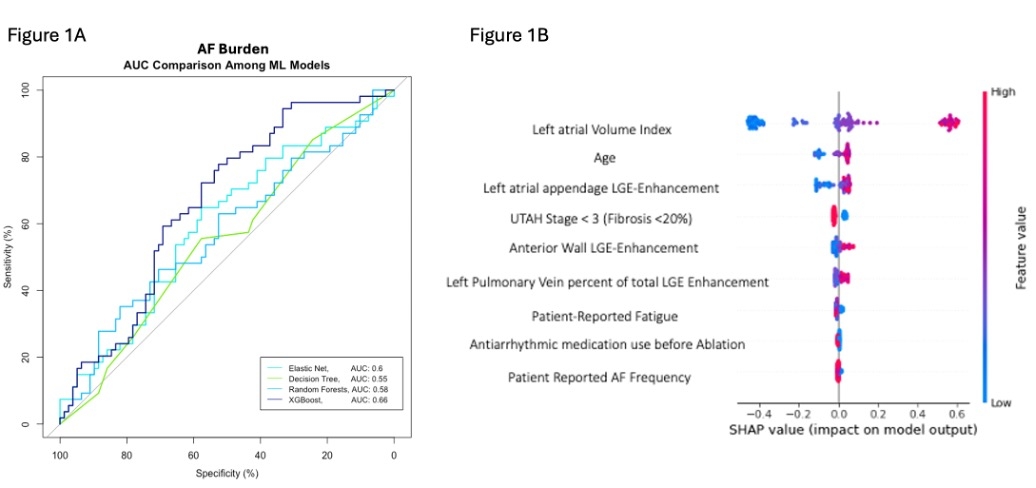
Results: The XGBoost models outperformed all other models in predicting AF recurrence (30 variables; cross-validated AUC = 0.64 ± 0.04) and AF burden ≥ 10% (27 variables; cross-validated AUC of 0.66 ± 0.03) (Figure 1A). SHAP analysis revealed the top predictors of high AF burden on a patient-specific level, including left atrial volume index (importance: 0.1), age (0.02), left atrial appendage enhancement (0.01), Utah stage <3 (0.01), and left pulmonary vein enhancement percentage (0.01). Fatigue at rest (0.01) and frequency of AF episodes (0.001) based on patient-filled questionnaires (University of Toronto Atrial Fibrillation Severity Scale- AFSS) did contribute to the prediction (Figure 1B).

Conclusion: XGBoost models, augmented by SHAP explainability, were the most reliable and explainable models for predicting both recurrence and high post-ablation AF burden (≥10%). These models can lead to a more granular risk stratification and facilitate future patient-specific management.
  • Bidaoui, Ghassan  ( Tulane University , New Orleans , Louisiana , United States )
  • Menassa, Yara  ( Tulane University , New Orleans , Louisiana , United States )
  • Liu, Yingshuo  ( Tulane University , New Orleans , Louisiana , United States )
  • Hassan, Abboud  ( Tulane School of Medicine , New Orleans , Louisiana , United States )
  • Jia, Yishi  ( Tulane University , New Orleans , Louisiana , United States )
  • Lim, Chanho  ( Tulane University , New Orleans , Louisiana , United States )
  • Noujaim, Charbel  ( Tulane Univeristy , New Orleans , Louisiana , United States )
  • Mekhael, Mario  ( Tulane University , New Orleans , Louisiana , United States )
  • Rao, Swati  ( Tulane University , New Orleans , Louisiana , United States )
  • Kreidieh, Omar  ( Tulane University , New Orleans , Louisiana , United States )
  • Pandey, Amitabh  ( Tulane Univestiy School of Medicine , New Orleans , Louisiana , United States )
  • Yamak, Sarrah  ( texas A&M , Houston , Texas , United States )
  • Marrouche, Nassir  ( Tulane University School of Medicin , New Orleans , Louisiana , United States )
  • Feng, Han  ( Tulane University , New Orleans , Louisiana , United States )
  • Assaf, Ala'  ( Tulane University , New Orleans , Louisiana , United States )
  • Massad, Christian  ( Tulane University , New Orleans , Louisiana , United States )
  • Bsoul, Mayana  ( Tulane University , New Orleans , Louisiana , United States )
  • Younes, Hadi  ( Tulane University , New Orleans , Louisiana , United States )
  • Atasi, Mohammad Montaser  ( Tulane University , New Orleans , Louisiana , United States )
  • Abou Khalil, Michel  ( Tulane University , New Orleans , Louisiana , United States )
  • Author Disclosures:
    ghassan bidaoui: DO NOT have relevant financial relationships | Yara Menassa: DO NOT have relevant financial relationships | Yingshuo Liu: No Answer | Abboud Hassan: No Answer | Yishi Jia: No Answer | Chanho Lim: No Answer | Charbel Noujaim: No Answer | Mario Mekhael: DO NOT have relevant financial relationships | Swati Rao: No Answer | Omar Kreidieh: No Answer | Amitabh Pandey: DO NOT have relevant financial relationships | Sarrah Yamak: No Answer | Nassir Marrouche: DO have relevant financial relationships ; Consultant:Biosense Webster:Active (exists now) ; Research Funding (PI or named investigator):Samsung:Active (exists now) ; Research Funding (PI or named investigator):Sanofi:Active (exists now) ; Research Funding (PI or named investigator):Boston Scientific:Active (exists now) ; Research Funding (PI or named investigator):GE:Active (exists now) ; Research Funding (PI or named investigator):Siemens:Active (exists now) ; Research Funding (PI or named investigator):Biosense Webster:Active (exists now) ; Research Funding (PI or named investigator):Medtronic:Active (exists now) ; Research Funding (PI or named investigator):Abbott:Active (exists now) ; Speaker:Sanofi:Active (exists now) ; Speaker:AtriCure:Active (exists now) ; Speaker:Biosense Webster:Active (exists now) ; Speaker:Abbott:Active (exists now) ; Consultant:AtriCure:Active (exists now) ; Consultant:Boston Scientific:Active (exists now) | Han Feng: DO NOT have relevant financial relationships | Ala' Assaf: DO NOT have relevant financial relationships | Christian Massad: DO NOT have relevant financial relationships | Mayana Bsoul: DO NOT have relevant financial relationships | Hadi Younes: No Answer | MOHAMMAD MONTASER ATASI: DO NOT have relevant financial relationships | Michel Abou Khalil: DO NOT have relevant financial relationships
Meeting Info:

Scientific Sessions 2025

2025

New Orleans, Louisiana

Session Info:

Harnessing AI: Innovations in Arrhythmia Detection and Management

Saturday, 11/08/2025 , 09:15AM - 10:30AM

Moderated Digital Poster Session

More abstracts on this topic:
A novel risk score predicts the prevalence of left atrial low-voltage areas and rhythm outcome in patients undergoing long-standing persistent atrial fibrillation ablation

Ooka Hirotaka, Nakao Sho, Kusuda Masaya, Ariyasu Wataru, Kudo Satoshi, Fujii Subaru, Mano Toshiaki, Matsuda Yasuhiro, Masuda Masaharu, Okamoto Shin, Ishihara Takayuki, Nanto Kiyonori, Tsujimura Takuya, Hata Yosuke, Uematsu Hiroyuki

Ablation for Atrial Fibrillation: A Comprehensive Meta-Analysis of Randomized Controlled Trials with Reconstructed Time-to-Event Data

Mi Jiaqi, Katapadi Aashish, Darden Douglas, Uppalapati Sree Varuntej, Kabra Aanya, Katapadi Aashika

More abstracts from these authors:
Pulsed Field Ablation Is Not Functionally Benign: Left Atrial Impact Mirrors Radiofrequency Ablation

Massad Christian, Hassan Abboud, Liu Yingshuo, Jia Yishi, Abi-rached Joe, Abou Zeid Karl, Noujaim Charbel, Dagher Lilas, Mekhael Mario, Rao Swati, Kreidieh Omar, Atasi Mohammad Montaser, Pandey Amitabh, Marrouche Nassir, Abou Khalil Michel, Bidaoui Ghassan, Younes Hadi, Bsoul Mayana, Menassa Yara, Feng Han, Lim Chanho

Adult Congenital Heart Disease and Atrial Fibrillation: A Double Burden on Cardiovascular Outcomes

Menassa Yara, Nahle Tarek, Lim Chanho, Hassan Abboud, Liu Yingshuo, Assaf Ala', El Hajjar Abdel Hadi, Noujaim Charbel, Dagher Lilas, Mekhael Mario, Rao Swati, Bsoul Mayana, Kreidieh Omar, Pandey Amitabh, Borgi Jamil, Marrouche Nassir, Atasi Mohammad Montaser, Jia Yishi, Feng Han, Abou Khalil Michel, Massad Christian, Bidaoui Ghassan, Younes Hadi

You have to be authorized to contact abstract author. Please, Login
Not Available