Soluble Urokinase Plasminogen Activator Receptor (suPAR), Lipoprotein(a), and Cardiovascular Outcomes in the Multi-Ethnic Study of Atherosclerosis (MESA)
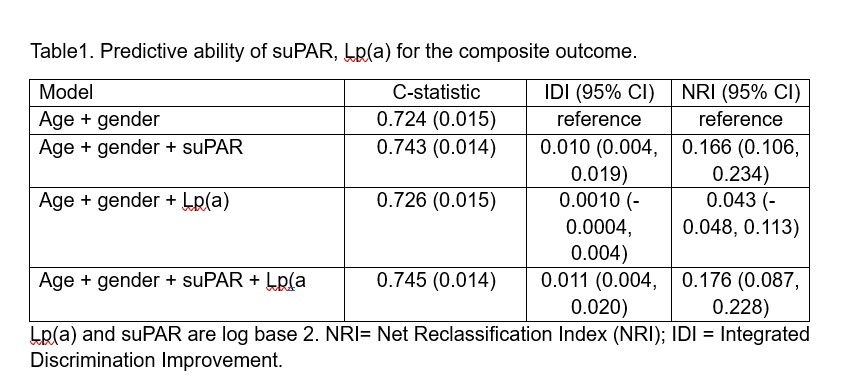
Abstract Body (Do not enter title and authors here): Background: Chronic inflammation and elevated lipoprotein(a) [Lp(a)] are key contributors to residual cardiovascular risk. Soluble urokinase plasminogen activator receptor (suPAR), a stable immune-derived glycoprotein, has been causally linked to atherosclerosis. While both suPAR and Lp(a) are individually associated with cardiovascular disease (CVD) outcomes, their relationship and comparative prognostic value remain unclear. Methods: We included 4,357 participants without known CVD from the from the Multi-Ethnic study of atherosclerosis (MESA), who had both suPAR and Lp(a) measurements. Spearman’s rank correlation tested associations between the two biomarkers. Cox proportional hazards models evaluated the associations with the composite outcome of all-cause death, CVD death, myocardial infarction, or stroke. Models were adjusted for age, sex, race, BMI, smoking, eGFR, hypertension, diabetes, LDL-C, HDL-C, and mutually for Lp(a) or suPAR. We assessed the predictive ability of biomarkers using discrimination analysis. Results: Median age was 62 years (SD 10.4), 48% were male, and 37.3% were white. Median suPAR was 2.57 ng/mL (IQR 2.0–3.1), and Lp(a) was 17.5 mg/dL (IQR 8.0–39.2). suPAR and Lp(a) were not correlated (Spearman’s rho = 0.008; p = 0.60). In fully adjusted models, elevated suPAR (>3 ng/mL) was associated with a 75% higher risk of the composite outcome (aHR 1.75; 95% CI 1.44–2.26). High Lp(a) (>70 mg/dL) was also associated with increased risk, though of lower magnitude compared to suPAR (aHR 1.50; 95% CI 1.06–2.13). suPAR showed superior risk discrimination performance compared to Lp(a), and adding Lp(a) to suPAR did not improve model performance (Table1). Conclusion: suPAR and Lp(a) are independent biomarkers that do not correlate and reflect distinct inflammatory and lipoprotein-mediated pathways contributing to residual cardiovascular risk. In this low-risk community-based cohort, suPAR is a strong independent biomarker of residual risk and the addition of Lp(a) did not improve risk prediction beyond suPAR.
Ismail, Anis
(
University of Texas Medical Branch
, Galveston , Texas , United States )
Hutten, Christina
(
University of Michigan Medicine
, Chicago , Illinois , United States )
Ghazzal, Bahjat
(
UMass Chan Medical School
, Worcester , Massachusetts , United States )
Blakely, Pennelope
(
University of Texas Medical Branch
, Galveston , Texas , United States )
Heckbert, Susan
(
UNIVERSITY OF WASHINGTON
, Seattle , Washington , United States )
Tsai, Michael
(
UNIVERSITY MINNESOTA
, Minneapolis , Minnesota , United States )
Hayek, Salim
(
University of Texas Medical Branch
, Galveston , Texas , United States )
Author Disclosures:
Anis Ismail:DO NOT have relevant financial relationships
| Christina Hutten:No Answer
| Bahjat Ghazzal:No Answer
| Pennelope Blakely:DO NOT have relevant financial relationships
| Susan Heckbert:DO NOT have relevant financial relationships
| Michael Tsai:No Answer
| Salim Hayek:DO have relevant financial relationships
;
Speaker:Boeringer-Ingelheim:Past (completed)
; Speaker:Siemens:Past (completed)
; Speaker:LexPharma:Past (completed)