Logo

American Heart Association

  31
  0


Final ID: 4370368

AI-Predicted Osteoporosis from Preprocedural CT Scans Predicts Mortality After TAVR: A Multicenter Study

Abstract Body (Do not enter title and authors here): Background:
Osteoporosis and sarcopenia are common but underrecognized contributors to frailty in older adults undergoing transcatheter aortic valve replacement (TAVR). Standard risk scores omit musculoskeletal parameters despite their known association with adverse outcomes.

Objective:
To evaluate whether osteoporosis predicted by an AI-based model using routine pre-TAVR CT scans is associated with long-term mortality in a large, multicenter TAVR cohort.

Methods:
We developed a radiomics-based machine learning model trained on 252 patients with paired CT and dual-energy X-ray absorptiometry (DXA) scans from Jewish General Hospital and McGill University Health Centre (Canada). The model estimated lumbar bone mineral density (BMD) and T-scores and was applied to preprocedural contrast-enhanced CT scans routinely acquired for TAVR planning in 906 patients across five institutions in the US, Canada, and Ireland. Osteoporosis was defined as AI-predicted T-score ≤ –2.5. Skeletal muscle density was extracted from the same CTs. Associations with all-cause mortality were assessed using Cox regression.

Results:
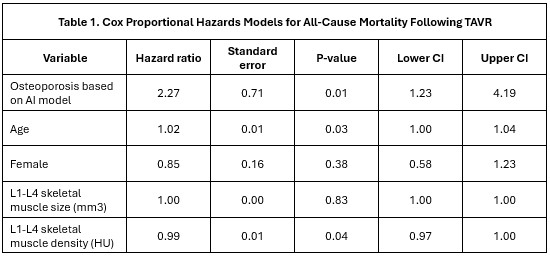
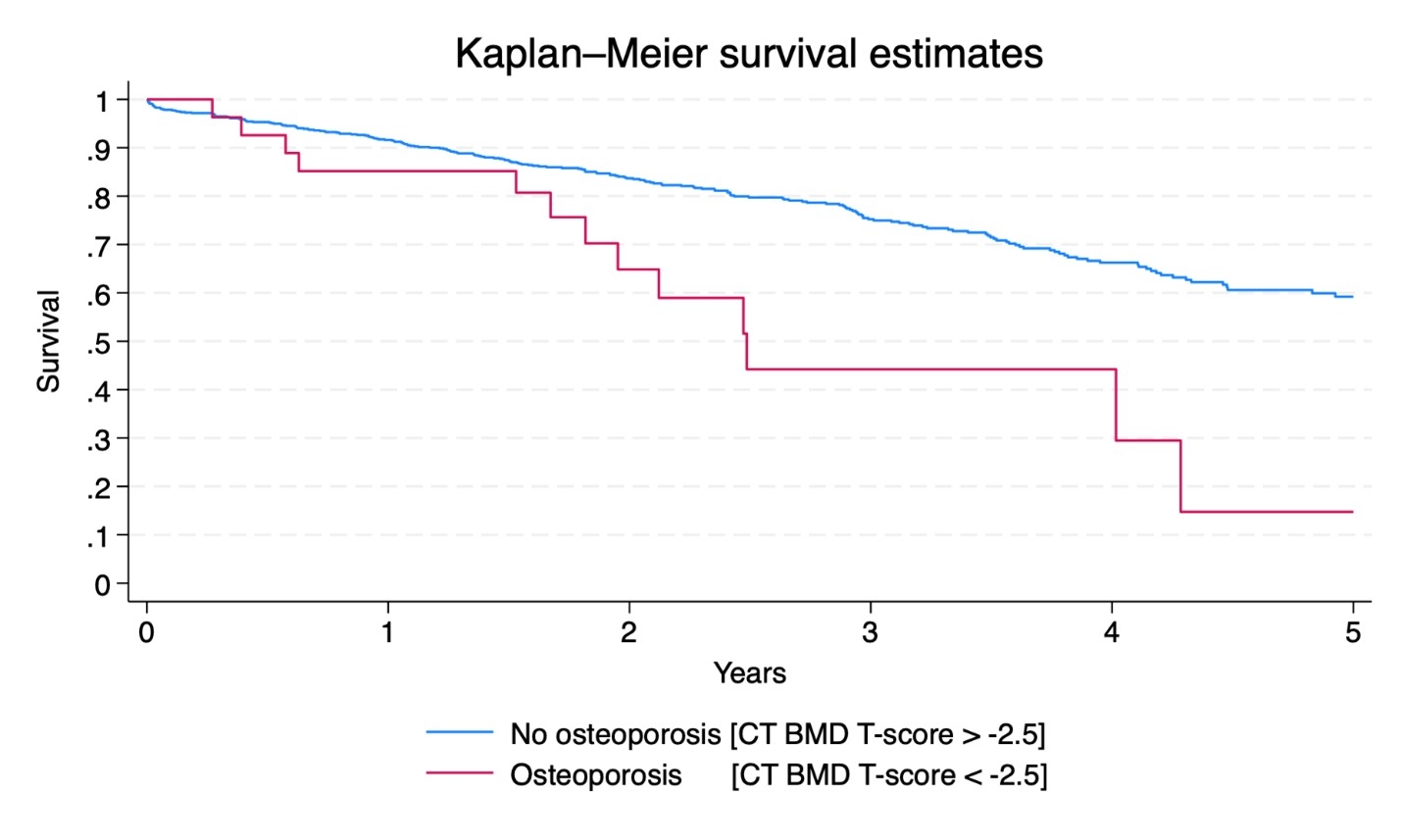
The radiomics-based regression model demonstrated strong agreement with DXA-derived BMD, achieving a mean absolute error of 0.06, R2 of 0.87, and correlation coefficient of 0.93. The corresponding classification model predicting WHO T-score categories (normal, osteopenia, osteoporosis) achieved an overall accuracy of 0.82. Applied to the external TAVR cohort (n=906), the model identified 3.0% (27/906) of patients as osteoporotic (T-score ≤ –2.5). AI-defined osteoporosis was significantly associated with increased long-term mortality (HR 2.27; 95% CI: 1.23–4.19; p=0.009). Higher skeletal muscle density was also associated with reduced mortality (HR per 1 HU increase: 0.987; p=0.041). Patients classified as osteoporotic had lower muscle volume and higher frailty scores. Kaplan–Meier survival analysis further demonstrated that osteoporotic patients had significantly lower long-term survival. Although only 3% of the cohort had osteoporosis, survival curves diverged early and remained separated, suggesting this subgroup represents a clinically vulnerable population.

Conclusion:
An automated AI-based model accurately estimates BMD from routine pre-TAVR imaging and identifies patients at increased mortality risk. Opportunistic CT-based assessment of bone and muscle health may enhance frailty screening and risk stratification in older adults undergoing TAVR.
  • Arif, Saleena Gul  ( McGill University , Montreal , Quebec , Canada )
  • Iram, Amna  ( Allama Iqbal Medical College , Lahore , Pakistan )
  • D Amico Gandia, Enzo  ( McGill University , Montreal , Quebec , Canada )
  • Zhang, Ding Yi  ( McGill University , Montreal , Quebec , Canada )
  • Afilalo, Jonathan  ( McGill University , Montreal , Quebec , Canada )
  • Author Disclosures:
    Saleena Gul Arif: DO NOT have relevant financial relationships | Amna Iram: No Answer | Enzo D'Amico-Gandia: DO NOT have relevant financial relationships | Ding Yi Zhang: DO NOT have relevant financial relationships | Jonathan Afilalo: DO NOT have relevant financial relationships
Meeting Info:

Scientific Sessions 2025

2025

New Orleans, Louisiana

Session Info:

From Molecules to Mechanics: Top Translational Advances in Valvular Heart Disease

Saturday, 11/08/2025 , 09:45AM - 11:00AM

Abstract Oral Session

More abstracts on this topic:
AI-CVD vs. PREVENT for Predicting Incident Heart Failure: The Multi-Ethnic Study of Atherosclerosis (MESA)

Naghavi Morteza, Mirjalili Seyed Reza, Atlas Kyle, Zhang Chenyu, Reeves Anthony, Azimi Amir, Wong Nathan

A Novel Imaging Biomarker to Make Precise Outcome Predictions for Patients with Acute Ischemic Stroke

Mallavarapu Monica, Kim Hyun Woo, Iyyangar Ananya, Salazar-marioni Sergio, Yoo Albert, Giancardo Luca, Sheth Sunil, Jeevarajan Jerome

You have to be authorized to contact abstract author. Please, Login
Not Available