Hybrid Rule-Based and Large Language Model Framework Extracts Statin-Related Information from Clinical Notes
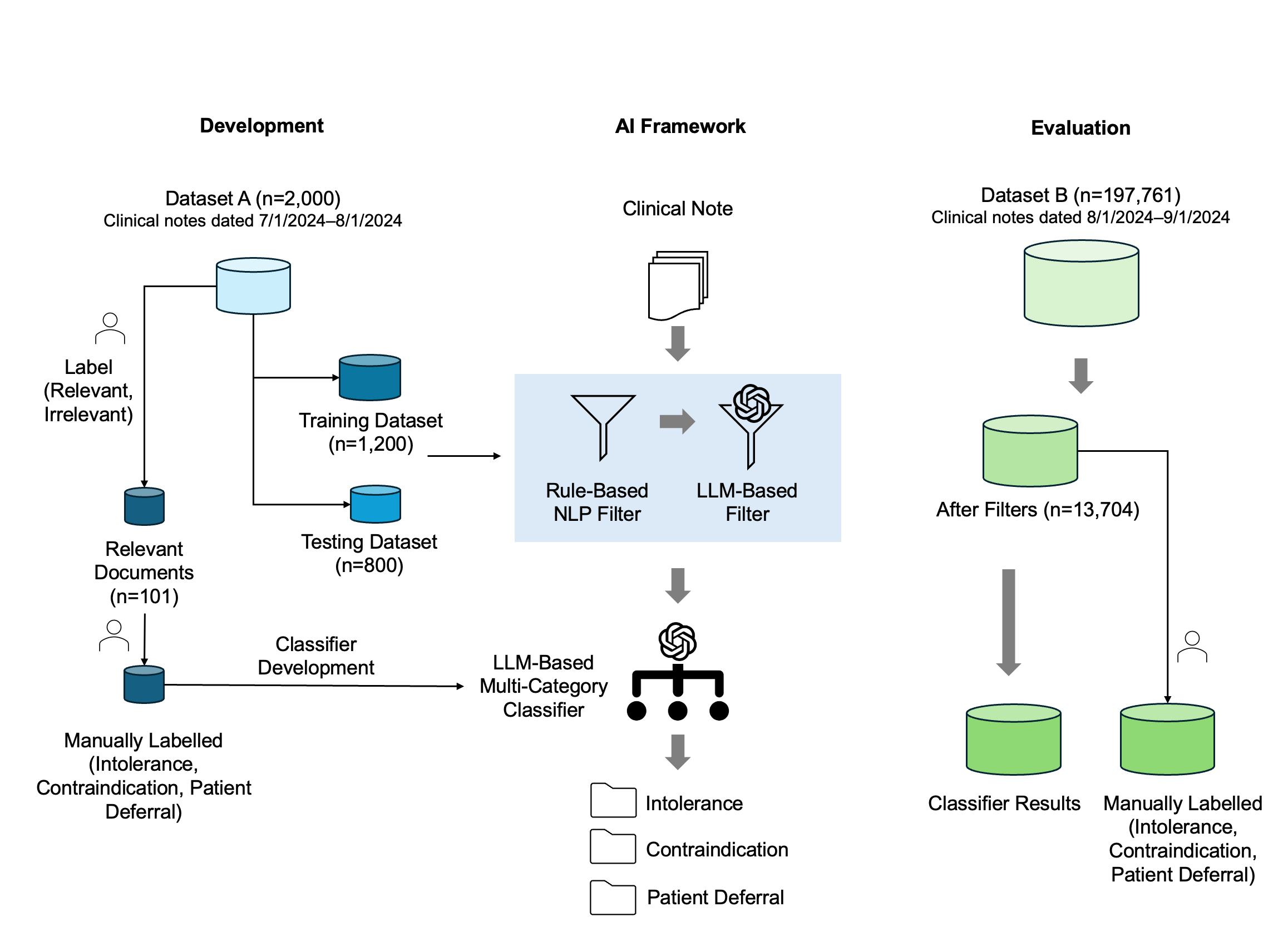
Abstract Body (Do not enter title and authors here): Background: Atherosclerotic cardiovascular disease is a leading cause of morbidity and mortality; statin therapy reduces risk but adherence is suboptimal. Clinical notes contain details on statin intolerance, contraindications, and patient deferral that structured data miss, yet manual extraction is time-consuming. Hypothesis: A hybrid AI framework combining rule-based NLP and LLM-based methods can accurately extract statin-related information from clinical notes to inform clinical decision support. Methods: We developed a three-component framework: (1) a rule-based NLP filter to exclude irrelevant notes, (2) an LLM-based refinement filter to identify notes likely containing relevant information, and (3) an LLM-based multicategory classifier to categorize records into intolerance, contraindications, and deferral. Dataset A (2,000 notes; July 1–August 1, 2024) from adult primary care visits at Vanderbilt University Medical Center (VUMC) was split into training (n = 1,200) and testing (n = 800) subsets for development and evaluation. Dataset B (197,761 notes; August 1–September 1, 2024) was used for retrospective evaluation. Performance metrics included precision, recall, F1, accuracy, and filter-out rate. Patient-level prevalence for each category was measured in Dataset B. Results: In Dataset A, the rule-based NLP filter excluded 81% of notes while retaining all relevant ones (precision = 1.00). The LLM-based refinement filter achieved precision = 0.973, recall = 0.947, F1 = 0.960, accuracy = 0.996, and a filter-out rate of 95.4% on the testing subset. The multicategory classifier attained F1 scores of 0.99 (intolerance), 0.81 (contraindications), and 0.86 (deferral). In Dataset B, after sequential filtering, 45,253 of 197,761 notes remained; the classifier identified 3,027 patients (6.4%) with documented intolerance, 310 (0.7%) with contraindications, and 1,391 (2.9%) who deferred therapy. Conclusions: The hybrid AI framework efficiently processes clinical notes, filtering out over 90% of irrelevant records while maintaining high precision for relevant content. This scalable approach enables extraction of actionable statin-related information and has potential to enhance clinical decision support by integrating patient-level insights to optimize statin therapy.
Liu, Siru
(
Vanderbilt University Medical Cente
, Nashville , Tennessee , United States )
Mccoy, Allison
(
Vanderbilt University Medical Cente
, Nashville , Tennessee , United States )
Wright, Adam
(
Vanderbilt University Medical Cente
, Nashville , Tennessee , United States )
Author Disclosures:
Siru Liu:DO NOT have relevant financial relationships
| Allison McCoy:DO NOT have relevant financial relationships
| Adam Wright:No Answer