
Logo

American Heart Association

  18
  0


Final ID: Sa4085

Inducible Smooth Muscle Cell MMP14 Knockout Decreases Atherosclerosis and Increases Plaque Stability in Ldlr-/- Mice

Abstract Body (Do not enter title and authors here): Background
Smooth muscle cells (SMCs) are essential contributors in atherosclerosis. More than 50% of foam cells within the atherosclerotic lesions of mice or humans are from a SMC origin. SMCs can adopt several phenotypes in atherosclerosis which either increase the plaque stability or propagate atherosclerosis.
Membrane type-1 matrix metalloproteinase or MMP-14 is expressed in SMCs in atherosclerosis. However, whether this expression by SMCs is adaptive or pathogenic is unknown. A constitutive SMC-specific KO leads to aneurysm formation and worsens atherosclerosis. Here, we investigate the effect of inducible SMC-specific Mmp14 KO on mice cardiovascular function and on atherosclerosis development.
Methods
A tamoxifen-inducible SMC-specific Mmp14 KO is utilised under the control of Myh11CreERT2. KO was induced in Myh11CreERT2 Mmp14f/f mice (Mmp14SMCiKO), then, cardiac function was assessed using echocardiography, while vascular function was assessed using wire and pressure myography.
For atherosclerosis, Myh11CreERT2 Mmp14f/f Ldlr-/- mice were fed Western Diet for 16-week. A comprehensive analysis of atherosclerotic lesions was done, and a single nuclei RNAseq analysis of aortas collected at the end point. Primary SMCs were isolated to investigate the possible mechanisms.
Results
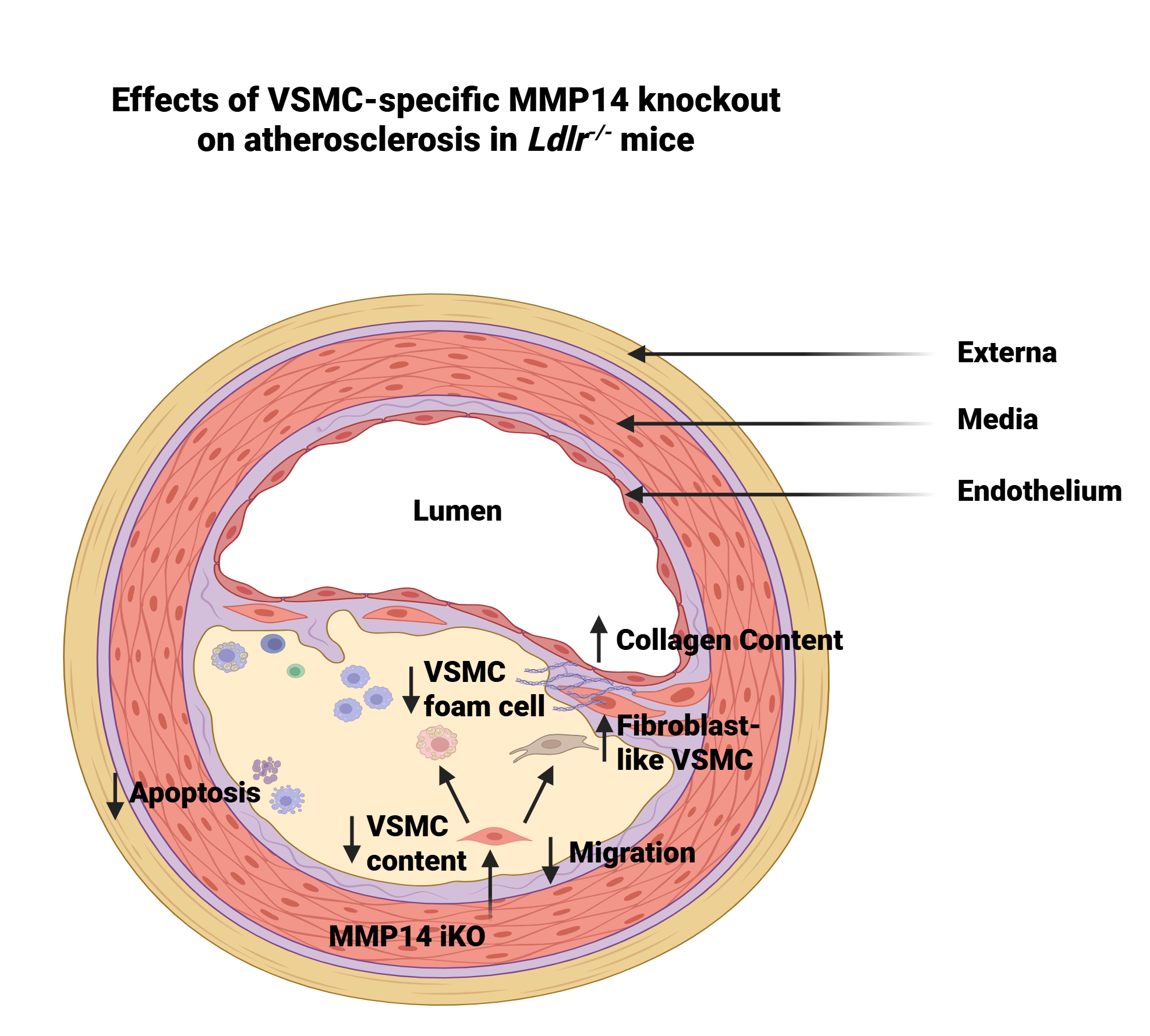
Mmp14SMCiKO has no significant effect on cardiac or vascular function. On the other hand, Ldlr-/-/Mmp14SMCiKO mice have significantly less atherosclerotic lesions (P<0.01) without aneurysm formation. Furthermore, Ldlr-/-/Mmp14SMCiKO lesions have higher collagen content (P<0.05). Sn-RNAseq analysis shows that SMCs in Ldlr-/-/Mmp14SMCiKO mice adopt a fibroblast ECM producing phenotype that increases plaque stability.
Primary SMCs isolated from the aorta of Mmp14SMCiKO mice shows decreased ability to invade through a collagen type I barrier. Similarly, aortic Mmp14SMCiKO SMC explant cultured in collagen type I gel is unable to degrade the surrounding collagen. Finally, primary SMCs lacking MMP14 were less proliferative.
Conclusion
Inducible SMC-specific Mmp14 KO did not affect the cardiovascular function, but significantly reduced atherosclerosis progression and increased the collagen content within Ldlr-/- mice lesions.
Primary SMCs invasion, collagen degradation, and proliferation is significantly reduced in MMP14 KO. Understanding the molecular mechanisms of how MM14 modulates these processes will pave the way for possible therapeutic targets to ameliorate atherosclerosis development.
  • Jarad, Suha  ( University of Alberta , Edmonton , Alberta , Canada )
  • Gu, Hongmei  ( University of Alberta , Edmonton , Alberta , Canada )
  • Gill, Govind  ( University of Alberta , Edmonton , Alberta , Canada )
  • Amadi, Peter  ( University of Alberta , Edmonton , Alberta , Canada )
  • Zhang, Da-wei  ( University of Alberta , Edmonton , Alberta , Canada )
  • Author Disclosures:
    Suha Jarad: DO NOT have relevant financial relationships | Hongmei Gu: No Answer | Govind Gill: No Answer | Peter Amadi: No Answer | Da-wei Zhang: No Answer
Meeting Info:

Scientific Sessions 2025

2025

New Orleans, Louisiana

Session Info:

Emerging Players in Atherosclerosis

Saturday, 11/08/2025 , 10:30AM - 11:30AM

Abstract Poster Board Session

More abstracts on this topic:
A major uremic toxin indoxyl sulfate impairs macrophage efferocytosis and accelerates atherogenesis: a potential mechanism for cardiovascular risk in chronic kidney disease

Jha Prabhash, Kasai Taku, Vromman Amelie, Holden Rachel, Libby Peter, Tabas Ira, Singh Sasha, Aikawa Elena, Aikawa Masanori, Lupieri Adrien, Sonawane Abhijeet, Le Thanh-dat, Becker-greene Dakota, Chelvanambi Sarvesh, Turner Mandy, Nakamura Yuto, Passos Livia

A Loss of Function Polymorphism in the Propeptide of Lysyl Oxidase Exacerbates Atherosclerosis

Jung In-hyuk, Amrute Junedh, Luna Sophia, Wagoner Ryan, Lee Paul, Burks Kendall, Holloway Karyn, Alisio Arturo, Stitziel Nathan

You have to be authorized to contact abstract author. Please, Login
Not Available