
Logo

American Heart Association

  34
  0


Final ID: MP904

Glycemic Control and Risk of Clinical Events in Diabetics Based on Severity of Peripheral Artery Disease: Insights from the Peripheral Artery Disease Long-Term Survival Study

Abstract Body (Do not enter title and authors here): Background:
Poor glycemic control is associated with increased risk of clinical events in diabetics with peripheral artery disease (PAD), especially with risk of chronic limb threatening ischemia (CLTI) and major amputation. Whether patients with more severe PAD achieve a similar benefit with glycemic control remains unclear.

Methods:
The Peripheral Artery Disease: Long-term Survival (PEARLS) is a longitudinal registry of new onset PAD in Veterans based on abnormal ankle brachial index (ABI) <0.9 or toe brachial index (TBI) <0.7. Severe PAD was defined as ABI <0.5 or TBI <0.4 in any limb. Longitudinal glycemic control was assessed using hemoglobin (Hgb) A1c during follow up, categorized as tight (≤7%), moderate (>7%-8%), or poor (>8%). Multivariable Cox regression models, with death as a competing risk, evaluated the association between time-varying HgbA1c and cardiovascular (CV: myocardial infarction or stroke) and limb (CLTI or major amputation) events, stratified by PAD severity.

Results:
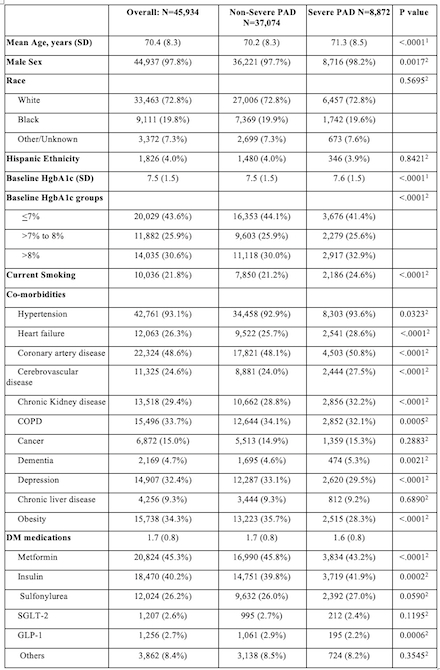
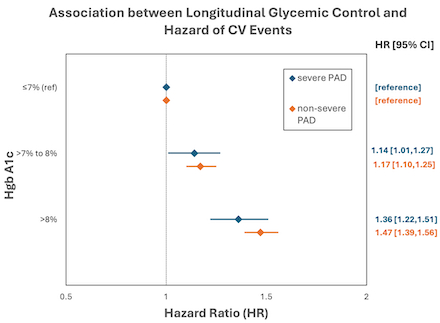
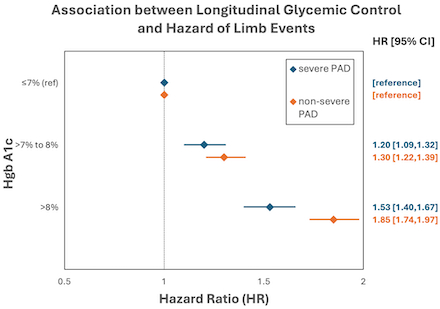
Among 45,934 diabetic PAD patients, 8,872 [19%] had severe PAD, mean age was 70.4 years, 19.8% were Black and 4% were Hispanic. Patients with severe PAD were older and had a higher prevalence of most co-morbidities (Table 1). Differences in baseline HgbA1c and diabetic medications were small, with low overall use of GLP-1 and SGLT-2 inhibitors. Over a median follow up of 3.9 years, patients with severe PAD had a higher incidence (per-100 patient years) of CV (6.2 vs. 4.6) and limb (9.7 vs. 4.1) events compared to non-severe PAD. Poor glycemic control was associated with increased risk of CV events and this association was consistent in both groups (Figure 1; p for interaction=0.59 ). While poor glycemic control was also strongly associated with risk of limb events in both groups, the relative hazard was lower in patients with severe PAD (Figure 2: non-severe PAD: sub-distribution hazard ratio [sHR]: 1.85; 95% CI: 1.74-1.97; severe PAD: sHR 1.53; 95% CI: 1.40-1.67; p for interaction=0.01).

Conclusion:
Among diabetic patients with PAD, poor glycemic control is associated with increased risk of clinical events. Although the risk of limb events associated with poor glycemic control is attenuated in severe PAD, poor control is still associated with >50% increased risk of limb events in such patients. Our findings highlight the importance of optimal glucose control in reducing the risk of clinical events including those with advanced PAD.
  • James, Feroz  ( University of Texas Southwestern , Dallas , Texas , United States )
  • Somisetty, Medha  ( University of Texas Southwestern , Dallas , Texas , United States )
  • Vaughan Sarrazin, Mary  ( University of Iowa , Iowa City , Iowa , United States )
  • Li, Qiang  ( University of Texas Southwestern , Dallas , Texas , United States )
  • Nguyen, Cathy  ( University of Texas Southwestern , Dallas , Texas , United States )
  • Nathani, Rohit  ( University of Texas Southwestern , Dallas , Texas , United States )
  • Girotra, Saket  ( University of Texas Southwestern , Dallas , Texas , United States )
  • Author Disclosures:
    Feroz James: DO NOT have relevant financial relationships | Medha Somisetty: DO NOT have relevant financial relationships | Mary Vaughan Sarrazin: No Answer | Qiang Li: DO NOT have relevant financial relationships | Cathy Nguyen: No Answer | Rohit Nathani: DO NOT have relevant financial relationships | Saket Girotra: DO NOT have relevant financial relationships
Meeting Info:

Scientific Sessions 2025

2025

New Orleans, Louisiana

Session Info:

Medical Therapy in Peripheral Artery Disease

Saturday, 11/08/2025 , 12:15PM - 01:25PM

Moderated Digital Poster Session

More abstracts on this topic:
Analysis of Near-Infrared Spectroscopy Vascular Occlusion Test as a Complement to Ankle-Brachial Index and 6-Minute Walk Test in Patients Diagnosed with Peripheral Artery Disease

Rodriguez Cesar, Lanka Santh Prakash, Maraj Joshua, Alsabbagh Yaman, Farres Sam, Ade Carl, Liu Xiuwen, Delp Judy

Adverse Pregnancy Outcomes Are Associated with Incident Peripheral Artery Disease, Results from the Women’s Health Initiative.

Jackson Elizabeth, Leblanc Erin, Haring Bernhard, Harrington Laura, Allison Matthew, Eaton Charles, Lamonte Michael, Hovey Kathleen, Andrews Chris, Wells Gretchen, Manson Joann, Levitan Emily, Spracklen Cassandra, Wild Robert

More abstracts from these authors:
Poor Glycemic Control is Associated with Increased Risk of Clinical Events in Older Diabetic Patients with Peripheral Artery Disease

Somisetty Medha, James Feroz, Vaughan Sarrazin Mary, Li Qiang, Nguyen Cathy, Nathani Rohit, Girotra Saket

Association Between Blood Pressure and Clinical Events in Peripheral Artery Disease with Small Vessel Disease

Nathani Rohit, Girotra Saket, Vaughan Sarrazin Mary, Chan Paul, Gupta Ajay, Kumbhani Dharam, Li Qiang, Nguyen Cathy, De Lemos James, Beckman Joshua

You have to be authorized to contact abstract author. Please, Login
Not Available