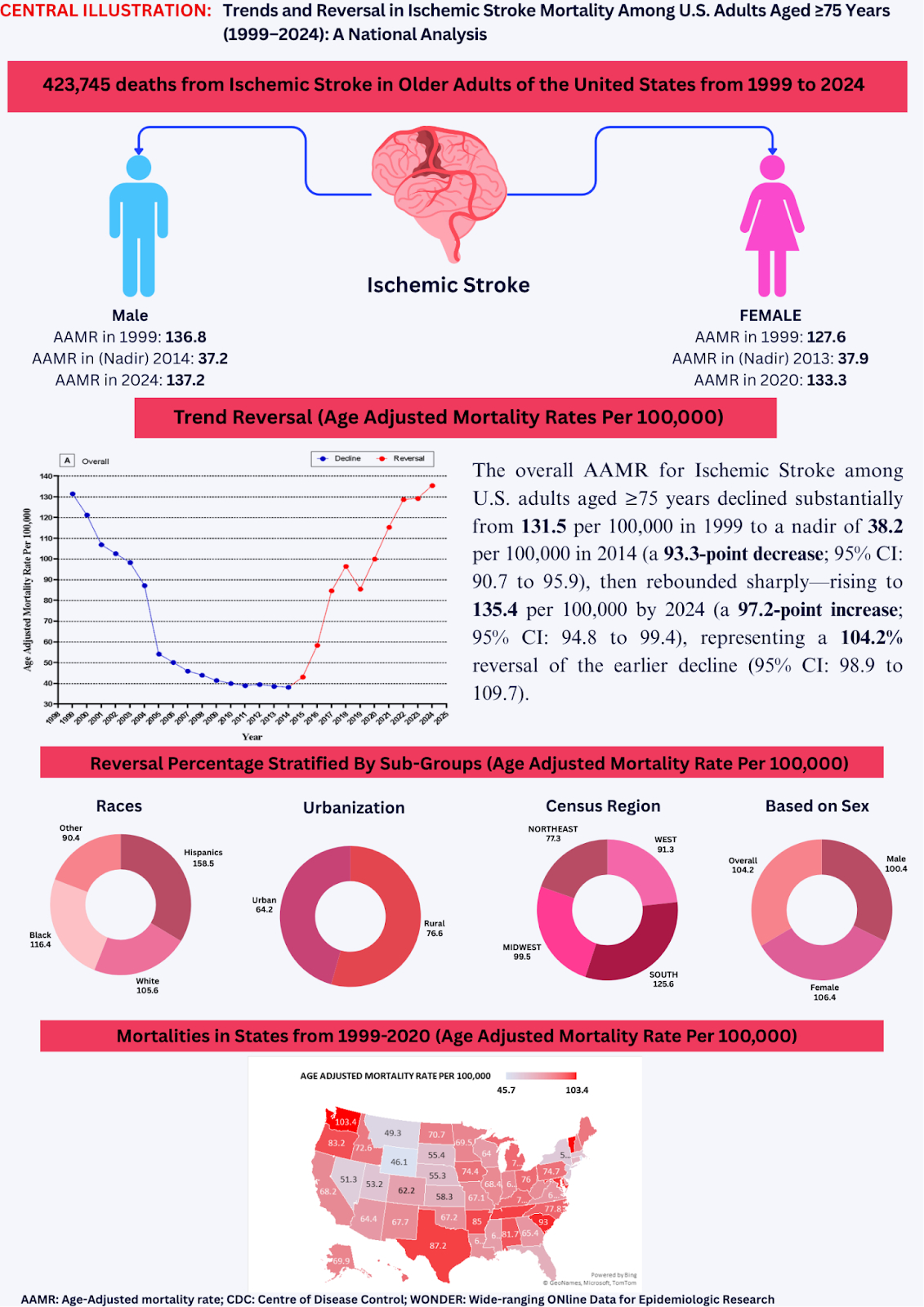
Trends and Reversal in Ischemic Stroke Mortality Among U.S. Adults Aged ≥75 Years (1999–2024): A National Analysis
Abstract Body (Do not enter title and authors here): Introduction/Background: US stroke death rates have declined for decades, but recent national data suggest plateauing or increases in some groups. It is unclear whether this trend extends to the oldest adults.
Research Question/Hypothesis: We examined ischemic stroke mortality trends among US adults ≥75 years (1999–2024) to determine if historical declines have reversed. We hypothesized that mortality decline has ceased and turned upward in this age group.
Methods: Using CDC WONDER underlying-cause-of-death data (ICD-10 I63) for 1999–2024, we calculated annual age-adjusted ischemic stroke mortality rates (2000 standard) for US residents aged ≥75. We applied Joinpoint regression to identify inflection points and estimate annual percentage changes (APCs) and their 95% confidence intervals (CIs). We defined “reversal” as the percentage ratio of the post-inflection mortality increase to the prior decline. Analyses were stratified by sex, race/ethnicity, urbanization, and US Census region.
Results: From 1999 to ~2014, stroke mortality in ≥75s fell steeply, then rose. In Joinpoint analysis, APCs were –12.7%/yr (95% CI –18.7 to –10.1) from 1999–2008 and –3.2% (–9.3 to 2.8) from 2008–2014, followed by +32.2% (8.8–40.7) per year during 2014–2017 and +7.8% (4.1–11.0) from 2017–2024. The nadir occurred ~2014 (38.2 per 100,000). By 2024, the rate reached 135.4 per 100,000 (95% CI 133.9–136.8). The absolute decline of 93.3/100k was offset by a 97.2/100k rise, yielding a 104.2% reversal (95% CI 97.4–104.9). Women and men experienced ~106.4% and 100% reversals, respectively. Among races, reversal was 158.5% in Hispanics (the smallest) versus ~105.6% in non-Hispanic Whites and 116.4% in non-Hispanic Blacks. Rural (76.6%) and urban (64.2%) areas and most regions (Northeast 77.3%, South 125.6%, Midwest 100.0%) saw >100% reversal while the West had 91.3%. All APC changes after 2014 were statistically significant (p<0.05).
Conclusions: In US adults ≥75, ischemic stroke mortality declines have been completely reversed: by 2024, death rates are at or above 1999 levels. These trends predate the COVID-19 era and mirror national stroke mortality stagnation. The findings underscore an urgent need to reinforce stroke prevention, risk factor management, and acute care for the oldest Americans.
Naveed, Muhammad Abdullah
(
Dow Medical College, DUHS
, Karachi , Pakistan )
Chigurupati, Himaja Dutt
(
East Carolina University
, Greenville , North Carolina , United States )
Neppala, Sivaram
(
University of Texas Health SA
, Boerne , Texas , United States )
Khan, Muhammad
(
West Virginia University
, Morgantown , West Virginia , United States )
Munir, Bilal
(
University of California, Davis
, Sacramento , California , United States )
Author Disclosures:
Muhammad Abdullah Naveed:DO NOT have relevant financial relationships
| Bilal Munir:No Answer
| Ahila Ali:No Answer
| Muhammad Omer Rehan:DO NOT have relevant financial relationships
| Hamza Naveed:DO NOT have relevant financial relationships
| Bazil Azeem:DO NOT have relevant financial relationships
| Rabia Iqbal:No Answer
| Himaja Dutt Chigurupati:DO NOT have relevant financial relationships
| Sivaram Neppala:DO NOT have relevant financial relationships
| Muhammad Khan:DO NOT have relevant financial relationships