
Atrial 18F-Fludeoxyglucose Avidity is Higher in Persistent than Paroxysmal Atrial Fibrillation
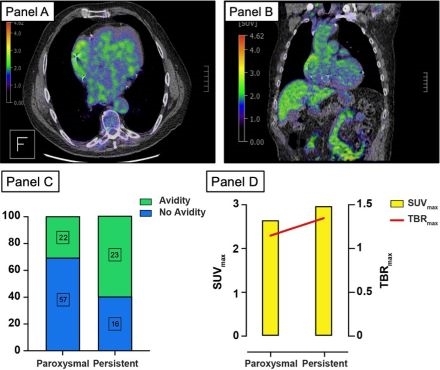
Abstract Body (Do not enter title and authors here): Background: Atrial fibrillation (AF) is marked by underlying inflammation and metabolic changes. Atrial 18F-Fludeoxyglucose (FDG) positron emission tomography (PET) can be used to assess these changes. Previous studies show increased FDG avidity in AF. Aim: We aim to investigate atrial uptake differences between paroxysmal AF (pAF) and persistent AF (perAF). Hypothesis: Patients with perAF exhibit a greater atrial FDG-PET avidity and demonstrate higher quantitative uptake measures compared to those with pAF. Methods: Patients undergoing FDG-PET for the evaluation of cardiac sarcoidosis (CS) were assessed for atrial avidity. Atrial FDG uptake, a semi-quantitative measure, was quantified using standardized uptake value (SUV)-mean, SUV-max, and normalized to the blood pool as the target-to-background ratio (TBR). Qualitatively, intensity with respect to liver uptake (less vs equal or greater), pattern (focal vs diffuse), and location were reported. AF types were determined using patient’s electronic medical records. Results: One hundred and twenty-six patients (age 67 ± 12 years, 26% female, BMI 29.8 ± 6.5 kg/m2) were included in the study. 35 pts (27.4%) met diagnostic criteria for cardiac sarcoidosis (CS). 79 (62.7%) patients had pAF, 39 (31%) had perAF, 8 (6.3%) had an unspecified subtype. Atrial avidity was seen in 45 patients and distributed accordingly: 30 in the right atrium, 13 bi-atrial, and 2 left atrial. Avidity had a predominant diffuse pattern (66.7%) with intensity equal or greater than the liver’s (62%). 23 (58%) of the avid atria were in perAF patients while only 22 (38%) were in pAF patients. Quantitively, aTBRmax was significantly higher in perAF group (1.35 ± 0.51 vs 1.14 ± 0.39, p=0.03). PerAF was associated with a higher aTBRmax (B=0.2, CI 0.03-0.37, p=0.02) after adjusting for cardiac sarcoidosis. Conclusion: Persistent AF is associated with higher qualitative and quantitative atrial FDG-PET avidity compared to paroxysmal AF. Additional studies are needed to better understand causality and mechanisms behind these associations.
Haykal, Romanos
( University of Washington
, Seattle
, Washington
, United States
)
Kassar, Ahmad
( University of Washington
, Seattle
, Washington
, United States
)
Chamoun, Nadia
( University of Washington
, Seattle
, Washington
, United States
)
Chahine, Yaacoub
( University of Washington
, Seattle
, Washington
, United States
)
Hensley, Tori
( University of Washington
, Seattle
, Washington
, United States
)
Al Yasiri, Hala
( University of Washington
, Seattle
, Washington
, United States
)
Andrikopoulou, Efstathia
( University of Washington
, Seattle
, Washington
, United States
)
Sadic, Murat
( University of Washington
, Seattle
, Washington
, United States
)
Akoum, Nazem
( University of Washington
, Seattle
, Washington
, United States
)
Author Disclosures:
Romanos Haykal:DO NOT have relevant financial relationships
| Ahmad Kassar:DO NOT have relevant financial relationships
| Nadia Chamoun:No Answer
| Yaacoub Chahine:DO NOT have relevant financial relationships
| Tori Hensley:No Answer
| Hala Al Yasiri:No Answer
| Efstathia Andrikopoulou:DO have relevant financial relationships
;
Advisor:Tempus Next:Active (exists now)
; Individual Stocks/Stock Options:Cloudstream Medical Imaging:Active (exists now)
; Executive Role:Cloudstream Medical Imaging:Active (exists now)
| Murat Sadic:DO NOT have relevant financial relationships
| Nazem Akoum:DO NOT have relevant financial relationships