Logo

American Heart Association

  19
  0


Final ID: MP1209

Vascular Leak Index Predicts Postoperative Fluid Accumulation Following Cardiac Surgery

Abstract Body (Do not enter title and authors here): Introduction:
Postoperative vascular leak and the associated fluid retention are frequent and clinically significant complications in patients following cardiac surgery. Despite their substantial impact on mortality and morbidity, no easily accessible and validated diagnostic tools exist to quantify endothelial dysfunction and predict fluid shifts. The Vascular Leak Index (VLI) was introduced as a straightforward yet effective tool to assess vascular leak in septic ICU patients. Our study aims to evaluate the applicability and prognostic value of VLI in adult patients following cardiac surgery, specifically evaluating its association with postoperative fluid accumulation.
Hypothesis:
We hypothesize that the VLI is a valid prognostic marker in patients after cardiac surgery and that elevated VLI values are associated with increased postoperative fluid accumulation.
Methods:
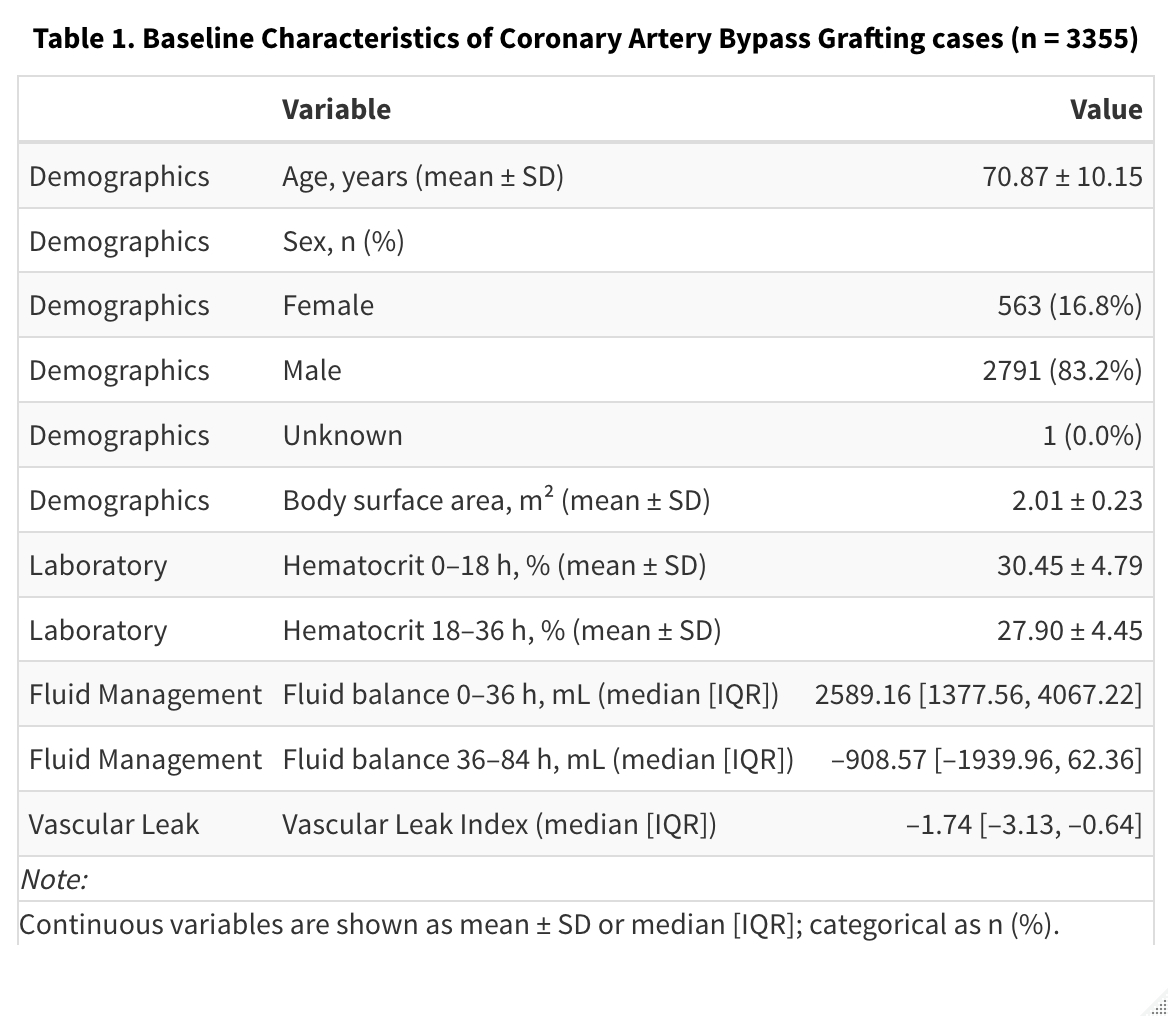
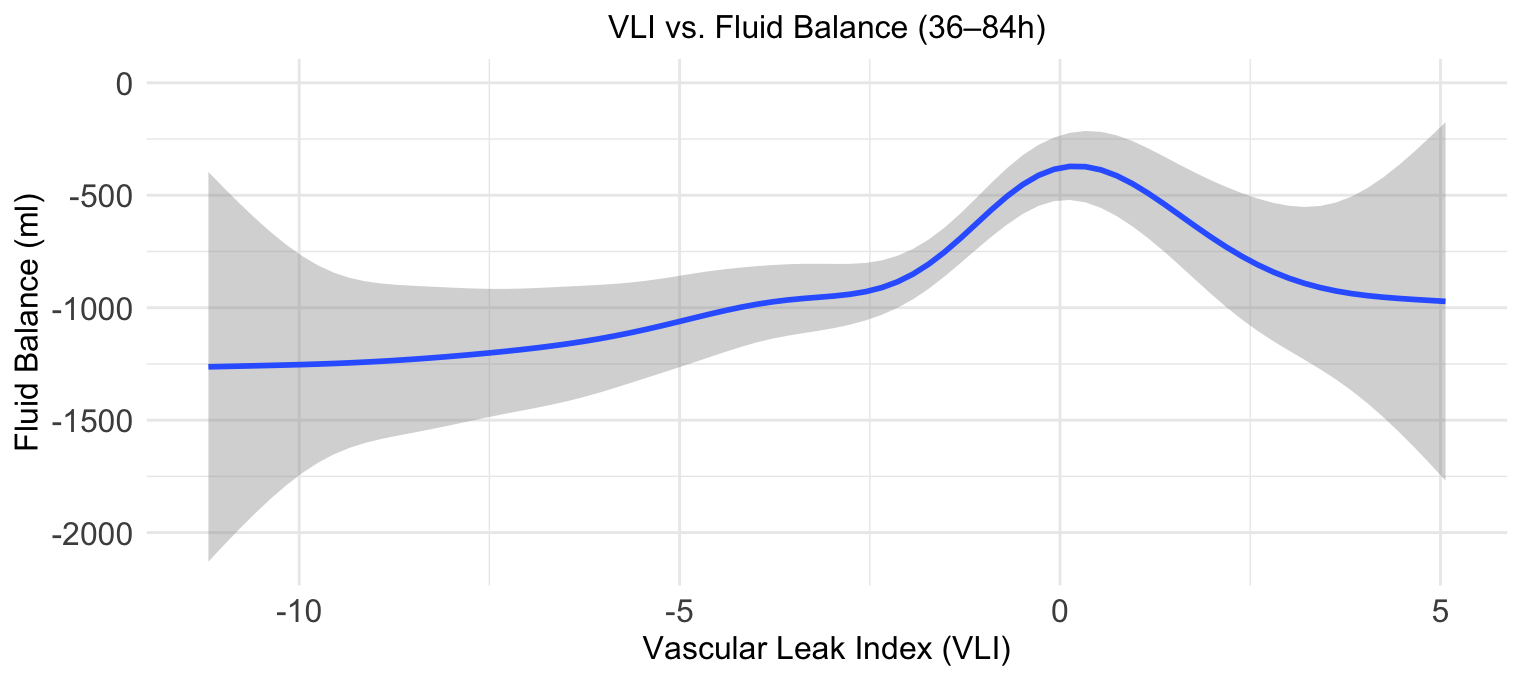
This retrospective cohort study included adult patients undergoing coronary artery bypass grafting, excluding those who received diuretics on the day of surgery or the first postoperative day, as well as those who died within the first four postoperative days. The VLI was calculated using changes in hematocrit from 0-36 h after ICU admission, normalized to net fluid balance and body surface area. The primary outcome was the fluid balance between 36-84 h post-ICU admission. Generalized additive models (GAMs) and linear regression were applied to assess associations.
Results:
A total of 3,355 cases were included (mean age 70.9 years, 16.8% female). The GAM model revealed a significant non-linear association between VLI and subsequent fluid accumulation during ICU hours 36-84 (p<0.001). To further examine the association, patients were stratified into VLI quartiles. Compared to the lowest quartile (Q1), fluid balance was significantly higher in Q3 (β=+313.5 mL, p=0.002) and Q4 (β=+610.8 mL, p<0.001). The linear model demonstrated a significant overall effect of VLI quartile on fluid accumulation (p<0.0001), independent of age and sex.
Conclusion:
Our findings suggest that the VLI, originally developed for sepsis, may also serve as a predictive tool to identify patients at risk of fluid accumulation after cardiac surgery. This highlights the potential of the VLI as a non-invasive stratification and monitoring tool for guiding postoperative ICU fluid management and identifying patients at risk for complications related to fluid accumulation.
  • Hubrich, Julian  ( Brigham and Women's Hospital , Boston , Massachusetts , United States )
  • Simeth, Leonard  ( Brigham and Women's Hospital , Boston , Massachusetts , United States )
  • Heine, Melina  ( Brigham and Women's Hospital , Boston , Massachusetts , United States )
  • Rehman, Muhammad Jamil Ur  ( Brigham and Women's Hospital , Boston , Massachusetts , United States )
  • Heinisch, Paul  ( German Heart Center Munich , San Francisco , California , United States )
  • Wollborn, Jakob  ( Brigham and Women's Hospital , Brookline , Massachusetts , United States )
  • Author Disclosures:
    Julian Hubrich: DO NOT have relevant financial relationships | Leonard Simeth: No Answer | Melina Heine: No Answer | Muhammad Jamil Ur Rehman: DO NOT have relevant financial relationships | Paul Heinisch: No Answer | Jakob Wollborn: DO NOT have relevant financial relationships
Meeting Info:

Scientific Sessions 2025

2025

New Orleans, Louisiana

Session Info:

Beyond the Scalpel: Innovations in Safer, Smarter Cardiac Surgery

Sunday, 11/09/2025 , 11:50AM - 01:00PM

Moderated Digital Poster Session

More abstracts on this topic:
Association between Neurological Complications and Carotid-cerebral Artery Disease after Coronary Artery Bypass Grafting

Liu Yi, Zhu Yunpeng, Jin Wei, Jin Zhijia, Gu Jianwei, Zhao Qiang

A Pilot Study of Post-Discharge Atrial Fibrillation Using a Novel Mobile Electrocardiography Monitoring Device

Iribarne Alexander, Kramer Robert, Moquete Ellen, Hupf Jonathan, Duncan Prezley, Mihelis Efstathia, Borger Michael, Muir Andrew, Starnes Vaughn, Edegran Albin, Fenton Kathleen, Patel Nirav, Taddei-peters Wendy, Moskowitz Alan, Ogara Patrick, Gelijns Annetine, Alexander John, Gillinov A, Bagiella Emilia, D'alessandro David, Dimaio John, Bhavnani Sanjeev, Badhwar Vinay, Sengupta Partho, Johnson Linda, Gajewska-dendek Elzbieta

You have to be authorized to contact abstract author. Please, Login
Not Available