Does Obesity Paradox Influence Outcomes Following Percutaneous Left Atrial Appendage Occlusion? A Propensity-Score Matched Analysis of the TriNetX Global Collaborative Network Database
Abstract Body (Do not enter title and authors here): Background: Percutaneous left atrial appendage occlusion (LAAO) has demonstrated promising results in reducing the risk of stroke in patients with atrial fibrillation who are not candidates for long-term oral anticoagulation. However, the impact of obesity, particularly the “obesity paradox”, on the outcomes following LAAO is unclear.
Methods: The TriNetX Global Collaborative Network database was queried using ICD-10-CM and CPT codes to identify adult patients undergoing percutaneous LAAO. Based on preprocedural BMI, patients were divided into two cohorts: BMI between 18.5 – 29.9 kg/m2 and BMI ≥ 30 kg/m2. The cohorts were then followed for 6 months, 1 year, and 3 years. The cohorts were propensity-score matched (PSM) 1:1 for baseline variables, including age, sex, race, comorbidities, medications, BMI, laboratory data, and LVEF. The primary outcome was all-cause mortality. Statistical analyses were conducted using the in-built statistical software on the TriNetX platform (TriNetX, LLC, Cambridge, MA).
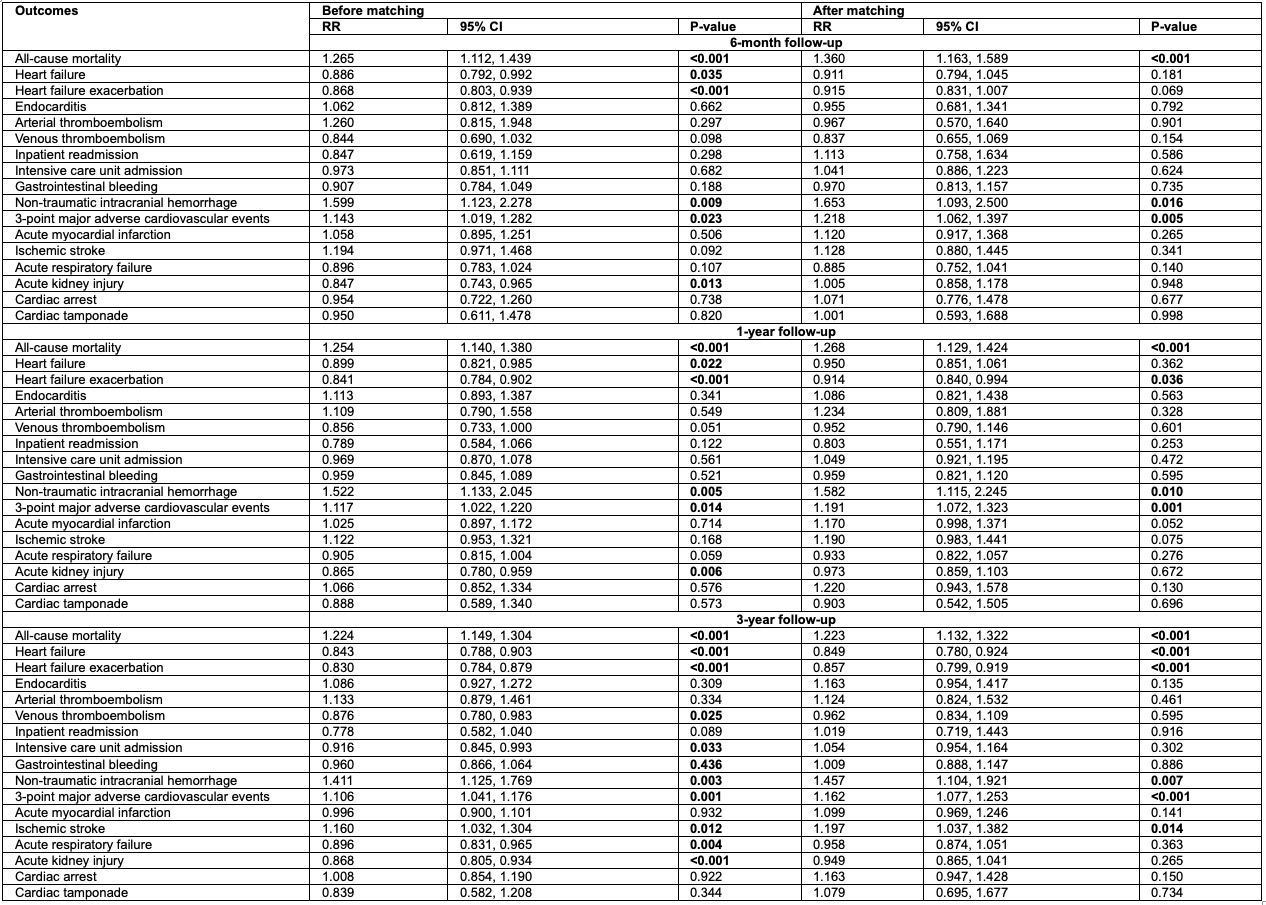
Results: After PSM, both cohorts had 10,361 patients undergoing percutaneous LAAO. Patients with lower BMI (18.5 – 29.9 kg/m2) consistently demonstrated a higher risk of all-cause mortality at 6-month [RR: 1.36; 95% CI: 1.16, 1.58; p<0.001], 1-year [RR: 1.26; 95% CI: 1.12, 1.42; p<0.001], and 3-year [RR: 1.22; 95% CI: 1.13, 1.32; p<0.001] follow-ups. Similarly, the risk of 3-point major adverse cardiovascular events and non-traumatic intracranial hemorrhage was consistently higher in lower BMI patients at all follow-ups. On the long-term follow-up (3 years), patients with lower BMI also demonstrated a higher risk of ischemic stroke [RR: 1.19; 95% CI: 1.03, 1.38; p=0.014], but had a significant reduction in the risk of heart failure (HF) [RR: 0.84; 95% CI: 0.78, 0.92l p<0.001] and HF exacerbation [RR: 0.85, 95% CI: 0.79, 0.91; p<0.001].
Conclusion: Patients with obesity (BMI ≥30 kg/m2) undergoing percutaneous LAAO demonstrate a lower risk of all-cause mortality, MACE, ischemic stroke, and non-traumatic intracranial hemorrhage compared to patients with lower BMI (18.5 - 29.9 kg/m2). However, the risk of HF and HF exacerbation is higher in obese patients. Large-scale, prospective data is warranted to optimize risk stratification in lower BMI categories and to explore the underlying mechanisms of this paradox.
Jain, Hritvik
(
All India Institute of Medical Sciences
, Jodhpur , India )
Soni, Kriti
(
SUNY Upstate Medical University
, Syracuse , New York , United States )
Agrawal, Siddharth
(
New York Medical College Landmark Medical Center
, Woonsocket , Rhode Island , United States )
Jain, Jyoti
(
All India Institute of Medical Sciences
, Jodhpur , India )
Odat, Ramez
(
Jordan University of Science and Technology
, Irbid , Jordan )
Pushparaji, Bala
(
MetroHealth Medical Center
, Cleveland , Ohio , United States )
Vallabhajosyula, Saraschandra
(
Brown University Warren Alpert Medical School
, Providence , Rhode Island , United States )
Author Disclosures:
Hritvik Jain:DO NOT have relevant financial relationships
| Kriti Soni:DO NOT have relevant financial relationships
| Siddharth Agrawal:DO NOT have relevant financial relationships
| Jyoti Jain:DO NOT have relevant financial relationships
| Ramez Odat:DO NOT have relevant financial relationships
| Bala Pushparaji:DO NOT have relevant financial relationships
| Saraschandra Vallabhajosyula:DO NOT have relevant financial relationships