Logo

American Heart Association

  17
  0


Final ID: Su2006

The Role of Sex-Specific Risk Factors in Sex Discordance unveiled by Artificial Intelligence-enhanced Electrocardiography: from the ELSA-Brasil study

Abstract Body (Do not enter title and authors here): Introduction: Artificial intelligence–enhanced electrocardiography (AI-ECG) models can accurately predict sex, and sex misclassification is associated with adverse cardiovascular (CV) outcomes and more male-like cardiac (e.g. greater left ventricular mass and chamber volumes) and non-cardiac phenotypes (e.g. higher muscle mass, lower body fat) in women. However, the underlying factors contributing to sex discordance besides traditional CV risk factors—such as sex-specific CV risk factors—remain unexplored.
Objective: To evaluate whether elevated AI-ECG sex-discordance scores are associated with sex-specific risk factors in women, while accounting for social determinants of health (SDoH).
Methods: In the community-based ELSA-Brasil cohort baseline (2008-2010), we evaluated whether sex-discordance scores in women—measured by an AI-ECG model—were associated with female-specific CV risk factors: early menarche (≤11 years), menopause status, non-spontaneous menopause, multiparity, infertility, polycystic ovary syndrome, hormone replacement therapy >60 years or >10 years post-menopause, menstrual cycle length, history of abortion, hormonal contraceptives, history of eclampsia, and pregnancy weight gain >30 kg. The sex-discordant score (absolute difference between AI-predicted and self-reported sex, with 0=men, 1=women) was treated as a continuous variable. Associations were tested using multivariable robust linear regression with an M-estimator at 95% efficiency, adjusted for age, race, education, and per capita income.
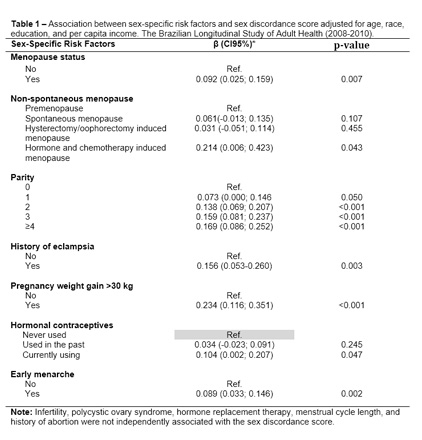
Results: Among 13,730 participants (mean age=52 years,SD:9.1; 54% women; 45% Black), higher sex-discordance scores were significantly associated with menopause (β = 0.092; 95%CI: 0.025–0.159), hormone and chemotherapy induced menopause (β = 0.215; 95%CI: 0.007–0.423), and multiparity (≥4 live births) (β = 0.169; 95%CI: 0.086–0.252), history of eclampsia (β = 0.157; 95%CI: 0.052–0.260), pregnancy-related weight gain >30 kg (β = 0.234; 95% CI: 0.117–0.352), early menarche (β = 0.154; 95% CI: 0.073–0.235), and use of hormonal contraceptives (β = 0.104; 95%CI: 0.002–0.207). All associations remained significant after adjustment for SDoH (Table 1).
Conclusions: Higher AI-ECG sex-discordance scores are associated with multiple female-specific CV risk factors. These findings suggest that the score may serve as a novel biomarker for identifying women at increased CV risk.
  • Brant, Luisa  ( Universidade Federal de Minas Gerai , Belo Horizonte , Brazil )
  • Zeidaabadi, Boroumand  ( Imperial College London , Chelmsford , United Kingdom )
  • Pinto Filho, Marcelo  ( Universidade Federal de Minas Gerai , Belo Horizonte , Brazil )
  • Ribeiro, Antonio Luiz  ( Universidade Federal de Minas Gerai , Belo Horizonte , Brazil )
  • Ng, Fu  ( Imperial College London , London , United Kingdom )
  • Camelo, Lidyane  ( Universidade Federal de Minas Gerai , Belo Horizonte , Brazil )
  • Sau, Arunashis  ( Imperial College London , London , United Kingdom )
  • Barreto, Sandhi  ( Universidade Federal de Minas Gerai , Belo Horizonte , Brazil )
  • Giatti, Luana  ( Universidade Federal de Minas Gerai , Belo Horizonte , Brazil )
  • Oliveira, Clara  ( Universidade Federal de Minas Gerai , Belo Horizonte , Brazil )
  • Paixao, Gabriela  ( Universidade Federal de Minas Gerai , Belo Horizonte , Brazil )
  • Pastika, Libor  ( Imperial College London , London , United Kingdom )
  • Barker, Joseph  ( Imperial College London , London , United Kingdom )
  • Patlatzoglou, Konstantinos  ( Imperial College London , London , United Kingdom )
  • Author Disclosures:
    Luisa Brant: DO NOT have relevant financial relationships | Boroumand Zeidaabadi: DO NOT have relevant financial relationships | Marcelo Pinto Filho: No Answer | Antonio Luiz Ribeiro: DO NOT have relevant financial relationships | Fu Ng: No Answer | Lidyane Camelo: No Answer | Arunashis Sau: DO have relevant financial relationships ; Other (please indicate in the box next to the company name):Inventor on patent relating to AI methods:Active (exists now) ; Ownership Interest:Cardiovolt.ai:Active (exists now) | Sandhi Barreto: No Answer | Luana Giatti: No Answer | Clara Oliveira: No Answer | Gabriela Paixao: DO NOT have relevant financial relationships | Libor Pastika: DO NOT have relevant financial relationships | Joseph Barker: No Answer | Konstantinos Patlatzoglou: DO NOT have relevant financial relationships
Meeting Info:

Scientific Sessions 2025

2025

New Orleans, Louisiana

Session Info:
More abstracts on this topic:
A Community Outreach Program Focused on Hypertension Awareness Reaches 600+ People in Rural Georgia and Works to Build the Next Generation of Biomedical Scientists

Dent Elena, Ilatovskaya Daria, Pinkerton Brittany, Crider Emily, Ryan Michael, Sullivan Jennifer

A Woman's Heart: Unveiling CMD as the Cause of Recurrent Syncope

Alvarez Betancourt Alejandro, Balasubramanian Suryakumar, Saladin Gustavo, Makaryus Amgad, Zeltser Roman

More abstracts from these authors:
AI-enhanced ECG for diastolic dysfunction: development, validation and prognosis across five international cohorts

Pastika Libor, O Gallagher Kevin, Shah Ajay, Barreto Sandhi Maria, Foppa Murilo, Paixao Gabriela, Khan Sadia, Brant Luisa, Kramer Daniel, Waks Jonathan, Peters Nicholas, Zeidaabadi Boroumand, Ribeiro Antonio Luiz, Sau Arunashis, Ng Fu Siong, Patlatzoglou Konstantinos, Khattak Gul Rukh, Barker Joseph, Aggour Hesham, El-medany Ahmed, Bernstein Brett, Wu Jack

Artificial Intelligence-enhanced Electrocardiography Sex-Discordance is Associated with Cardiovascular Events and Risk Factors in Women: from the ELSA-Brasil study

Camelo Lidyane, Zeidaabadi Boroumand, Pinto Filho Marcelo, Ribeiro Antonio Luiz, Ng Fu, Brant Luisa, Sau Arunashis, Barreto Sandhi, Giatti Luana, Oliveira Clara, Paixao Gabriela, Barker Joseph, Pastika Libor, Patlatzoglou Konstantinos

You have to be authorized to contact abstract author. Please, Login
Not Available