Logo

American Heart Association

  18
  0


Final ID: 4369799

AI-enhanced ECG for diastolic dysfunction: development, validation and prognosis across five international cohorts

Abstract Body (Do not enter title and authors here): Background
Evaluation of left ventricular diastolic function is integral to diagnosing heart failure with preserved ejection fraction (HFpEF), but echocardiography is resource-intensive and not always available, leading to delayed detection. We developed an AI-enhanced ECG (AI-ECG) model to detect echocardiography-determined diastolic dysfunction (DD).
Methods
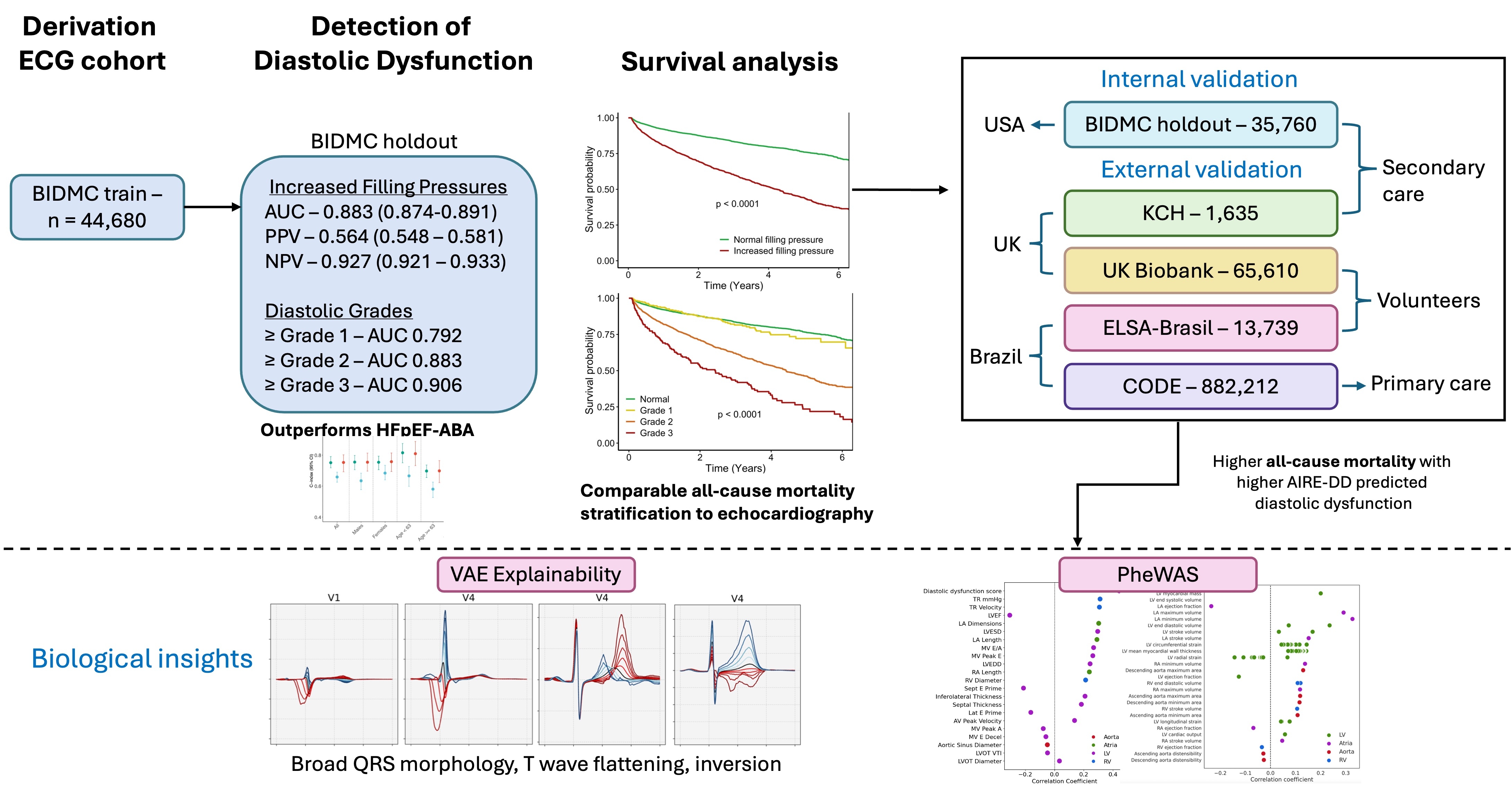
The AI-Risk Estimator for DD (AIRE-DD) is a residual neural network with a discrete-time survival loss function. It was trained on 89,100 ECG-echocardiography (ECG–TTE) pairs from Beth Israel Deaconess Medical Center (BIDMC) and externally validated in four cohorts: King’s College Hospital (KCH; n=1 635), CODE (Brazil; n=882,212), ELSA-Brasil (n=13,739) and UK Biobank (UKB; n = 65 610).
Results
In the BIDMC holdout set (n = 35,760 ECG–TTE pairs), AIRE-DD detected increased LV filling pressures with an AUC of 0.883 (95 % CI 0.874–0.891), sensitivity 0.780, specificity 0.822, PPV 0.564 and NPV 0.927. AIRE-DD also detected grades of diastolic dysfunction with AUCs of 0.792 (≥ grade I), 0.882 (≥ grade II) and 0.906 (grade III). For incident DD prediction in BIDMC participants without baseline DD and LVEF ≥ 50 %, AIRE-DD achieved a C-index of 0.751 (95 % CI 0.719–0.791). In KCH, AIRE-DD identified clinician-confirmed HFpEF with an AUC of 0.850 (0.809–0.887).
In BIDMC, increased filling pressures predicted by AIRE-DD stratified incident outcomes at least as well as echocardiography (age- and sex-adjusted hazard ratios [HRs]: mortality 2.09 vs 1.98; atherosclerotic cardiovascular disease 2.02 vs 1.70; atrial fibrillation 2.12 vs 1.79; heart failure 2.24 vs 2.40; chronic kidney disease 1.93 vs 1.70). Across BIDMC, CODE, ELSA-Brasil and UKB, AIRE-DD-predicted increased filling pressures were associated with age- and sex-adjusted HRs for all-cause mortality of 2.05 (1.87–2.26), 2.83 (2.75–2.92), 4.38 (3.46–5.52) and 1.67 (1.33–2.09), respectively.
Explainability analyses showed that AIRE-DD predictions correlated with broad QRS morphology, T-wave inversion/flattening and poor precordial R-wave progression, and were associated with echocardiographic metrics of impaired relaxation, chamber enlargement and myocardial remodelling.
Conclusion
AIRE-DD provides a non-invasive, scalable method for detection and prediction of diastolic dysfunction and stratification of mortality risk, supporting its potential as a first-line screening tool to prioritise patients for confirmatory imaging and early intervention.
  • Pastika, Libor  ( Imperial College London , London , United Kingdom )
  • O Gallagher, Kevin  ( KINGS COLLEGE LONDON , London , United Kingdom )
  • Shah, Ajay  ( KINGS COLLEGE LONDON , London , United Kingdom )
  • Barreto, Sandhi Maria  ( Universidade Federal Minas Gerais , Belo Horizonte , Brazil )
  • Foppa, Murilo  ( HCPA , PortoAlegre , Brazil )
  • Paixao, Gabriela  ( FEDERAL UNIVERSITY OF MINAS GERAIS , Belo Horizonte , Brazil )
  • Khan, Sadia  ( Chelsea and Westminster NHS Foundation Trust , London , United Kingdom )
  • Brant, Luisa  ( FEDERAL UNIVERSITY of MINAS GERAIS , Belo Horizonte , Brazil )
  • Kramer, Daniel  ( Beth Israel Deaconess Medical Cente , Newton Center , Massachusetts , United States )
  • Waks, Jonathan  ( Beth Israel Deaconess Medical Cente , Newton Center , Massachusetts , United States )
  • Peters, Nicholas  ( Imperial College London , London , United Kingdom )
  • Zeidaabadi, Boroumand  ( Imperial College London , London , United Kingdom )
  • Ribeiro, Antonio Luiz  ( UFMG , Belo Horizonte , Brazil )
  • Sau, Arunashis  ( Imperial College London , London , United Kingdom )
  • Ng, Fu Siong  ( Imperial College , London , United Kingdom )
  • Patlatzoglou, Konstantinos  ( Imperial College London , London , United Kingdom )
  • Khattak, Gul Rukh  ( Imperial College London , London , United Kingdom )
  • Barker, Joseph  ( Imperial College London , London , United Kingdom )
  • Aggour, Hesham  ( Imperial College London , London , United Kingdom )
  • El-medany, Ahmed  ( Imperial College London , London , United Kingdom )
  • Bernstein, Brett  ( KINGS COLLEGE LONDON , London , United Kingdom )
  • Wu, Jack  ( KINGS COLLEGE LONDON , London , United Kingdom )
  • Author Disclosures:
    Libor Pastika: DO NOT have relevant financial relationships | Kevin O Gallagher: No Answer | Ajay Shah: No Answer | Sandhi Maria Barreto: DO NOT have relevant financial relationships | Murilo Foppa: No Answer | Gabriela Paixao: DO NOT have relevant financial relationships | Sadia Khan: No Answer | Luisa Brant: DO NOT have relevant financial relationships | Daniel Kramer: DO NOT have relevant financial relationships | Jonathan Waks: No Answer | Nicholas Peters: DO NOT have relevant financial relationships | Boroumand Zeidaabadi: No Answer | Antonio Luiz Ribeiro: DO NOT have relevant financial relationships | Arunashis Sau: DO have relevant financial relationships ; Other (please indicate in the box next to the company name):Inventor on patent relating to AI methods:Active (exists now) ; Ownership Interest:Cardiovolt.ai:Active (exists now) | Fu Siong Ng: No Answer | Konstantinos Patlatzoglou: DO NOT have relevant financial relationships | Gul Rukh Khattak: DO NOT have relevant financial relationships | Joseph Barker: No Answer | Hesham Aggour: DO NOT have relevant financial relationships | Ahmed El-Medany: DO NOT have relevant financial relationships | Brett Bernstein: DO NOT have relevant financial relationships | Jack Wu: DO NOT have relevant financial relationships
Meeting Info:

Scientific Sessions 2025

2025

New Orleans, Louisiana

Session Info:
More abstracts on this topic:


A Case of Possible IgG4-Related Constrictive Pericarditis Masquerading as Idiopathic Pericarditis: A Rare and Elusive Diagnosis

Nandyal Shreyas, Sharma Bharosa, Gajjar Rohan, Varma Revati, Ezegwu Olisa, Amdetison Gedion Yilma, Tottleben Jon

A Multicenter Friedreich Ataxia Registry Identifies Posterior Wall Thickness as a Predictor of Major Adverse Cardiac Events

Lin Kimberly, Johnson Jonathan, Mccormack Shana, Lynch David, Tate Barbara, Feng Yixuan, Huang Jing, Mercer-rosa Laura, Dedio Anna, Mcsweeney Kara, Fournier Anne, Yoon Grace, Payne Ronald, Cripe Linda, Patel Aarti, Niaz Talha

More abstracts from these authors:
Artificial Intelligence-Enabled Electrocardiography For The Prediction of Future Type 2 Diabetes Mellitus

Pastika Libor, Peters Nicholas, Kramer Daniel, Waks Jonathan, Sau Arunashis, Ng Fu Siong, Patlatzoglou Konstantinos, Sieliwonczyk Ewa, Barker Joseph, Zeidaabadi Boroumand, Mcgurk Kathryn, Khan Sadia, Mandic Danilo, Ware James

Artificial Intelligence-enhanced Electrocardiography Sex-Discordance is Associated with Cardiovascular Events and Risk Factors in Women: from the ELSA-Brasil study

Camelo Lidyane, Zeidaabadi Boroumand, Pinto Filho Marcelo, Ribeiro Antonio Luiz, Ng Fu, Brant Luisa, Sau Arunashis, Barreto Sandhi, Giatti Luana, Oliveira Clara, Paixao Gabriela, Barker Joseph, Pastika Libor, Patlatzoglou Konstantinos

You have to be authorized to contact abstract author. Please, Login
Not Available