Cardiac Autoimmunity in Pediatric Single Ventricle Congenital Heart Disease
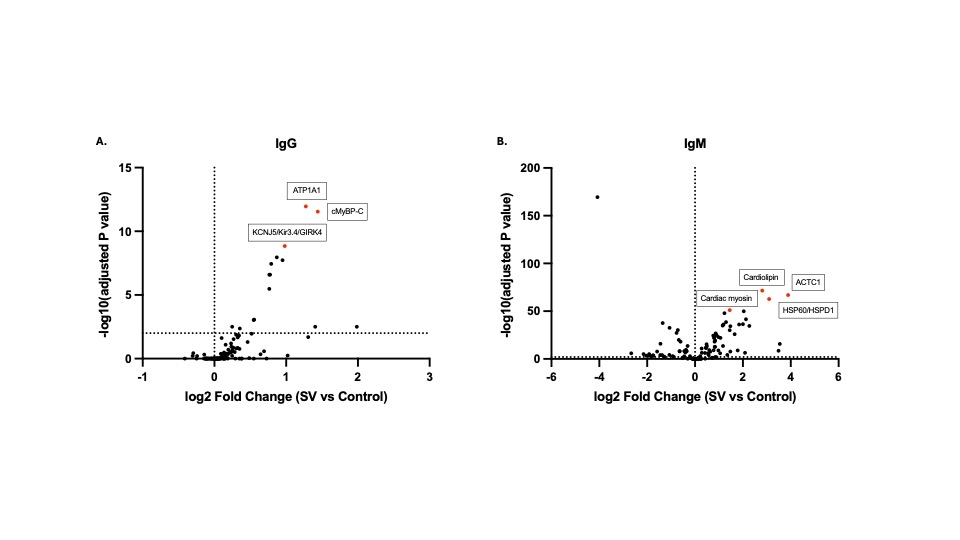
Abstract Body (Do not enter title and authors here): BACKGROUND: Heart-specific autoimmunity has emerged as a key contributor to cardiac dysfunction and heart failure. In pediatric patients with single ventricle (SV) physiology, the first stage of surgical palliation (Norwood procedure) often requires thymectomy. Early thymus removal may disrupt T-cell development and central tolerance, promoting the expansion of autoreactive T-cell clones. Autoreactive CD4+ T cells may stimulate B cell activation, ultimately leading to the production of pathogenic autoantibodies. Additionally, repeated surgeries in this population may result in cardiac damage and release of intracellular cardiac antigens, potentially amplifying autoimmune responses. HYPOTHESIS: Multifactorial immune dysregulation in pediatric SV patients fosters a pro-autoimmune environment, promoting myocardial inflammation and increasing the risk of systolic dysfunction and heart failure. METHODS: We analyzed 210 plasma samples from pediatric SV patients (n= 186) and normal pediatric controls (n= 24). SV subjects were stratified by stage of surgical palliation. Autoantibody profiling was performed using a fluorescence-based microarray comprising 121 cardiac-relevant antigens (GeneCopoeia PA016 Antigen Array). Data was analyzed using multiple unpaired t-test with Holm-Šídák correction. RESULTS: When compared to pediatric controls, SV patients showed elevated IgG response (p < 0.000001) against ATP1A1, cardiac myosin-binding protein C (cMyBPC), and KCNJ5 (Kir3.4/GIRK4), all previously implicated in cardiac autoimmunity (Figure 1A). Additionally, we observed higher levels of IgM (p < 0.000001) against cardiolipin, cardiac myosin, cardiac actin (ACTC1), and HSP60, antigens previously linked to autoimmune cardiomyopathy (Figure 1B). In the Fontan group, IgG reactivity remained elevated (p < 0.000001) against ATP1A1, cMyBPC and KCNJ5, compared to the control group, suggesting a potential role in chronic immune activation. Early-stage comparison (pre- vs post-Norwood) revealed increased IgM responses (p < 0.00001) to cardiac myosin, ACTC1, cardiolipin, and HSP70, consistent with acute post-surgical autoimmune response. CONCLUSIONS: Pediatric SV patients exhibit a distinct autoantibody profile targeting cardiac autoantigens involved in contractility, conduction and stress response. These findings support the development of heart-specific autoimmunity in this population and its potential contribution to disease progression.
Tomasso, Federica
( University of Colorado Anschutz
, Aurora
, Colorado
, United States
)
Du, Yanmei
( University of Colorado Anschutz
, Aurora
, Colorado
, United States
)
Abbott, Jordan
( University of Colorado SOM
, Aurora
, Colorado
, United States
)
Lin, Daniel
( Childrens Hospital Colorado
, Aurora
, Colorado
, United States
)
Nakano, Stephanie
( Childrens Hospital Colorado
, Aurora
, Colorado
, United States
)
Author Disclosures:
Federica Tomasso:DO NOT have relevant financial relationships
| Yanmei Du:DO NOT have relevant financial relationships
| Jordan Abbott:No Answer
| Daniel Lin:DO NOT have relevant financial relationships
| Stephanie Nakano:DO NOT have relevant financial relationships