The serum and glucocorticoid regulated kinase 1 (SGK1) inhibitor THRV-1268 attenuates hallmarks of heart failure by reducing inflammation and fibrosis beyond sodium/glucose cotransporter 2 inhibition
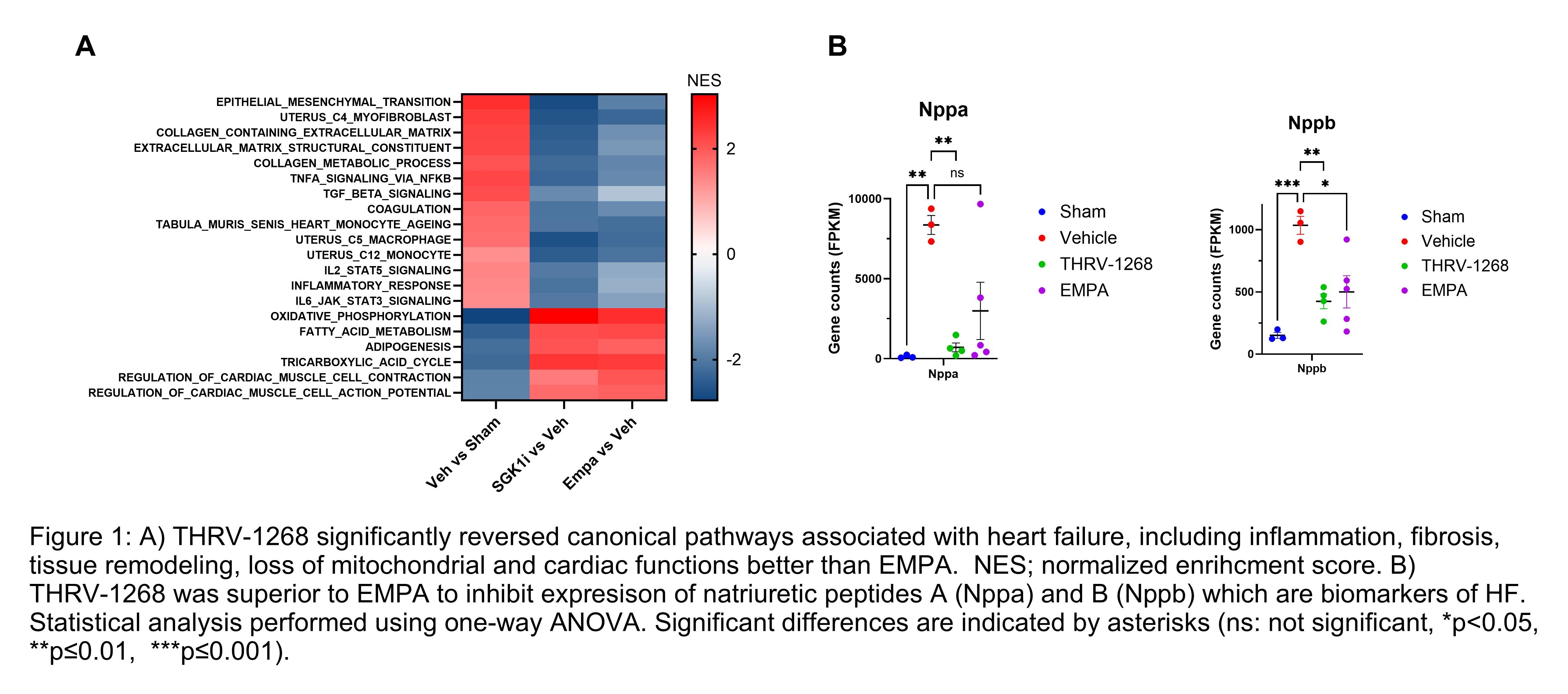
Abstract Body (Do not enter title and authors here): Background Heart failure (HF) remains a leading cause of morbidity and mortality despite current therapies. SGK1, a stress activated kinase, plays a key role in remodeling, fibrosis, and inflammation in HF progression. Genetic inhibition of SGK1 in a transverse aortic constriction (TAC) model of HF with reduced ejection fraction (HFrEF) has been shown to be cardioprotective. THRV-1268 (1268) has demonstrated encouraging effect is rodent models of HFpEF, but have not been evaluated in the TAC model. Methods Sprague Dawley rats that underwent TAC or sham surgery were dosed via oral gavage from Day 3 until the end of the study on Day 56 with vehicle, 1268 (30 mg/kg/d), EMPA (10 mg/kg/d). Cardiac function was assessed by echocardiography through the study to monitor disease progression. Left ventricles were collected from each group for bulk RNA-Seq, gene expression and pathway analyses (with DESeq2 and GSEA, respectively). Results 1268 prevented the development of cardiac dysfunction and cardiac hypertrophy better than EMPA (data submitted for presentation at AHA 2025, Pradhananga et al). To uncover the molecular mechanisms involved in the superior activity of 1268, RNA-Seq analysis was carried out and revealed that 1268 significantly modulated the expression of 1199 genes whereas EMPA only modulated 105 genes. Pathway analyses highlighted that 1268 significantly reversed numerous canonical pathways associated with HF (Figure 1A). The EMPA group showed reduced reversion, significantly less potent than 1268, suggesting that SGK1 inhibition has superior anti-inflammatory and anti-fibrotic properties. We also monitored the mRNA expression of two known biomarkers elevated in HF, natriuretic peptides A and B, and both 1268 and EMPA significantly decreased their expression, but 1268 was superior (Figure 1B). The BioMAP® Fibrosis panel confirmed that 1268 displayed potent, dose-dependent inhibition of several markers associated with inflammation, fibrosis, and tissue remodeling. Cell culture experiments in human cardiac fibroblasts confirmed the anti-fibrotic and anti-inflammatory properties of 1268. In contrast, treatment with EMPA or dapagliflozin did not attenuate TGFb-induced fibrosis. Conclusion 1268 was superior to empagliflozin in mitigating HFrEF by reversing major hallmarks and biomarkers associated with HF. This analysis identified the direct impact of 1268 on cardiac fibroblasts as a potential differentiating mechanism from lesser effects seen with EMPA.
Campeau, Eric
( Thryv Therapeutics Inc.
, Montreal
, Quebec
, Canada
)
Das, Saumya
( Massachusetts General Hospital
, Boston
, Massachusetts
, United States
)
Pradhananga, Sabindra
( Thryv Therapeutics Inc.
, Montreal
, Quebec
, Canada
)
Srinivasan, Dinesh
( Thryv Therapeutics Inc.
, Montreal
, Quebec
, Canada
)
Labit, Delphine
( Thryv Therapeutics Inc.
, Montreal
, Quebec
, Canada
)
Frias Boligan, Kayluz
( Thryv Therapeutics Inc.
, Montreal
, Quebec
, Canada
)
Vidal, Marc
( Thryv Therapeutics Inc.
, Montreal
, Quebec
, Canada
)
Odink, Debra
( Thryv Therapeutics Inc.
, Montreal
, Quebec
, Canada
)
Truex, Paul
( Thryv Therapeutics Inc.
, Montreal
, Quebec
, Canada
)
Sehnert, Amy
( Thryv Therapeutics Inc.
, Montreal
, Quebec
, Canada
)