
Logo

American Heart Association

  21
  0


Final ID: MP265

Gender-Specific Differences in Large Vessel Occlusion Outcomes: A National Inpatient Sample Analysis

Abstract Body (Do not enter title and authors here): Background
Large vascular occlusion (LVO) strokes account for a significant proportion of ischemic strokes, with considerable morbidity and death. While sex-based differences in stroke presentation and treatment have been discovered, comprehensive national data on gender-specific outcomes after LVO remain scarce.
Objective
To evaluate gender-specific differences in in-hospital outcomes, interventions, and mortality among patients hospitalized with acute ischemic stroke due to large vessel occlusion using the National Inpatient Sample.
Methods
We performed a retrospective cohort analysis of the National Inpatient Sample (2016-2020) to identify adult patients (≥18 years) with acute ischemic stroke owing to LVO using ICD-10-CM codes (I63.x) and procedure codes for mechanical thrombectomy (03CG3ZZ, 03CG4ZZ). The patients were split into sexes. The main outcome was inpatient mortality. Secondary outcomes were thrombectomy, thrombolysis, discharge status, length of stay (LOS), and total hospital expenditures. Demographics, comorbidities, and hospital characteristics were all adjusted by multivariate logistic regression.
Results
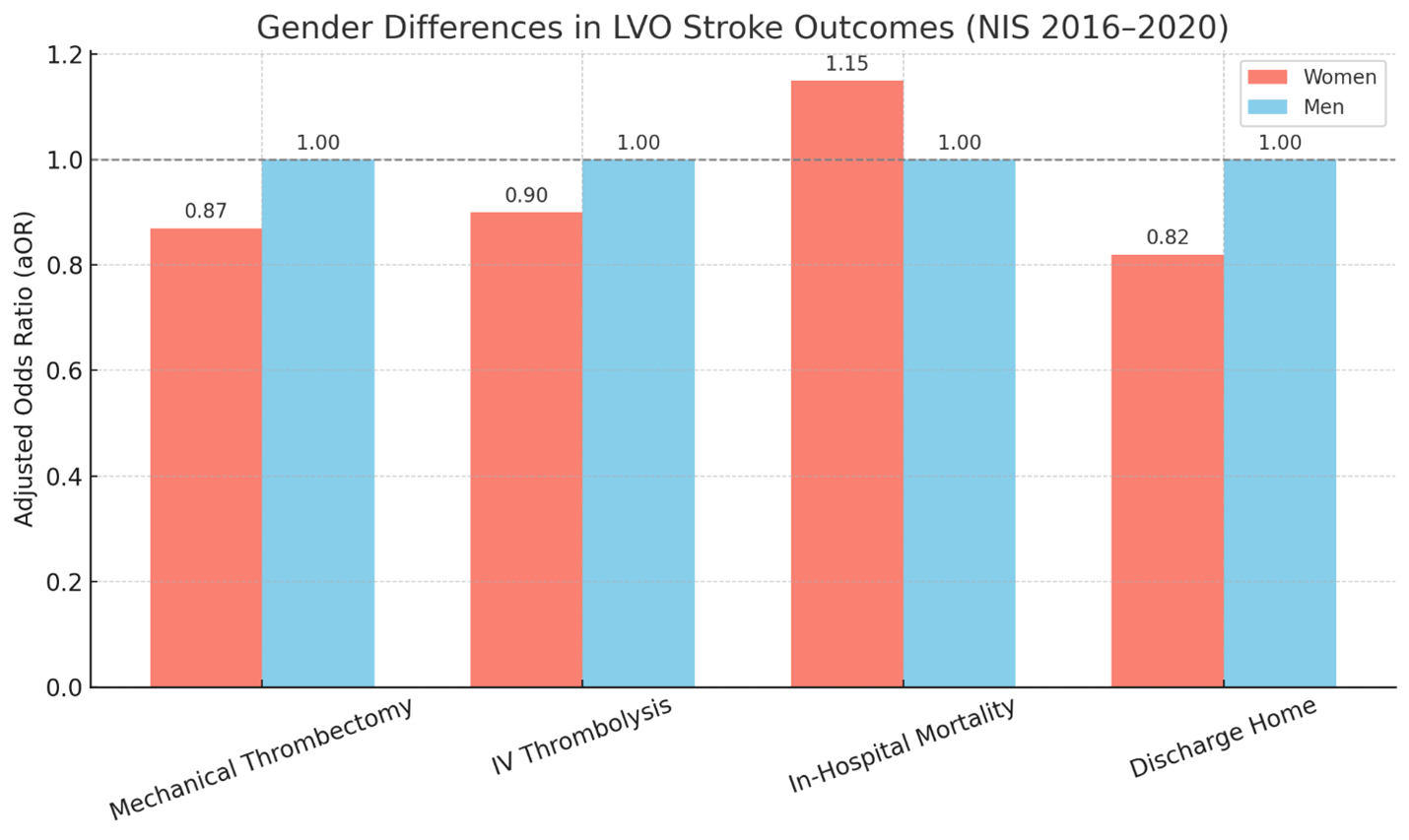
A total of 52,491 weighted hospitalizations for LVO were investigated (53.8% female, 46.2% male). Women were significantly older (mean age 74.2 vs. 68.5 years, p < p<0.001) and had higher rates of atrial fibrillation and hypertension. After adjusting, women had a lower risk of receiving mechanical thrombectomy (aOR 0.87; 95% CI: 0.84-0.91) and IV thrombolysis (aOR 0.90; 95% CI: 0.86-0.94). Despite this, women had higher in-hospital death rates (aOR 1.15; 95% CI: 1.09-1.22). Women were less likely to be discharged home (aOR 0.82; 95% CI: 0.78-0.86) and had a greater length of stay (+1.2 days, p<0.01). Total charges were comparable for both sexes.
Conclusion
Significant gender inequalities exist in the care and outcomes of LVO stroke hospitalizations in the U.S. Women are less likely to receive revascularization treatment and have inferior in-hospital outcomes despite comparable healthcare resource usage. These findings concentrated strategies to minimize sex-based disparities in stroke therapy and increase equity in acute neurovascular intervention.
  • Kumar, Harendra  ( Dow University of Health Sciences , Hyderabad , Pakistan )
  • Maheshwari, Rimza  ( Indus Medical College , TMK , Pakistan )
  • Georgiyeva, Kateryna  ( Memorial Hospital Pembroke , Pembroke Pines , Florida , United States )
  • Author Disclosures:
    Harendra Kumar: DO NOT have relevant financial relationships | Rimza Maheshwari: No Answer | Kateryna Georgiyeva: DO NOT have relevant financial relationships
Meeting Info:

Scientific Sessions 2025

2025

New Orleans, Louisiana

Session Info:

Stroke Outcomes: AI, Access, and Equity

Saturday, 11/08/2025 , 10:45AM - 12:00PM

Moderated Digital Poster Session

More abstracts on this topic:
A Retrospective Analysis of Chronic Kidney Disease and Arrhythmias-Related Mortality Among Adults in the United States (1999-2020): Insights into Disparities by Gender, Race/Ethnicity, and Geography

Waseem Neha, Nouman Zainab, Chaudhry Sohaib Aftab Ahmad, Tariq Waleed, Khan Iftikhar, Shah Mazhar, Farooqi Hanzala Ahmed, Faiz Muneeb

A Case Series of Papillary Fibroelastomas on the Coumadin ridge

Aboukhatwa Omar, Akiki Elias, Kurmann Reto, Larson Kathryn, Keeney Michael, Bois Melanie, Klarich Kyle

You have to be authorized to contact abstract author. Please, Login
Not Available